
This article was updated on 23 September 2026 to reflect the full operational transition to the Peppol PINT A-NZ specification following the complete decommissioning of Peppol BIS Billing 3.0 on 31 March 2026, the progress of federal Non-corporate Commonwealth Entities (NCEs) toward the 30% intake target, and the approaching 31 December 2026 milestone for automated processing and dispatch across the Commonwealth.
Introduction and digital tax strategy
The Commonwealth of Australia operates an open, non-clearance framework designed to digitalise business transactions across the national economy. Rather than building a centralised state clearance platform or imposing an economy-wide statutory mandate on private enterprises, the federal government has positioned electronic invoicing as a core component of its national productivity agenda. The overarching strategy focuses on replacing unstructured PDF attachments with structured, machine-readable data, driving organic market adoption through public sector capability and commercial incentives such as five-day payment terms.
Administered by the Australian Taxation Office (ATO) in its statutory capacity as the Australian Peppol Authority (APA), the national architecture relies on an open, four-corner network. Electronic documents route directly between suppliers' and buyers' software platforms through accredited access points. This direct exchange removes the manual friction of rekeying paper or scanned records while mitigating the security vulnerabilities associated with unencrypted email correspondence.
The Australian framework's primary motives are macroeconomic productivity, invoice fraud prevention, and supply chain efficiency. Research from federal Treasury indicates that processing a traditional paper or PDF invoice costs Australian organisations roughly AUD 30, whereas processing an automated electronic invoice costs under AUD 10. By adopting the international Peppol network, Australia enables domestic enterprises to automate accounts payable and receivable operations while maintaining technical compatibility with trading partners across Europe and the Asia-Pacific region.
"Processing a traditional invoice costs Australian organisations roughly AUD 30, whereas an automated Peppol e-invoice costs under AUD 10. Australia's transition to PINT A-NZ is transforming procurement from an administrative overhead into an automated cash-flow engine."
Historical evolution and global context
Australia's e-invoicing framework has developed through deliberate bilateral collaboration, underpinned by regional market integration and open international technical standards.
The Trans-Tasman Electronic Invoicing Arrangement
The foundational policy was established in late 2018, when the Prime Ministers of Australia and New Zealand agreed to create a unified digital economic area. On 25 October 2018, both nations executed the Trans-Tasman Electronic Invoicing Arrangement (TTEIA). Formally revised and re-executed on 16 December 2024, the arrangement established the Australia and New Zealand Electronic Invoicing Board (ANZEIB) to oversee cross-Tasman regulatory coordination and ensure that businesses operating across both jurisdictions face no cross-border technical friction.
Following public consultations in early 2019, both governments selected the Peppol Interoperability Framework over proprietary, bilateral Electronic Data Interchange (EDI) protocols. On 31 October 2019, the ATO officially assumed the role of the Australian Peppol Authority.
The global shift: From Peppol BIS 3.0 to PINT A-NZ
Australia initially implemented the Peppol BIS Billing 3.0 standard, adapted with domestic business rules. However, because Peppol BIS Billing 3.0 was intrinsically derived from the European standard EN 16931, its underlying data models struggled to accommodate non-European taxation structures, multiple currency representations, and regional identifiers without complex structural extensions.
To resolve these limitations, the Australian and New Zealand Peppol Authorities partnered with OpenPeppol to develop PINT (Peppol International Invoice). PINT establishes an international semantic baseline accompanied by country-specific Core Invoice Usage Specifications (CIUS).
The regional standard, PINT A-NZ, became mandatory for all accredited Peppol service providers in Australia and New Zealand on 15 May 2025. Following a transition period, the legacy A-NZ extension of Peppol BIS Billing 3.0 was decommissioned and removed from the Peppol network on 31 March 2026. This technical standard allows an Australian business to exchange structured documents with trading partners in Japan, Singapore, and across the European Union using common international pipelines.
Comparison with European and global CTC regimes
The Australian framework differs fundamentally from centralised Continuous Transaction Controls (CTCs) deployed across Latin America and parts of Europe:
No clearance gateway: Unlike Italy's Sistema di Interscambio (SdI) or Poland's KSeF, the Australian Government does not intercept, inspect, validate, or clear commercial invoices before delivery.
No fiscal e-reporting: While France deploys mandatory e-reporting alongside its Y-model, and the EU prepares for mandatory Digital Reporting Requirements (DRRs) under the VAT in the Digital Age (ViDA) package by 2030, Australia requires no real-time transactional reporting for domestic supplies.
Decentralised 4-corner network: Australia utilises the open Peppol 4-corner model, keeping data flows strictly between commercial trading partners and their chosen accredited access points.
Complete compliance timeline
The following table provides the historical, legislative, and operational milestones governing e-invoicing in Australia:
Date | Category | Milestone |
25 October 2018 | Policy | Australia and New Zealand execute the initial Trans-Tasman Electronic Invoicing Arrangement. |
31 October 2019 | Governance | The ATO officially assumes the role of the Australian Peppol Authority. |
1 January 2020 | B2G Policy | The Department of Finance enacts the Supplier Pay On-Time or Pay Interest Policy (RMG 417), introducing 5-day payment terms for Peppol e-invoices on contracts up to AUD 1 million. |
25 February 2022 | B2B Consultation | Treasury concludes consultations on the Business E-invoicing Right (BER); the federal government determines not to enact mandatory private-sector rules at that time. |
1 July 2022 | B2G Mandate | All federal Non-corporate Commonwealth Entities (NCEs) must be capable of receiving Peppol e-invoices. RMG 417 eliminates the AUD 1 million cap, extending 5-day terms to contracts of any value. |
5 December 2023 | Policy Review | Government publishes its response to the Statutory Review of the Payment Times Reporting Act 2020, endorsing wider e-invoicing adoption across Commonwealth supply chains. |
14 May 2024 | Budget Funding | Federal Budget 2024 - 2025 allocates AUD 23.3 million to accelerate e-invoicing adoption, mitigate invoice redirection fraud, and establish e-invoicing as default in Commonwealth procurement. |
16 December 2024 | Governance | Australia and New Zealand re-execute the revised Trans-Tasman Electronic Invoicing Arrangement, reinforcing regulatory alignment and PINT specifications. |
15 May 2025 | Technical | Peppol PINT A-NZ Billing becomes mandatory for all accredited service providers in Australia and New Zealand. |
8 December 2025 | Technical | OpenPeppol publishes PINT A-NZ Billing and Self-billing version 1.1.2, introducing updated Schematron validation rules and revised code lists. |
31 March 2026 | Technical | The legacy A-NZ extension of Peppol BIS Billing 3.0 is decommissioned and removed from the Peppol network, leaving PINT A-NZ as the sole active invoice specification. |
1 July 2026 | B2G Target | Federal Non-corporate Commonwealth Entities (NCEs) target lifting Peppol e-invoicing intake to 30% of all procurement invoices, submitting quarterly progress updates to the ATO. |
31 December 2026 | B2G Target | Federal Non-corporate Commonwealth Entities (NCEs) target operational readiness for automated end-to-end processing and outbound sending of e-invoices. |
Legal framework
Australia's e-invoicing framework is established through procurement directives, public accountability statutes, and international treaties, supported by tax record-keeping regulations.
Trans-Tasman Electronic Invoicing Arrangement: The intergovernmental treaty between Australia and New Zealand. It defines the common technical architecture, reciprocal service provider accreditations, and joint governance under ANZEIB.
Public Governance, Performance and Accountability Act 2013 (PGPA Act): Regulates the governance, performance, and financial management of Commonwealth bodies, providing the legal foundation for binding federal procurement mandates.
Supplier Pay On-Time or Pay Interest Policy (Resource Management Guide No. 417): Issued by the Department of Finance under the PGPA framework. It legally obligates Non-corporate Commonwealth Entities (NCEs) to settle valid Peppol e-invoices within 5 calendar days, compared to 20 calendar days for non-electronic invoices. If an agency misses the deadline, it must pay compound interest on the outstanding balance if the accrued interest exceeds AUD 100.
Taxation Administration Act 1953 (Section 382-5): Governs statutory commercial record-keeping. Taxpayers must retain commercial records, including electronic invoices, for at least 5 years from the date the document was prepared or the transaction concluded. Records must remain in English (or readily convertible) and accessible to the Commissioner of Taxation.
Payment Times Reporting Act 2020: Obligates large entities with annual total income exceeding AUD 100 million to publish semi-annual reports on their payment terms to small business suppliers, creating structural incentives to automate procure-to-pay pipelines.
Authorities
Administration of electronic invoicing across Australia involves multiple statutory bodies and government departments:
Australian Taxation Office (ATO)
The Australian Taxation Office serves as the Australian Peppol Authority (APA). The ATO maintains strict functional separation between its taxation revenue activities and its Peppol network governance role. In its APA capacity, the ATO:
Accredits and monitors Peppol service providers operating in Australia.
Publishes local validation rules, specifications, and cryptographic requirements.
Administers network participant identification rules using the Australian Business Number (ABN).
Does not intercept, receive, view, or archive commercial invoices exchanged across the network.
Department of Finance
The Department of Finance develops Whole-of-Government procurement policy. It oversees the Commonwealth Procurement Rules (CPRs) and monitors compliance with the Supplier Pay On-Time or Pay Interest Policy (RMG 417), directing federal agency adoption.
The Treasury
The Treasury leads national economic policy, corporate regulation, and legislative reform. Treasury evaluates private sector uptake, including previous consultations on the Business E-invoicing Right (BER), and coordinates the Trans-Tasman digital partnership with New Zealand's Ministry of Business, Innovation and Employment (MBIE).
Australia and New Zealand Electronic Invoicing Board (ANZEIB)
Established under the TTEIA, ANZEIB provides executive leadership across the Tasman, ensuring technical specifications, security protocols, and operational policies remain aligned between both countries.
Scope of the mandate
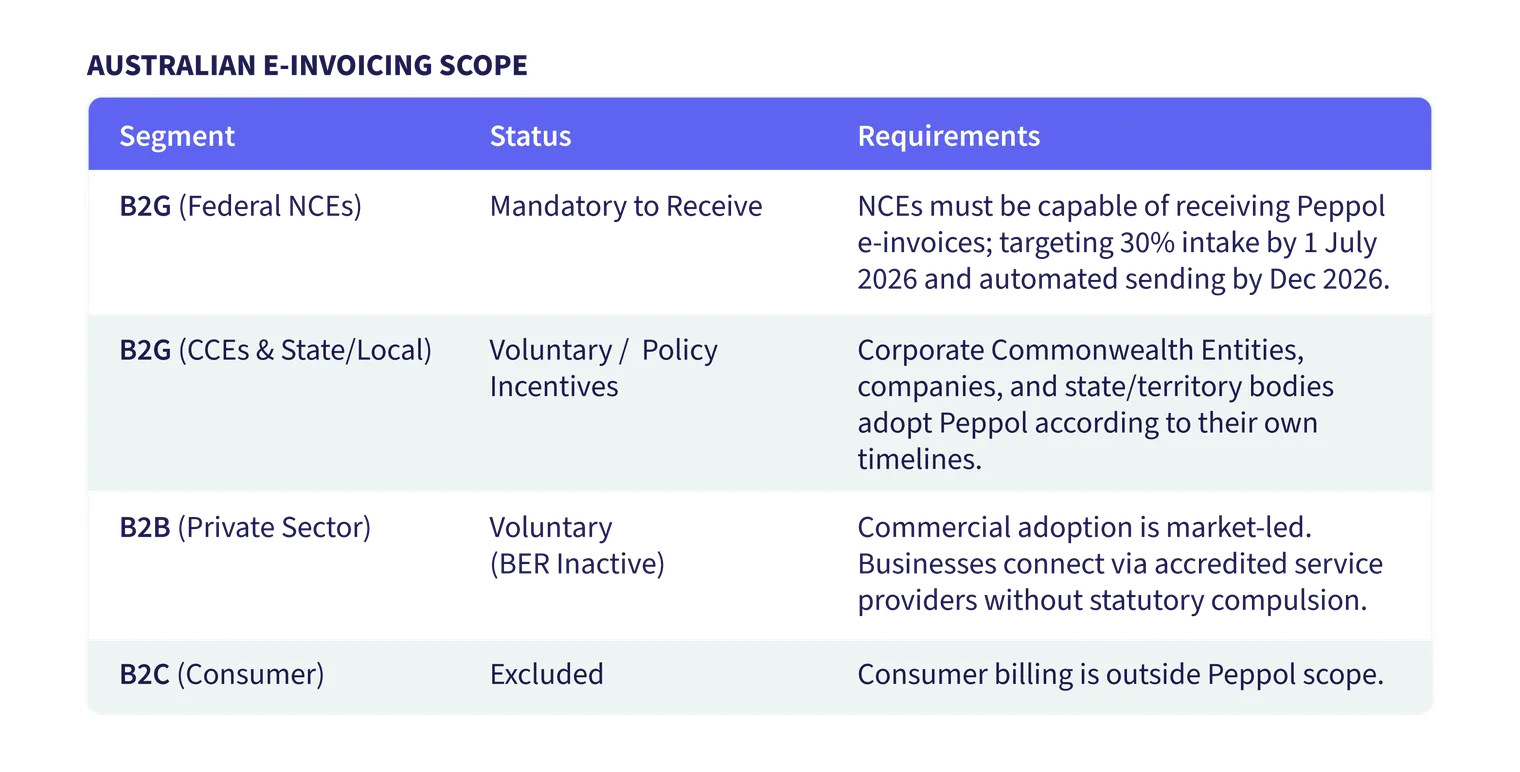
Australia structures e-invoicing obligations by transaction category, corporate registration, and entity classification:
Business-to-Government (B2G) transactions
Non-corporate Commonwealth Entities (NCEs): Since 1 July 2022, all federal NCEs (departments of state, parliamentary departments, and executive agencies) must be capable of receiving e-invoices via Peppol. These agencies are working to lift Peppol intake to at least 30% of total invoice volumes by 1 July 2026 and enable automated processing and outbound sending by 31 December 2026.
Corporate Commonwealth Entities (CCEs) and Commonwealth Companies: Bodies such as Australia Post, the CSIRO, and corporate boards are outside mandatory PGPA Act NCE directives. However, they are formally encouraged to adopt the framework.
State, Territory, and Local Governments: State governments (including New South Wales, Victoria, and Queensland) manage independent procurement policies. While several state bodies accept Peppol invoices and encourage supplier onboarding, adoption remains state-led rather than federally mandated.
Business-to-Business (B2B) transactions
B2B e-invoicing in Australia is entirely voluntary. Commercial enterprises face no statutory requirement to issue or receive electronic invoices.
Between December 2021 and February 2022, Treasury conducted public consultations regarding a Business E-invoicing Right (BER). The proposed mechanism would have legally entitled businesses to require electronic invoices from trading partners upon request, phasing in from large enterprises down to small businesses. However, the federal government determined that a statutory mandate would impose administrative burdens on small businesses. Consequently, the findings were not enacted, leaving private adoption to be driven by accounting software integration, operational cost savings, and supply chain efficiency.
Business-to-Consumer (B2C) transactions
B2C transactions are excluded from the Peppol e-invoicing framework. Consumer retail transactions follow standard Australian tax invoice rules under A New Tax System (Goods and Services Tax) Act 1999, using standard receipts, points of sale, and paper or digital records.
Cross-border trade conditions
Cross-border transactions benefit directly from the shared Trans-Tasman arrangement. Because Australia and New Zealand share the PINT A-NZ specification and operate reciprocal service-provider accreditation, an Australian organisation on Peppol can exchange structured invoices with a New Zealand counterparty as easily as with a domestic partner. Furthermore, because PINT aligns with OpenPeppol international profiles, Australian entities can trade with enterprises across Singapore, Japan, and Europe without custom format conversions.
E-invoicing requirements
To trade compliantly across the Australian Peppol network, organisations and accounting platforms must adhere to defined technical, validation, and data formatting criteria:
Mandatory syntax and data specifications
Australia exclusively supports structured XML formats complying with the international UBL (Universal Business Language) syntax:
Peppol PINT A-NZ Billing (UBL 2.1): The sole active specification for standard commercial invoices across the Australian Peppol network. It replaced the deprecated Peppol BIS Billing 3.0 specification on 31 March 2026.
Peppol PINT A-NZ Self-Billing (UBL 2.1): The official specification for recipient-created tax invoices (RCTIs), optional for service providers to support but standardised across the network.
Business identifiers and electronic addressing
Every participant in the Australian Peppol directory must be identified by a verified national identifier:
Participant scheme identifier: Australia uses the International Code Designator (ICD) scheme 0151, which corresponds to the Australian Business Number (ABN).
Electronic addressing: Invoices route through the network using the format urn:oasis:names:tc:ebcore:partyid-type:iso6523:0151:<11-digit-ABN>.
Mandatory directory publication: Under APA regulations, all Australian receiving entities on the Peppol network must publish their receiving capabilities in the official Peppol Directory, ensuring transparent routing across the ecosystem.
Core mandatory invoice data elements
A compliant Australian PINT A-NZ electronic invoice must contain structured data matching Goods and Services Tax (GST) legislation and PINT Schematron validation rules:
Specification identifier: The explicit PINT A-NZ customisation identifier confirming compliance with regional business rules.
Document metadata: A unique invoice reference number, issue date, and invoice type code (e.g. Code 380 for commercial invoices, Code 381 for credit notes).
Supplier and buyer data: Legal entity names, trading addresses, and verified 11-digit ABNs under scheme 0151.
Line-item details: Clear descriptions of supplied goods or services, quantities, net unit prices, line item totals, and applicable GST category codes (e.g. Taxable Standard Rate S, GST-free E, or Zero-rated Z).
Tax breakdown: Currency code (AUD), total taxable amounts, total GST amount payable, and the net payable total inclusive of tax.
Payment instructions: Bank account details (BSB and account number) or designated payment instructions to support automated reconciliation.
Archiving and record-keeping rules
Australian tax legislation enforces strict standards for digital records:
Retention duration: Businesses must retain all original invoice files for at least 5 years.
Storage format: Invoices may be stored digitally in their original structured XML format or within compliant cloud accounting databases, provided that the data can be fully reproduced in English upon an ATO audit.
Data integrity: The storage solution must maintain the uncorrupted integrity and authenticity of the electronic records throughout the entire retention lifecycle.
E-reporting requirements
Unlike tax administrations deploying Continuous Transaction Controls (CTCs), Australia enforces no transactional e-reporting requirements.
E-invoicing vs e-reporting in Australia | |
Peppol e-invoicing | Transactional e-reporting |
[Supplier] ---> [Access Point] ---> [Access Point] ---> [Buyer]
|
|
Operational distinction: Zero government clearance
Under the Australian framework:
The ATO does not receive a copy of commercial e-invoices.
Invoices do not receive a government clearance token, digital signature, or state UUID.
There is no periodic electronic sales ledger upload or Standard Audit File for Tax (SAF-T) filing.
Standard periodic reporting obligations
Businesses fulfill statutory tax reporting through standard, retrospective mechanisms:
Business Activity Statements (BAS): Entities report aggregated GST collected, input tax credits, and PAYG withholding periodically (monthly, quarterly, or annually).
Single Touch Payroll (STP): While Australia pioneered real-time reporting for payroll through Single Touch Payroll Phase 2, this mechanism remains separate from invoice and sales transactions.
Technical architecture
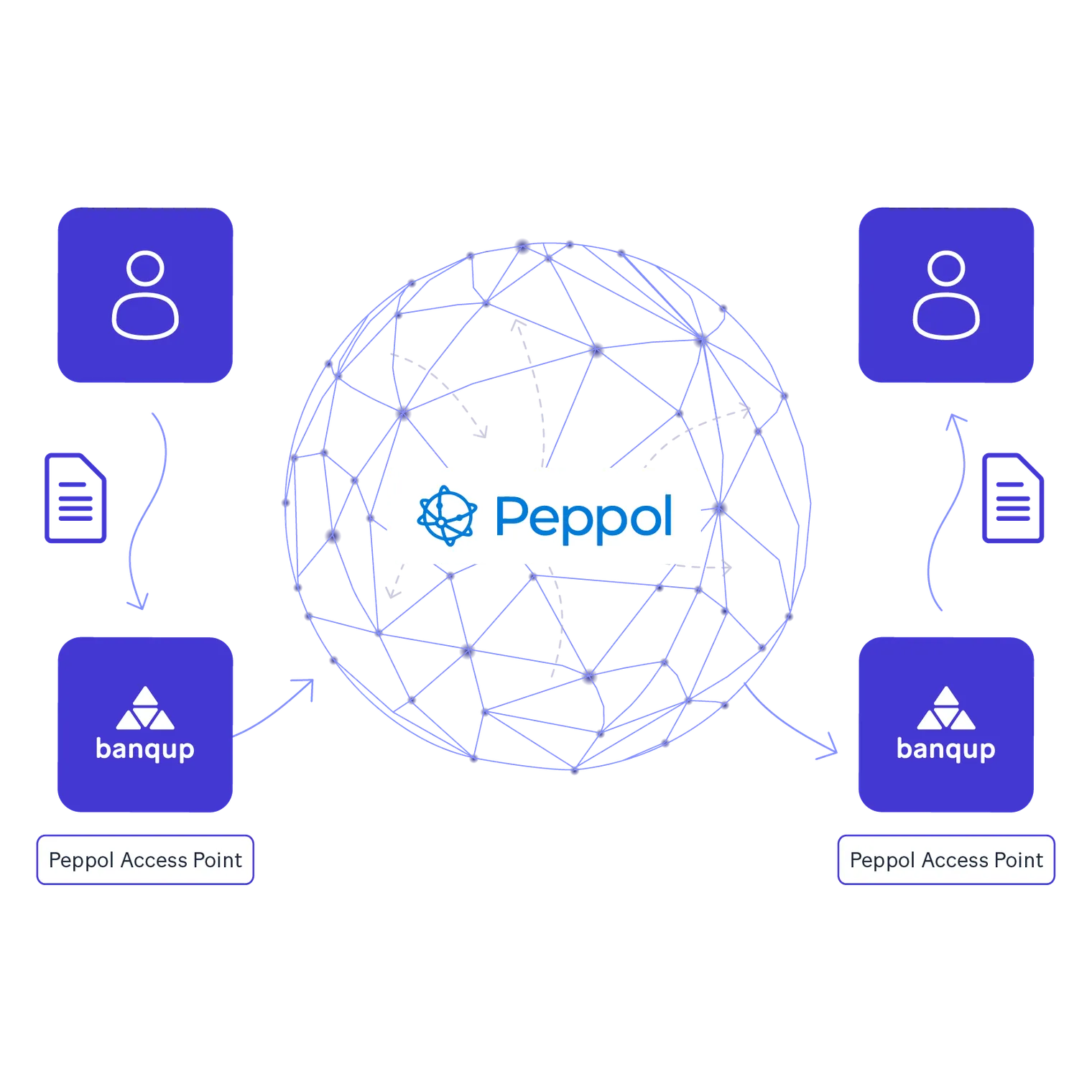
Australia's e-invoicing architecture is based on the Peppol 4-corner model, an open, decentralised network that enables direct document exchange between diverse commercial software applications without requiring bilateral point-to-point connections.
Step-by-step transaction flow
Document creation (Corner 1): The supplier creates an invoice within their native accounting software or ERP. The software generates the invoice payload formatted in accordance with the PINT A-NZ UBL 2.1 schema.
Access point dispatch (Corner 2): The supplier's certified Peppol Access Point receives the document, runs Schematron validation checks, and queries the Service Metadata Locator (SML) and Service Metadata Publisher (SMP) to discover the recipient's Access Point address.
Encrypted network transmission: The supplier's Access Point securely transmits the encrypted payload over the Peppol eDelivery Network to the buyer's Access Point using the AS4 transport protocol.
Receipt and ingestion (Corner 3 and Corner 4): The buyer's Access Point (Corner 3) receives, authenticates, and decrypts the invoice, immediately feeding the structured XML data directly into the buyer's ERP (Corner 4) for automated matching and accounts payable processing.
Penalties
Because Australia has not enacted a mandatory B2B e-invoicing statute or a centralised transaction control regime, there are no statutory financial penalties for failing to issue an electronic invoice.
However, non-compliance carries commercial risks, procedural penalties, and interest liabilities across public procurement and financial administration:
Area | Risk / Penalty Mechanism | Operational Consequence |
B2G Procurement (Government Risk) | Supplier Pay On-Time or Pay Interest Policy (RMG 417) | Federal NCEs that fail to settle valid Peppol e-invoices within 5 calendar days must pay compound interest to suppliers using the ATO General Interest Charge (GIC) rate. |
B2G Procurement (Supplier Risk) | Loss of Fast Payment Privileges | Suppliers submitting paper or PDF invoices forfeit the 5-day settlement guarantee, defaulting to standard 20-day terms and manual verification queues. |
Tax Record-Keeping | Taxation Administration Act 1953 (Section 288-25) | Failure to keep and retain business records (including electronic invoices) in an accessible format for 5 years incurs administrative penalties of up to 20 penalty units per violation. |
Corporate Transparency | Payment Times Reporting Act 2020 | Large enterprises failing to publish accurate, timely payment times reports face civil penalties of up to 350 penalty units for individuals and 1,750 penalty units for corporate bodies. |
Cybersecurity Vulnerabilities | Commercial Fraud and Redirection | Continued reliance on unencrypted PDF invoices over email leaves organisations exposed to business email compromise (BEC) and bank account redirection fraud. |
How businesses can prepare
To capitalise on the operational efficiencies of the Peppol network and access government fast-payment cycles, Australian businesses should execute a structured five-step preparation plan:
1. Verify Australian Business Number (ABN) master data
Because the Australian Peppol network routes all transactions using the ABN scheme (0151), ensure your business details on the Australian Business Register (ABR) are accurate, active, and fully updated. Cleanse your customer and supplier master files to ensure trading partner ABNs are correctly recorded.
2. Confirm ERP and accounting software capability
Verify whether your existing accounting system (e.g. SAP, Oracle, Microsoft Dynamics 365, Xero, MYOB) possesses native Peppol integration or connects via a certified service provider. Ensure your billing engine supports the PINT A-NZ Billing specification and is updated to support version 1.1.2 or later.
3. Connect to an accredited Peppol access point
Partner with an accredited service provider that has completed the accreditation requirements established by the Australian Taxation Office. For organisations trading across the Tasman, selecting a provider with dual accreditation in both Australia and New Zealand is vital for cross-border consistency.
4. Register receiving capabilities on the Peppol Directory
Publish your Peppol participant identifier in the global Peppol Directory through your service provider. This signals to your clients, trading partners, and Commonwealth procurement teams that your organisation is ready to receive structured PINT A-NZ invoices directly into your accounting ledger.
5. Transition government contract billing to Peppol
If your business supplies Non-corporate Commonwealth Entities, update your billing protocols immediately to deliver electronic invoices over Peppol. Ensure that contracts explicitly reference Peppol delivery to activate the 5-day payment guarantee under RMG 417, improving working capital and reducing debtor days.
Conclusion
Australia's approach to e-invoicing combines open international standards with commercial incentives rather than restrictive statutory mandates. By anchoring its national framework in the decentralised Peppol 4-corner network and completing the transition to the PINT A-NZ standard, the country has established an infrastructure that protects commercial data privacy while eliminating manual processing overhead.
For businesses operating in Australia, the commercial value of adoption is clear. Connecting to Peppol offers immediate access to 5-day government payment terms under RMG 417, delivers structural protection against invoice redirection scams, and unlocks automated processing across Trans-Tasman and global supply chains. As Non-corporate Commonwealth Entities progress toward their 31 December 2026 automated dispatch and processing targets, organisations that modernise their billing infrastructure today will lead digital trade across Australia and the wider Asia-Pacific region.
FAQ
No. Business-to-business e-invoicing remains voluntary. The Australian Government consulted on introducing a Business E-invoicing Right (BER) between 2021 and 2022, but the proposal was not enacted. Private businesses can choose whether to adopt Peppol e-invoicing based on commercial efficiency, security, and customer demand.