
This article was updated on 2 October 2026 to reflect the operational status of Austria's Business-to-Government (B2G) electronic invoicing mandate via the federal Unternehmensserviceportal (USP) and e-Rechnung.gv.at platform, the latest schema maintenance for the national ebInterface standard (versions 5.0 and 6.1), Peppol BIS Billing 3.0 routing protocols, and national preparatory steps aligning domestic commercial accounting with the European Union's VAT in the Digital Age (ViDA) package.
Introduction & digital tax strategy
Austria has required structured electronic invoicing for supplies to federal public authorities since 1 January 2014, subject to specific statutory exceptions. Domestic B2B e-invoicing remains voluntary. Since 1 January 2014, suppliers providing commercial goods and professional services to the Austrian federal government (Bund) have been legally required to submit structured electronic invoices. Administered under the auspices of the Federal Ministry of Finance (Bundesministerium für Finanzen - BMF) and operated technically by the Federal Computing Centre (Bundesrechenzentrum - BRZ), the Austrian framework operates primarily through a centralised gateway known as e-Rechnung.gv.at, which is directly integrated into the national business service hub, the Business Service Portal (Unternehmensserviceportal - USP).
Unlike aggressive real-time clearance models implemented in Southern or Eastern Europe, Austria's tax administration strategy balances public sector automation with administrative proportionality for the private sector. The national strategy prioritises high invoice processing efficiency in public procurement while allowing domestic Business-to-Business (B2B) electronic invoicing to develop through market-led adoption and mutual contractual consent. At the consumer level, Austria enforces rigorous anti-fraud fiscalisation rules for cash registers rather than requiring continuous e-invoicing.
This technical guide provides enterprise finance leaders, tax advisors, and software providers with an operational overview of Austria's digital tax landscape. It details the governing statutory instruments, platform mechanics across e-Rechnung.gv.at and Peppol, mandatory invoice schemas, archiving requirements, and the structural adjustments required ahead of the European Union's upcoming cross-border digital reporting rules.
Historical evolution & EU/global context
Austria's digital tax framework represents over two decades of deliberate technological evolution, originating long before the European Union formalised supranational e-invoicing directives:
2004 - 2010 (Development of the ebInterface national standard): Recognising the inefficiencies of unstructured document exchange, the Austrian Federal Economic Chamber (Wirtschaftskammer Österreich - WKO), through its digital business subsidiary AUSTRIAPRO, joined forces with the BMF and enterprise software developers to construct ebInterface. Engineered as an XML-based schema tailored to domestic Austrian tax legislation, ebInterface established a unified format for machine-to-machine invoice exchange.
1 January 2014 (Enactment of the federal B2G mandate): Austria became one of the earliest EU Member States to enact a statutory B2G e-invoicing mandate under Section 5 of the ICT Consolidation Act (IKT-Konsolidierungsgesetz - IKTKonG). The statute mandated all contractors supplying federal government ministries and supreme public bodies to submit invoices exclusively in structured electronic formats via e-Rechnung.gv.at. Paper and unstructured PDF invoices addressed to federal contracting authorities lost their legal validity.
1 January 2016 - 1 April 2017 (Retail cash fiscalisation via RKSV): To combat retail cash underreporting and suppress the shadow economy, Austria introduced the Cash Register Security Regulation (Registrierkassensicherheitsverordnung - RKSV). Rather than mandating digital B2C e-invoicing, the law required every cash register to generate cryptographically chained receipts featuring a mandatory machine-readable code (QR code).
18 April 2020 (Transposition of Directive 2014/55/EU): Through Section 368 of the Federal Public Procurement Act 2018 (Bundesvergabegesetz 2018 - BVergG 2018), Austria fully aligned its public procurement architecture with EU Directive 2014/55/EU. This reform expanded technical intake channels by mandating that federal public entities support the European semantic standard EN 16931 and accept structured documents transmitted via the international OpenPeppol network.
2024 - 2026 (Format modernisation and B2B market digital growth): The BMF and BRZ systematically deprecated obsolete XML schemas (ebInterface versions 4.0, 4.1, and 4.2), standardising platform intake on ebInterface versions 4.3, 5.0, 6.0, and 6.1 alongside Peppol BIS Billing 3.0. Concurrently, voluntary domestic B2B e-invoicing gained substantial momentum across private industry as enterprises automated accounts payable and receivable pipelines.
EU ViDA convergence (Target: 1 July 2030): The European Union's VAT in the Digital Age (ViDA) package sets a binding framework for digital transaction oversight across Member States. Under ViDA, structured electronic invoicing based on EN 16931 and near real-time Digital Reporting Requirements (DRRs) will become mandatory for intra-EU cross-border B2B supplies from 1 July 2030. Austria's established Peppol infrastructure and EN 16931 compatibility position the country for smooth interoperability once supranational enforcement begins.
Complete compliance timeline
The following table provides a comprehensive chronological record of enacted milestones and projected regulatory implementations governing electronic invoicing and digital VAT compliance in Austria:
Date | Scope & transaction type | Regulatory milestone & operational impact |
1 January 2014 | B2G (Federal government) | Mandatory electronic invoicing enters into force under § 5 IKTKonG. All suppliers to Austrian federal ministries and administrative agencies must submit structured XML invoices via e-Rechnung.gv.at. |
1 January 2016 | B2C (Cash fiscalisation) | General record-keeping and receipt-issuing obligation (Belegerteilungspflicht) under the Federal Fiscal Code (Bundesabgabenordnung - BAO) takes effect for commercial cash transactions. |
1 April 2017 | B2C (Cash fiscalisation) | Technical enforcement of the Cash Register Security Regulation (RKSV). In-scope cash registers must feature a certified cryptographic signature creation device and print verifiable QR codes on receipts. |
1 January 2019 | B2G (Peppol expansion) | Federal administration begins phased acceptance of Peppol BIS Billing 3.0 payloads alongside ebInterface, facilitating cross-border public sector transactions. |
18 April 2020 | B2G (Transposition of Directive 2014/55/EU) | Section 368 of the Federal Public Procurement Act 2018 entered into force on 18 April 2019 for contracting authorities listed in Annex III and on 18 April 2020 for other contracting authorities. For above-threshold public procurement, the provision requires contracting authorities to receive and process electronic invoices that comply with EN 16931 and the specified UBL or UN/CEFACT CII syntaxes. |
6 April 2022 | B2G (Schema maintenance) | From 6 April 2022, e-Rechnung.gv.at no longer accepts ebInterface versions 4.0, 4.1 and 4.2. The supported ebInterface versions are 4.3, 5.0, 6.0 and 6.1 |
1 July 2030 | B2B / Cross-border (EU ViDA) | Mandatory structured electronic invoicing and near real-time Digital Reporting Requirements (DRRs) take effect for intra-Community cross-border B2B supplies across the European Union. |
Legal framework
Austria's electronic invoicing and digital fiscal compliance structures are codified across specific federal statutes and implementing regulations:
Section 5 of the ICT Consolidation Act (IKT-Konsolidierungsgesetz - IKTKonG, BGBl. I Nr. 35/2012): Establishes the statutory mandate for federal B2G electronic invoicing. It obligates suppliers to transmit invoices to federal authorities (Bund) exclusively via the federal service portal using structured electronic formats, explicitly prohibiting the submission of paper or unstructured electronic formats.
Section 368 of the Federal Public Procurement Act 2018 (Bundesvergabegesetz 2018 - BVergG 2018, BGBl. I Nr. 65/2018): Transposes EU Directive 2014/55/EU into Austrian federal law, establishing that public contracting authorities must accept and process electronic invoices that comply with the European standard EN 16931.
Section 11 of the Austrian Value Added Tax Act 1994 (Umsatzsteuergesetz 1994 - UStG 1994, BGBl. Nr. 663/1994): Governs general invoice issuance, mandatory tax content, and electronic invoicing rules. Under Section 11(2) UStG, electronic invoices are legally permissible for commercial transactions provided the recipient agrees to electronic delivery and the authenticity of origin, integrity of content, and legibility are guaranteed.
Section 132 of the Federal Fiscal Code (Bundesabgabenordnung - BAO, BGBl. Nr. 194/1961): Enforces statutory retention rules for business records, commercial correspondence, books, and invoices, setting the mandatory retention period at seven years.
Cash Register Security Regulation (Registrierkassensicherheitsverordnung - RKSV, BGBl. II Nr. 417/2015): Regulates anti-tamper fiscalisation for consumer cash transactions, establishing mandatory digital security mechanisms, closed cryptographic logging (Datenerfassungsprotokoll), and scannable receipt QR codes.
Authorities
The administration, oversight, and technical execution of Austria's digital tax framework involve several key governmental bodies and standardisation entities:
Authority / Institution | Operational role & administrative responsibilities |
Federal Ministry of Finance (Bundesministerium für Finanzen - BMF) | Formulates national tax legislation, issues VAT regulations, oversees statutory audit compliance, and sponsors digital tax modernisation initiatives across Austria. |
Federal Computing Centre (Bundesrechenzentrum - BRZ) | Serves as the government's official technology provider. Operates the technical infrastructure of the USP portal, the e-Rechnung.gv.at gateway, validation web services, and internal federal workflow routing. |
Business Service Portal (Unternehmensserviceportal - USP) | Acts as the central administrative online portal for registered Austrian companies, providing single-sign-on authentication for federal tax filings, social security, and B2G e-invoicing access. |
AUSTRIAPRO (Wirtschaftskammer Österreich - WKO) | The technical standardisation association affiliated with the Austrian Federal Economic Chamber. Responsible for developing, updating, and documenting the national ebInterface XML schema specification. |
OpenPeppol / Peppol Authority network | International non-profit governance body establishing standards for Peppol Access Points and document schemas. Austrian public entities connect to Peppol to facilitate international trade. |
Which transactions require e-invoicing in Austria?
The application of digital invoicing and transaction recording rules in Austria depends strictly on the counterparty and the underlying commercial transaction type.
Austrian transaction compliance scope | ||
Business-to-Government | Business-to-Business | Business-to-Consumer |
B2G - Federal | B2B - Domestic | B2C - Retail |
|
|
|
Business-to-Government (B2G) transactions
Under Section 5 IKTKonG, mandatory structured electronic invoicing applies to all supplies of goods and services rendered to Austrian federal government entities (Bund).
In-scope buyers: All federal ministries, subordinate federal agencies, the Austrian Parliament, the Supreme Courts, and supreme federal administrative institutions.
Contractor liability: Domestic suppliers must submit structured e-invoices. Foreign contractors with a seat abroad are only obliged to the extent technically possible, and paper invoices continue to be accepted from them. Foreign contractors with a seat in Austria are fully subject to the obligation (USP.gv.at).
Sub-central and municipal administrations: Austrian federal states (Bundesländer) and local municipalities (Gemeinden) are not federally mandated to process invoices via e-Rechnung.gv.at. However, several states (including Vienna, Styria, and Carinthia) and major cities voluntarily permit suppliers to route invoices through the central portal or via individual regional accounting platforms.
Business-to-Business (B2B) transactions
Electronic invoicing between private enterprises is currently voluntary under Austrian domestic tax law:
Contractual mutual agreement: Under Section 11(2) UStG, commercial suppliers may issue electronic invoices provided the buyer agrees to electronic receipt. Agreement can be established through explicit contract terms or implied through silent acceptance and automated processing.
Format flexibility: Commercial parties may exchange invoices using structured XML (ebInterface, Peppol BIS, UBL, CII), hybrid formats (such as German ZUGFeRD / Factur-X), Electronic Data Interchange (EDI/EDIFACT), or human-readable PDF documents.
Cross-border trade under EU ViDA: While domestic B2B e-invoicing remains voluntary today, businesses operating within Austria must prepare for the European Union's mandatory cross-border B2B digital reporting and e-invoicing rules scheduled for 1 July 2030.
Business-to-Consumer (B2C) transactions
Austria does not impose an electronic invoicing obligation for consumer sales. Invoices or sales slips may be issued on paper or electronically. However, commercial retailers and hospitality providers are bound by the receipt-issuing obligation (Belegerteilungspflicht) under Section 132a BAO and the technical cash register security rules of the RKSV. Where cash register and RKSV requirements apply, businesses must maintain the prescribed tamper-evident transaction records and issue compliant receipts. Since 1 October 2026, electronic receipts may be delivered by email or app, or made available for customers to retrieve on-site. Customers also have the right to request a paper receipt
Summary matrix of Austrian transaction scopes
Transaction type | Mandatory status | Approved transmission channel | Prescribed data format |
B2G (Federal bodies) | Mandatory | e-Rechnung.gv.at (via USP) or Peppol network | ebInterface (4.3, 5.0, 6.0, 6.1) or Peppol BIS Billing 3.0 |
B2G (States & Municipalities) | Varies by region | Regional portals, email, or voluntary e-Rechnung.gv.at | ebInterface, Peppol BIS, or standard PDF (recipient specific) |
B2B (Domestic supplies) | Voluntary | Direct email, secure SFTP, Peppol network, or private EDI | Unrestricted (XML, PDF/A, hybrid, or paper subject to mutual consent) |
B2B (Cross-border EU) | Mandatory by 2030 | Direct digital reporting / Peppol network (ViDA) | Structured EN 16931-compliant XML (UBL or CII syntax) |
B2C (Retail cash sales) | Voluntary invoicing | Point-of-sale receipt printout or electronic delivery | Cash register receipt with cryptographic signature / QR code (RKSV) |
Austria's e-invoicing requirements
Electronic invoices submitted to Austrian federal authorities must meet the applicable format, content and transmission requirements. e-Rechnung.gv.at supports ebInterface versions 4.3, 5.0, 6.0 and 6.1 and UBL 2.1, with Peppol providing an additional transmission channel for compliant UBL invoices.
Mandatory semantic data elements for federal B2G invoices
In addition to general VAT information required under Section 11 UStG (such as legal supplier name, Austrian tax UID number, sequential invoice number, line-item description, tax rates, and tax totals), federal public invoices must contain unique routing identifiers:
Internal order reference (Auftragsreferenz): The order reference (InvoiceRecipient/OrderReference/OrderID) is mandatory. If the recipient is the Bund and the reference is a 10-digit numeric order number, the matching order position number must be stated on each invoice line (ebInterface spec).
Supplier number (Lieferantennummer): An administrative identification code assigned to the registered contractor by the federal procurement authority (Bund).
Federal Public Procurement Agency identifiers (BBG-Referenz): Where goods or services are delivered under contracts negotiated by the Federal Public Procurement Agency (Bundesbeschaffung GmbH - BBG), the supplier must include the assigned BBG contract number.
If these administrative tokens are missing or syntactically invalid, the central e-Rechnung.gv.at validator rejects the file immediately, preventing delivery to the recipient department.
Accepted invoice formats
e-Rechnung.gv.at supports ebInterface versions 4.3, 5.0, 6.0 and 6.1, as well as UBL 2.1. Peppol transmission uses UBL-based Peppol BIS Billing 3.0. For above-threshold public procurement, Section 368 BVergG 2018 requires contracting authorities to receive and process EN 16931-compliant invoices using UBL or UN/CEFACT CII. See the supported invoice formats and Section 368 BVergG 2018.
Transmission channels for B2G e-invoices
Suppliers delivering electronic invoices to the Austrian federal administration must utilise one of four supported submission methods:
Supplier ERP / Billing Software
Option 1: Manual Web Form Entry (*e-Rechnung.gv.at* via USP login)
Option 2: Manual File Upload (XML upload via e-Rechnung.gv.at)
Option 3: Automated B2G submission through the officially documented SOAP web service.
Option 4: OpenPeppol Network (via certified Peppol Access Point)
Manual online form entry: Low-volume suppliers without specialised accounting software can log into e-Rechnung.gv.at via their corporate USP user account and transcribe invoice line items manually into a web form. The platform generates an internal structured electronic invoice automatically.
Manual XML file upload: Businesses that can export compliant ebInterface or Peppol XML files from their internal ERP can manually upload the file through the authenticated e-Rechnung.gv.at portal interface. The platform validates the file in real time and returns a delivery confirmation.
Automated web service API: High-volume suppliers can establish an automated system-to-system connection with the BRZ central intake servers. This direct web service enables enterprise ERP systems (such as SAP, Oracle, or Microsoft Dynamics) to dispatch structured XML documents securely without human intervention.
The Peppol network: Enterprises utilising an accredited Peppol Access Point can transmit Peppol BIS Billing 3.0 invoices directly into the Austrian federal receiver endpoint. All federal invoice recipients share one Peppol participant ID, iso6523-actorid-upis::9915:b; the effective recipient is determined from the order reference (Auftragsreferenz) in the invoice, see e-Rechnung.gv.at – Peppol.
Statutory archiving requirements
Under Section 132 BAO, electronic invoices issued and received must be retained for a statutory period of seven years from the end of the calendar year in which the invoice was issued or booked.
Crucial archiving conditions include:
Format preservation: Austrian law generally requires invoices to be retained for seven years, while preserving authenticity, integrity and legibility. Electronic invoices may also be retained as paper printouts if these conditions remain verifiable throughout the retention period. Retaining the original XML and associated validation records is good practice, but it is not a universal statutory requirement.
Data integrity and accessibility: The archiving environment must ensure the authenticity of origin, content integrity, and legibility throughout the seven-year retention cycle.
Extended retention for real estate: Documents relating to immovable property may be subject to longer retention periods. Depending on the circumstances, these can extend to 12 or 22 years. Businesses should assess the applicable retention period according to the underlying transaction.
Storage abroad: Digital storage outside Austria is permitted across the EU and EEA, provided the Austrian tax administration is guaranteed complete, direct, and immediate online read and export access during tax audits.
Does Austria require real-time VAT e-reporting?
Unlike jurisdictions such as Italy, Spain, France, or Romania, Austria has not implemented a domestic real-time Continuous Transaction Control (CTC) e-reporting regime for private sector B2B commerce.
Current reporting mechanisms
Commercial entities operating in Austria satisfy their statutory tax reporting liabilities through conventional, periodic filings administered via the official tax portal FinanzOnline:
Advance VAT returns (Umsatzsteuervoranmeldung - UVA): Businesses submit monthly or quarterly electronic UVA summaries detailing aggregate output VAT, allowable input VAT deductions, and net payable tax balances.
Recapitulative statements (Zusammenfassende Meldung - ZM): Periodic electronic reporting of intra-Community supplies of goods and cross-border services rendered to VAT-registered buyers across other EU Member States.
Standard Audit File for Tax (SAF-T on audit request): Austria does not require periodic, monthly SAF-T data exports. However, under Section 131 BAO, during a formal tax inspection (Betriebsprüfung), tax auditors have the statutory authority to demand digital accounting ledgers and journal records in a structured electronic format compatible with federal auditing analysis tools.
The transition toward EU ViDA Digital Reporting Requirements (DRRs)
Austria's digital reporting posture will undergo structural transformation on 1 July 2030 upon enforcement of the EU VAT in the Digital Age directive:
Intra-Community real-time reporting: Under Directive (EU) 2025/516, e-invoices must be issued within 10 days of the chargeable event. Transaction data must be transmitted at the time of issuance (no later than 5 days after issuance for self-billing and for recipient-side reporting of intra-EU acquisitions). The rules apply from 1 July 2030 (European Commission).
Abolition of summary statements: ViDA is expected to replace the ZM for transactions covered by the DRR; the Austrian implementation is not yet enacted.
Technical architecture
Austria uses a centralised B2G invoice submission and validation gateway alongside a decentralised domestic B2B exchange model. The federal B2G platform validates and routes invoices to public authorities but does not function as a general tax clearance system for commercial transactions.
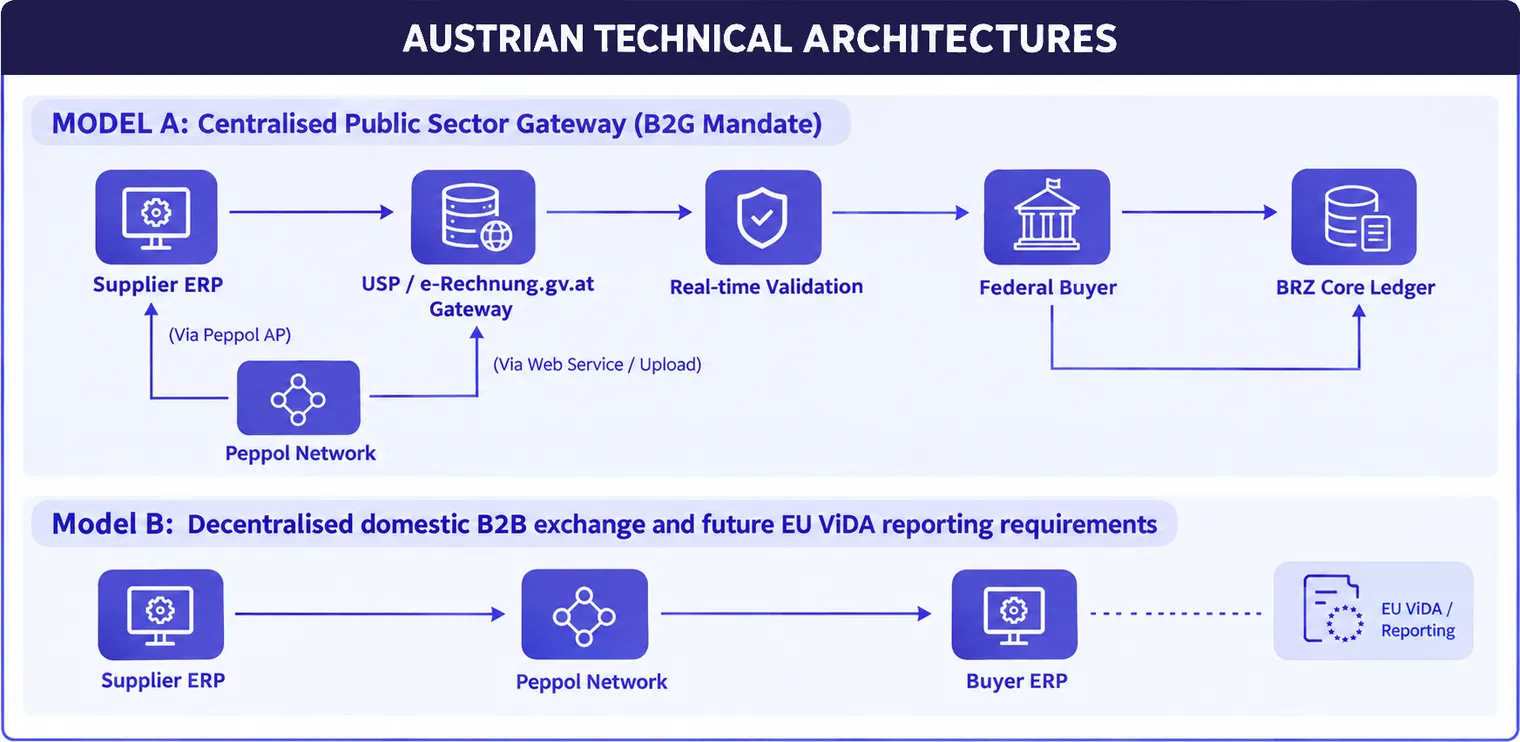
Domestic B2B invoices can currently be exchanged directly between trading partners or through service providers. From 1 July 2030, covered intra-EU cross-border transactions will be subject to ViDA digital reporting requirements. The reporting architecture should not be presented as an existing integration with FinanzOnline unless officially confirmed.
Centralised federal B2G model
For transactions involving the federal state, Austria functions under a centralised intake architecture:
Endpoint consolidation: All federal administrative departments share a single receiving endpoint managed by the BRZ. Individual ministries do not operate independent receiving servers.
Synchronous schema validation: When an electronic document hits the e-Rechnung.gv.at gateway, the system executes real-time validation against the published XML schemas (ebInterface XSD or Peppol Schematron).
Internal routing: Once technical and business validation rules pass, the BRZ infrastructure parses the internal order reference (Auftragsreferenz) and securely delivers the payload into the enterprise resource system of the specific purchasing ministry.
Decentralised private B2B model
For domestic B2B trade, enterprises interact directly without government pre-clearance. Companies exchange documents via bilateral EDI pipelines, direct encrypted email, or through certified service providers operating across the Peppol 4-corner network. This preserves complete commercial privacy and avoids transactional latency.
Statutory penalties and compliance risks
Failure to adhere to Austrian invoicing and tax compliance regulations entails measurable administrative and financial liabilities codified under the Value Added Tax Act and the Financial Criminal Act (Finanzstrafgesetz - FinStrG).
B2G administrative non-compliance risks
Total payment rejection: The primary commercial risk under Section 5 IKTKonG is automated non-acceptance. The federal government’s accounting systems cannot process payment claims submitted on paper or as unstructured PDF attachments. Invoices that fail validation may not reach the intended public-sector recipient, which can delay payment. Whether late-payment interest arises depends on the applicable contractual and statutory provisions and should be assessed separately.
Dispute overhead and cash flow disruption: Invoices rejected because of an invalid Auftragsreferenz must be corrected and submitted again. The appropriate handling of the invoice number depends on the nature of the correction and the accounting record. Repeated validation failures can delay processing and affect cash flow.
VAT and corporate tax audit penalties
Under general Austrian tax law, issuing non-compliant or inaccurate tax invoices exposes businesses to severe fiscal adjustments:
Disallowance of input VAT deduction (Vorsteuerabzug): Under Section 11 and Section 12 UStG, commercial purchasers can deduct input VAT only when supported by a legally compliant invoice containing all statutory tax elements. If an invoice lacks mandatory supplier identifiers, Austrian VAT numbers, or clear service descriptions, tax auditors will disallow the buyer's input VAT deduction during tax inspections.
Administrative fines under the Financial Criminal Act: Intentional breaches of certain tax record-keeping, documentation or invoice retention duties may constitute a financial regulatory offence under Section 51 of the Financial Criminal Act (Finanzstrafgesetz, FinStrG). The statutory maximum fine under this provision is €5,000.
Financial criminal proceedings (Finanzstrafgesetz - FinStrG): Deliberate invoice manipulation, suppression of taxable turnover, or systemic accounting record tampering triggers formal prosecution under the Finanzstrafgesetz. Sanctions include severe corporate fines reaching up to twice the evaded tax amount and personal criminal liability for responsible company officers.
How can businesses prepare for Austria's e-invoicing rules and ViDA?
Although domestic B2B e-invoicing remains voluntary, commercial suppliers and international enterprises operating in Austria must take proactive operational steps to guarantee public sector compliance and future-proof systems ahead of European ViDA mandates:
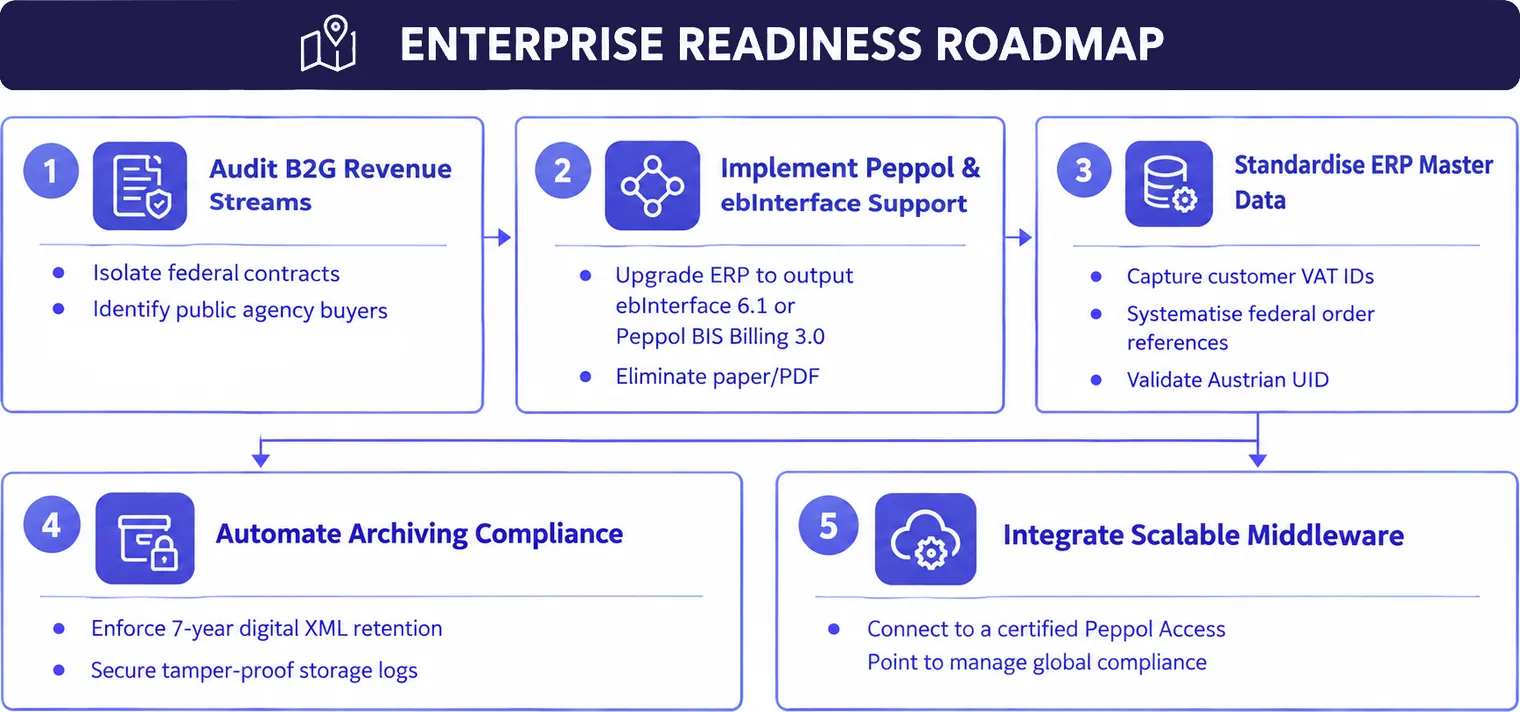
1. Audit public procurement exposure
Examine existing customer master directories across Austrian operating entities. Isolate all contracts linked to federal ministries, subordinate agencies, and supreme constitutional bodies. Ensure sales teams understand that federal accounts must never be invoiced via paper or email PDFs.
2. Configure ERP schemas for ebInterface and Peppol BIS 3.0
Verify that billing and enterprise software (SAP, Oracle, Microsoft Dynamics) can generate native, valid structured XML files. Standardise internal mapping on ebInterface version 6.1 or Peppol BIS Billing 3.0 (UBL 2.1). Ensure older systems reliant on deprecated schemas (ebInterface 4.0, 4.1, 4.2) are updated immediately to prevent transmission rejections.
3. Establish robust master data governance
B2G e-invoices fail predominantly due to master data deficiencies. Systematise internal order-to-cash workflows to capture the mandatory federal internal order reference (Auftragsreferenz) and supplier number (Lieferantennummer) at the moment of contract signing or purchase order booking. Establish automated pre-validation rules to verify buyer Austrian VAT numbers (UID-Nummer with the prefix ATU).
4. Transition to automated Peppol network routing
Rather than maintaining bespoke web service scripts for individual national portals, organisations should connect their internal accounting environments to an accredited Peppol Access Point. Peppol integration enables businesses to transmit structured B2G invoices to the Austrian federal administration using the official participant identifier iso6523-actorid-upis::9915:b. The receiving authority is identified through the order reference within the invoice. The same network can also support electronic invoice exchange with other participating organisations.
5. Consolidate compliant digital archiving
Review electronic document archiving systems against Section 132 BAO standards. Ensure digital archives retain the primary, structured XML payloads together with validation status certificates for the mandatory seven-year retention window. Maintain indexed, human-readable visualisations alongside raw files to ensure rapid accessibility during tax inspections.
Conclusion
Austria's electronic invoicing framework represents a mature, highly functional digital compliance model. By mandating structured e-invoicing across federal public procurement through the Unternehmensserviceportal (USP) and e-Rechnung.gv.at as early as 2014, the Austrian federal administration has established a reliable and automated B2G procurement ecosystem.
While domestic B2B e-invoicing remains voluntary, enterprises cannot afford to adopt a passive approach. The EU's VAT in the Digital Age (ViDA) requirements will expand mandatory structured e-invoicing and digital reporting for intra-EU cross-border B2B transactions from 1 July 2030. Austrian businesses should therefore assess whether their invoicing and reporting systems can support EN 16931-compliant processes
Organisations that update their ERP systems to generate ebInterface and Peppol BIS Billing 3.0 files, enforce strict master data controls for routing tokens, and connect to certified Peppol Access Points will secure immediate operational efficiencies in public procurement while establishing seamless, future-proof compliance across the European single market.
FAQ
No. Domestic B2B electronic invoicing is currently voluntary under Austrian tax law. Businesses may agree to exchange electronic invoices, but there is no statutory obligation forcing private companies to adopt structured e-invoicing for domestic transactions today.