
This article was updated on 19 August 2026 to incorporate the 18 July 2026 federal cabinet approval of the draft law (avant-projet de loi) for mandatory near-real-time e-reporting starting 1 January 2028, the 22 May 2026 initiation of the ViDA transposition into Belgian national law, and the active administrative penalties following the end of the initial transition window.
Introduction & digital tax strategy
Belgium's transition to mandatory structured e-invoicing represents a fundamental transformation of corporate financial administration. The Federal Public Service Finance (SPF Finances / FOD Financiën) designed the reform to modernise tax administration, close the national VAT gap, and eliminate administrative inefficiencies across private enterprise.
A 2012 study by Hasselt University, commissioned by Belgium's Administrative Simplification Agency (ASA), whose administrative-simplification missions were integrated into the Federal Public Service Policy and Support (BOSA) in 2022, estimated that the average cost of a paper B2B invoice was approximately €12.08, while e-invoicing could reduce this cost by up to €9 per invoice. Applied to the roughly one billion invoices estimated to be exchanged annually in Belgium, fully automating invoice processing could generate potential annual efficiency gains of approximately €3.5 billion.
The estimate reflects savings across the entire invoice lifecycle, including preparation, transmission, reception, and processing. These structural savings stem from reduced printing and postal expenses, minimised manual data entry and error reconciliation, lower archiving overheads, and accelerated payment settlement cycles.
Rather than implementing a centralised clearance system where every transaction requires real-time tax authority pre-approval, Belgium selected a decentralised continuous transaction model. By embedding invoice exchange directly within the international Peppol network, the Belgian strategy avoids single-point-of-failure risks and systemic platform bottlenecks, establishing a resilient infrastructure for future digital tax compliance.
Historical evolution & EU/global context
Belgium’s digital tax strategy developed across distinct legislative phases spanning public procurement and private sector mandates:
2017–2021: Early adoption began in the regional public sector. The Flemish regional government mandated e-invoicing for its suppliers in 2017, followed by the Brussels-Capital Region in November 2020, and Wallonia promoted e-invoicing as the preferred method for B2G transactions from January 2022.
2022–2024: Belgium completed the phased rollout of mandatory Business-to-Government (B2G) e-invoicing under the Law of 7 April 2019, which transposed Directive 2014/55/EU, and the Royal Decree of 9 March 2022. The federal obligation was introduced in stages by contract value, extending from larger contracts in November 2022 to contracts below €30,000 in 2023 and, generally, to public contracts of €3,000 or more from 1 March 2024. Contracting authorities could apply stricter requirements, and federal authorities were required to impose e-invoicing below the €3,000 threshold.
October 2023: Belgium formally requested a derogation from Articles 218 and 232 of EU Directive 2006/112/EC in order to introduce mandatory B2B e-invoicing without requiring the recipient’s prior acceptance ahead of the broader EU consensus.
February 2024: The Belgian Parliament adopted the Law of 6 February 2024, establishing mandatory structured e-invoicing for most domestic B2B transactions from 1 January 2026. Initially conditional on obtaining the requested EU derogation, the mandate later became supported by the Council’s ViDA Directive, which amended Articles 218 and 232 with effect from 14 April 2025 and removed the need for individual Member State derogations.
May 2026: The Council of Ministers formally initiated national transposition of the EU VAT in the Digital Age (ViDA) package (Directive (EU) 2025/516).
July 2026: The Council of Ministers approved a preliminary draft law (avant-projet de loi) introducing domestic B2B e-reporting for 2028, subject to completion of the legislative process. The proposal represents the next stage of Belgium’s digital VAT strategy but is not yet binding law.
Belgium's model aligns with broader European digital trade directives and serves as a foundational building block for ViDA’s upcoming Digital Reporting Requirements (DRR) across the European Union.
Complete compliance timeline
Date | Legislative / Operational Milestone | Scope & Authority |
1 November 2022 | B2G e-invoicing mandatory for public contracts > €215,000 | Public Procurement / Royal Decree 9 March 2022 |
1 May 2023 | B2G e-invoicing threshold reduced to public contracts > €30,000 | Public Procurement / FPS BOSA |
1 March 2024 | B2G e-invoicing mandatory for all public contracts > €3,000 | All Belgian Public Authorities |
1 January 2025 | Enhanced 120% tax deduction for structured e-invoicing investments during 2024–2027 taxable periods becomes active | Article 64ter CIR 92 (Taxable periods 2024–2027) |
1 January 2026 | Mandatory structured domestic B2B e-invoicing enters into force | Law of 6 February 2024 / All Belgian VAT entities |
1 April 2026 | Initial Q1 2026 administrative tolerance period ends; formal enforcement begins | FPS Finance (SPF Finances) |
22 May 2026 | Formal transposition of EU ViDA Directive into Belgian law begins | Council of Ministers / Directive (EU) 2025/516 |
18 July 2026 | Cabinet approval of preliminary draft law (avant-projet de loi) for B2B e-reporting | Belgian Federal Cabinet |
1 January 2027 | ViDA Article 2 provisions take effect (harmonised VAT chargeability, niche B2C scope additions for energy and specific services, and cross-border stock rule clarifications) | National ViDA Transposition |
1 January 2028 | Proposed go-live for mandatory near-real-time domestic B2B e-reporting, subject to adoption of the draft legislation | Proposed Belgian e-reporting regime |
1 July 2028 | ViDA provisions take effect: Full B2C scope expansion of OSS, introduction of the Transfer of Own Goods Special Scheme, initiation of the call-off stock scheme phase-out, and mandatory B2B reverse charge for non-established suppliers | National ViDA Transposition |
1 July 2029 | ViDA Article 4 provisions take effect (full abolition of the traditional call-off stock regime following its phase-out) | National ViDA Transposition |
1 January 2030 | Main ViDA digital reporting and intra-EU e-invoicing provisions become applicable, subject to the directive’s detailed transitional rules. | Directive (EU) 2025/516 |
Legal framework
The legal foundation for electronic invoicing and digital tax compliance in Belgium is established by the following enacted statutes and decrees:
Law of 7 April 2019: Transposes EU Directive 2014/55/EU into national public procurement legislation.
Royal Decree of 9 March 2022: Sets technical and operational obligations for suppliers to public sector bodies under public procurement and concession contracts.
Law of 6 February 2024 amending the Value Added Tax Code (published in the Moniteur Belge on 20 February 2024): Amends Article 53 of the Belgian VAT Code, replacing the requirement for buyer acceptance with a mandatory obligation for all VAT-registered entities to issue and receive structured electronic invoices for domestic B2B transactions.
Article 64ter of the Income Tax Code 1992 (CIR 92): Modified by the Law of 6 February 2024 to introduce a 120% increased tax deduction for expenses incurred in adopting Peppol-compliant e-invoicing software and related consultancy services.
Avant-projet de loi (Draft Law approved 18 July 2026): Establishes the legal framework for mandatory domestic near-real-time e-reporting and abolishes the annual client listing (clientenlisting) for covered taxpayers from 2028.
Authorities
Digital tax compliance and e-invoicing in Belgium involve three primary institutional roles:
Belgian Federal Government and Parliament: Responsible for adopting the legislation that establishes the scope, deadlines and legal requirements for B2G and B2B e-invoicing. Once adopted, those rules are administered primarily by FPS Finance and supported technically by BOSA.
FPS Finance (SPF Finances / FOD Financiën): The national tax administration responsible for VAT policy, enforcement, tax audits, and the legal definition of structured electronic invoices.
FPS Policy and Support (SPF BOSA / FOD BOSA): The digital authority responsible for the technical and digital infrastructure supporting public-sector e-invoicing, and operating the public sector invoice hub (Mercurius) through December 2026, after which the platform is scheduled to be decommissioned and transitioned to a new framework.
Belgian Peppol Authority: This is not a separate government entity but a role performed by FPS BOSA since March 2016. It manages Peppol Access Point accreditations, enforces network specifications, and oversees national interoperability standards.
Scope of the mandate
Belgium’s structured e-invoicing mandate is determined by the parties’ Belgian VAT establishment, the nature and location of the transaction, and whether the transaction is taxable or exempt:
In-scope transactions
Domestic B2B transactions: Taxable supplies of goods and services carried out in Belgium between VAT-taxable persons or where the supplier and customer otherwise have the relevant Belgian establishment.
Belgian-established entities: Entities incorporated in Belgium, Belgian permanent establishments of foreign entities (if the establishment intervenes in the supply), Belgian VAT group members, and entities under the special agricultural VAT scheme, at least for receiving purposes.
Obligation to receive: All Belgian VAT-registered entities must be able to receive structured electronic invoices, even where they do not issue B2B invoices themselves. However, entities exclusively carrying out Article 44 VAT-exempt activities are generally outside both the issuing and receiving obligations.
Out-of-scope transactions
Non-established entities: Foreign companies holding only a direct VAT registration in Belgium without a permanent establishment are generally exempted from the mandatory issuing and receiving scope of the domestic B2B e-invoicing mandate.
Exempt transactions: Healthcare, educational, financial, and other transactions exempt from VAT under Article 44 of the Belgian VAT Code. However, note that businesses with both taxable and Article 44-exempt activities may still be in scope for their taxable B2B transactions.
Cross-border transactions: Many intra-Community supplies, exports, and cross-border B2B services remain outside the domestic mandate (until wider cross-border e-invoicing and digital reporting obligations are introduced by future EU ViDA rules). However, cross-border transactions involving Belgian fixed establishments or transactions treated as domestic for Belgian VAT purposes require separate analysis.
Business-to-Consumer (B2C): Sales to private individuals remain outside the mandate.
Bankrupt entities: Businesses declared bankrupt are generally excluded from issuing structured e-invoices for transactions carried out after the bankruptcy declaration, subject to the precise legal conditions and the role of the bankruptcy administration.
Important distinction for compliance
Being exempt from the obligation to issue structured electronic invoices does not automatically mean being exempt from the obligation to receive them. This distinction is particularly relevant for small businesses, B2C-focused enterprises, and businesses with limited taxable activity, all of which must still maintain the technical capability to ingest structured invoices from their suppliers even if they do not issue invoices for their own outward supplies.
E-invoicing requirements
Belgian law mandates structured machine-to-machine exchange of transactional data.
Technical formats & standards
The default Belgian format is Peppol BIS Billing 3.0, based on Universal Business Language (UBL 2.1 XML) and aligned with the European semantic standard EN 16931. Businesses should use the Peppol profile unless they have agreed an alternative compliant arrangement with their trading partner.
Unstructured formats & hybrid files
PDF files: Standalone PDF files sent via email do not satisfy Belgian legal requirements for domestic B2B transactions.
Hybrid invoices: Files combining human-readable PDF layouts with embedded structured XML (e.g., Factur-X / ZUGFeRD) may be usable where the underlying XML meets the applicable EN 16931 requirements, and the parties agree to use that format. In this case, the structured data is the legally relevant component for automated processing.
Transmission channels
Peppol is the default and generally expected channel for exchanging Belgian domestic B2B e-invoices. Businesses normally send and receive invoices through certified Peppol Access Points, which provide routing, participant identification, and technical validation.
However, under the established dual-track framework, Belgian rules allow an alternative channel, such as an existing EDI or other direct system-to-system arrangement, where both parties agree and the invoice remains structured, machine-readable and compliant with the applicable EN 16931 requirements.
Simply emailing a PDF, or manually emailing an XML file without an appropriate agreed system-to-system process, does not satisfy the mandate.
Archiving rules
Taxpayers must retain the original structured electronic invoice and relevant supporting data in their original form for the applicable statutory retention period, generally 10 years under Belgian VAT and accounting rules. Archival storage systems must preserve the authenticity of origin, integrity of content, and continuous legibility throughout the retention timeframe. For a UBL invoice, this means retaining the original XML; for a compliant hybrid invoice, the original hybrid file and its embedded structured data should be retained.
E-reporting requirements
Belgium is preparing a second phase of its digital VAT strategy. While structured B2B invoice exchange is already mandatory, the federal government has proposed adding near-real-time reporting of selected invoice data to the Belgian tax administration.
On 18 July 2026, the Belgian Council of Ministers approved a preliminary draft law (avant-projet de loi) that would introduce this obligation starting 1 January 2028. The proposal still needs to pass through the remaining legislative process, and the detailed reporting data, technical specifications and operational arrangements may still change.
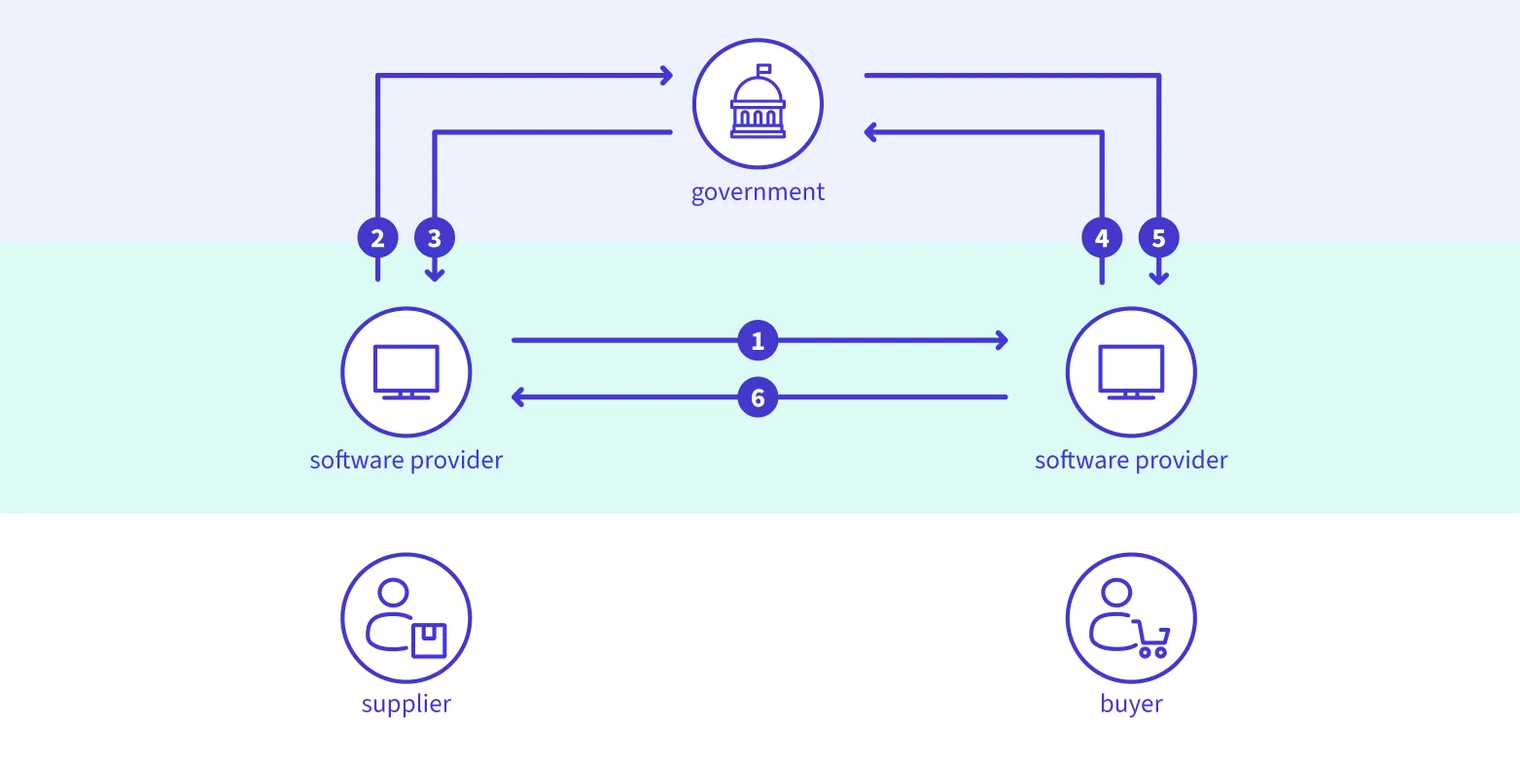
Proposed reporting flow:
Key proposed e-reporting parameters
Scope: Domestic B2B transactions already covered by the e-invoicing mandate.
Reporting mechanism: Dual-side reporting where both suppliers and buyers would transmit key invoice data points to the federal tax administration, FPS Finance.
Transmission channel: Integrated into the Peppol infrastructure using a 5-corner Continuous Transaction Control (CTC) framework. This bilateral approach is intended to support automated matching of sales and purchase data.
Timing: Reporting would take place electronically on a near-real-time basis, shortly after the relevant transaction. The final timing and data fields remain subject to the legislation and implementing rules.
Technical model: The proposal would build on Belgium’s existing Peppol infrastructure and evolve the current four-corner exchange model towards a five-corner Continuous Transaction Controls framework, with the tax administration added as a participant.
Simplification benefit: Under the proposed new e-reporting model, the near-real-time reporting framework would replace the legacy annual client listing (clientenlisting) for all participating taxpayers.
Technical architecture
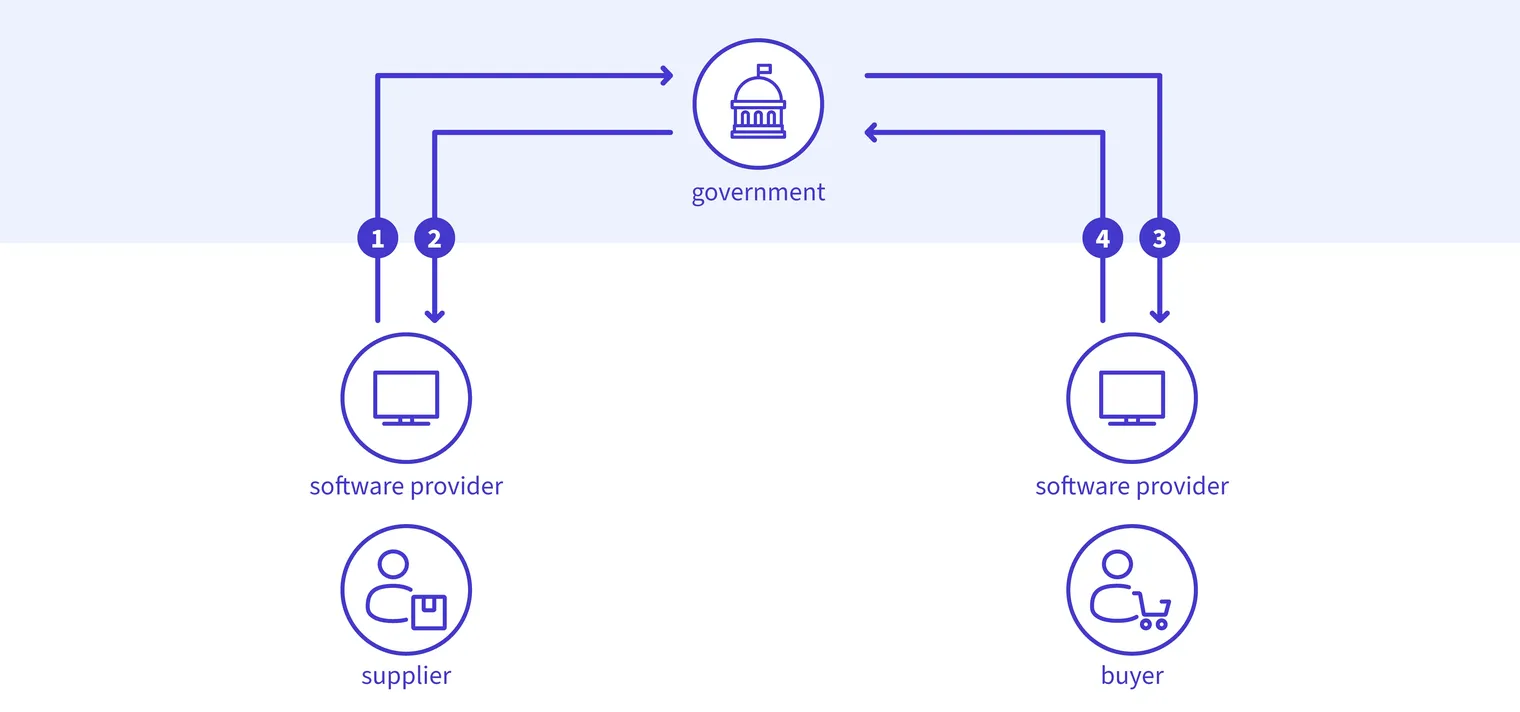
Belgium’s e-invoicing model uses a decentralised 4-corner Peppol architecture, expected to transition into a 5-corner CTC model for 2028 e-reporting.
The dual-track framework
To balance standardisation with operational flexibility, Belgian legislation establishes two exchange tracks:
Track 1 (default): The Peppol 4-corner network using Peppol BIS Billing 3.0. Connecting once to a certified Peppol Access Point grants automatic reachability to all other connected participants without requiring individual bilateral agreements.
Track 2 (opt-out): Trading partners may explicitly agree to use alternative structured formats or networks (e.g., EDI over AS2), provided the format strictly respects European standard EN 16931.
The former Hermes platform
Before its decommissioning, Belgium’s Hermes platform served as a transitional fallback and technical fail-safe. If a sender attempted to issue a structured e-invoice via Peppol to a buyer who was not yet reachable on the network, HERMES acted as a default gateway, converting the structured document into an accessible format and notifying the recipient, thereby ensuring the sender fulfilled its legal obligation.
HERMES was decommissioned for sending and receiving documents on 31 December 2025, ahead of the nationwide B2B e-invoicing mandate. Users could access previously exchanged documents in consultation mode until 31 March 2026. Businesses can no longer rely on HERMES and must use a Peppol Access Point or another compliant exchange arrangement.
Tax incentives and financial support
To ease the transition from manual invoicing to structured electronic processes and offset initial adoption costs, the Belgian government introduced a dedicated financial incentive.
Under Article 64ter of the Income Tax Code 1992 (CIR 92), businesses making digital investments in Peppol-compliant, structured e-invoicing software packages are eligible for an increased tax deduction of 120%. This enhanced deduction also covers implementation and consultancy costs associated with meeting the B2B mandate's obligations. The incentive applies to taxable periods from 2024 through 2027, helping organisations offset their initial expenses and accelerate their digital transformation.
This supportive approach is innovative, but by no means globally unique. While electronic invoicing generates significant long-term efficiencies, businesses often perceive new regulations primarily as a compliance burden rather than an operational upgrade. By introducing targeted financial incentives, some governments help businesses realise e-invoicing benefits much quicker. For instance, Singapore’s government introduced a similar proactive approach to promote e-invoicing adoption in 2022.
Penalties
Following the end of the initial three-month administrative grace period on 31 March 2026, FPS Finance may impose graduated administrative fines for failure to have the technical means to issue and receive structured electronic invoices where the mandate applies:
First offence: €1,500
Second offence: €3,000
Third & subsequent offences: €5,000 per violation.
The fines are not automatically calculated per non-compliant invoice; they relate to the established infringement. An offence is generally treated as a subsequent offence only if it is established more than three months after the previous one, which is meant to allow businesses enough time to meet the requirements. Existing VAT penalties may also remain applicable to other underlying invoicing or tax violations.
Failure to comply with the receiving or archiving requirements may create audit exposure and make it more difficult to substantiate input VAT recovery, particularly where the original structured invoice or supporting records cannot be produced.
How businesses can prepare
Belgium’s structured B2B e-invoicing mandate has been live since 1 January 2026, but compliance remains an ongoing responsibility. Businesses should reassess their scope when their VAT status, establishments, activities or group structure change, and should also prepare for the proposed e-reporting regime.
Review scope: Confirm whether Belgian establishments, VAT groups, mixed taxable/exempt activities or changes in business operations affect your obligations.
Cleanse and maintain master data: Verify customer VAT numbers, enterprise numbers (KBO / BCE), legal names and Peppol identifiers. The standard Belgian identifier generally uses scheme code 0208 followed by the Belgian enterprise number (e.g., 0208:0123456789) or scheme code 9925 followed by the VAT number.
Check Peppol connectivity: Partner with an accredited Peppol Access Point provider to ensure automated invoice validation and delivery. If utilising a new provider, test sending, receiving, credit notes, corrections and rejection handling.
Eliminate PDF processes: Update Accounts Payable (AP) and Accounts Receivable (AR) software to process native structured invoice files and retain the original XML.
Implement controls: Validate invoices before transmission, monitor delivery and rejection statuses, and reconcile ERP records with Access Point records.
Review archiving: Preserve original structured invoices, supporting documents and audit trails for the applicable retention period.
Prepare for e-reporting: Monitor the proposed 2028 regime and assess whether your systems can support additional transaction-level reporting.
Leverage tax incentives: Review eligibility for the temporary 120% increased tax deduction under Article 64ter CIR 92 for qualifying e-invoicing software and implementation consultancy expenses incurred through taxable period 2027.
Conclusion
Belgium’s transition to mandatory B2B electronic invoicing has established structured XML data exchange via Peppol as an operational standard across the country. Technical stability has been maintained across the distributed network, shifting focus toward complete Peppol registration, master data accuracy, and automated workflow integration.
With ViDA transposition active and mandatory near-real-time e-reporting scheduled for 1 January 2028, Belgian entities must move beyond minimal compliance. Organisations that integrate structured data validation into their accounting systems will mitigate penalty risks while capturing efficiency gains across their financial operations.
FAQ
No. As of 1 January 2026, standalone PDF files sent via email do not satisfy Belgian legal requirements for domestic B2B transactions between established entities.