
This article was updated on 21 October 2026. On 30 September 2026, the National Tax Service (Servicio de Impuestos Nacionales, SIN) issued RND No. 102600000038, repealing the four 2024 online-invoicing designations for groups 9–12 and their amendments. The previously planned 1 October 2026 group-based start date must not be treated as operative. SIN also published RND No. 102600000034 (SIN resolution register) on 2 September 2026 concerning adjustments to the invoicing system; the exact operative testing and approval requirements remain subject to review of the original resolution.
Introduction & digital tax strategy
Bolivia operates a national fiscal invoicing framework under SIN, with both online and other authorised invoicing modes. The duty to use an online mode depends on the taxpayer's current legal assignment or another applicable rule. Administered by the National Tax Service (Servicio de Impuestos Nacionales, commonly known as SIN), the Integrated Tax Administration System (Sistema Integrado de la Administración Tributaria, SIAT) establishes controls over corporate and retail commerce. The strategic objective of the Bolivian government is to broaden the formal tax base, eliminate Value Added Tax (Impuesto al Valor Agregado, IVA) evasion, and modernise commercial accounting workflows through digital audit trails.
Bolivia combines digital fiscal-document controls with separate purchase and sales records and periodic VAT declarations. Using an online invoicing mode does not, by itself, replace those reporting duties. Taxpayers assigned to an online mode must follow its specific fiscal-document, authorisation, transmission and contingency rules. System-based online modes use digital fiscal-document data, while the SIN portal supports direct issuance; technical steps and exceptions depend on the mode and current specifications. Taxpayers and their accounting advisors can independently confirm their assigned billing modality using the official online classification portal operated by SIN.
Earlier online-invoicing rollout groups have historical implementation dates. However, RND No. 102600000038 repealed the four 2024 designations for groups 9–12 on 30 September 2026. It did not establish a replacement common deadline; taxpayers must check their current SIN assignment. Concurrently, SIN lists RND No. 102600000034 (SIN resolution register) as Ajustes al Sistema de Facturación, published on 2 September 2026. The full operative requirements and technical implementation timetable must be confirmed from the signed resolution and applicable annex versions.
Bolivian fiscal invoices must meet the legal requirements of the issuer's applicable invoicing mode. The effect of a particular defect on input VAT credit depends on tax law and the circumstances of the transaction.
Historical evolution & global context
Bolivia's fiscal invoicing rules developed through earlier computerised and virtual systems before the current SIN framework.
New Invoicing System (2007): Bolivia initiated structured invoice controls under the New Invoicing System (Nuevo Sistema de Facturación, NSF-07), enacted through Resolution RND No. 10-0016-07. This early mechanism introduced initial computerised authorisation codes (Código de Autorización de Facturas) but relied heavily on physical paper printouts and delayed batch declarations.
Virtual invoicing system (historical): SIN regulated the Sistema de Facturación Virtual through RND No. 10-0025-14 and later amendments.
The 2018 electronic transition attempt: SIN attempted a full shift toward online billing under Resolution RND No. 101800000026 on 20 November 2018 (Sistema de Facturación Electrónica, SFE). This model was repeatedly postponed and eventually restructured to accommodate domestic IT constraints and industry readiness.
SIN invoicing framework (2021 onwards): RND No. 102100000011, as amended, regulates three online modes alongside other authorised invoicing modes. Rollout began on 1 December 2021 with large taxpayers (Principales Contribuyentes, PRICOS) under Resolutions RND No. 102100000012 and RND No. 102100000017.
Regional and global comparative context
Within the broader Latin American landscape, Bolivia's SIAT aligns with the centralised Continuous Transaction Control (CTC) clearance mechanisms established in Chile, Mexico, and Brazil. Bolivia uses its national SIN fiscal-invoicing infrastructure rather than an EU-like Peppol mandate. Fiscal documents issued through SIN's online modes follow the controls of their authorised mode. These rules do not apply to every digital business document generated in Bolivia. Businesses with Bolivian invoicing duties should identify their authorised SIN mode before choosing an integration method. Daily CUFD codes and digital signatures apply according to the selected mode, not as a universal requirement for every taxpayer.
For a broader comparison, see Banqup's guide to global e-invoicing compliance models.
Complete compliance timeline
The transition to mandatory online invoicing in Bolivia has progressed through staged administrative resolutions targeting specific taxpayer groups based on commercial turnover, economic sector, and transaction volume:
Date | Legal instrument | Regulatory milestone |
18 May 2007 | RND No. 10-0016-07 | Launch of the New Invoicing System (Nuevo Sistema de Facturación, NSF-07). |
1 January 2016 | RND No. 10-0025-14 | Enactment of the Virtual Invoicing System (Sistema de Facturación Virtual, SFV). |
20 November 2018 | RND No. 101800000026 | Initial publication of the Electronic Invoicing System (Sistema de Facturación Electrónica, SFE), subsequently redesigned. |
11 August 2021 | RND No. 102100000011 | RND No. 102100000011 adopted on 11 August 2021 and published on 12 August 2021; this established the SIN invoicing framework for online and other authorised modes. |
1 December 2021 | RND No. 102100000012 & 17 | Phase 1 go-live: Mandatory compliance for Group 1 taxpayers, including designated large enterprises (PRICOS). |
1 August 2022 | RND No. 102200000002 | Phase 2 go-live: Mandatory online invoicing enforced for Group 2 taxpayers. |
1 April 2023 | RND No. 102200000024 | Phase 3 go-live: Mandatory online invoicing enforced for Group 3 taxpayers. |
1 August 2023 | RND No. 102300000006 | Phase 4 go-live: Mandatory online invoicing enforced for Group 4 taxpayers. |
1 October 2023 | RND No. 102300000019 | Phase 5 go-live: Mandatory online invoicing enforced for Group 5 taxpayers. |
1 March 2024 | RND No. 102300000032 | Phase 6 go-live: Mandatory online invoicing enforced for Group 6 taxpayers. |
1 July 2024 | Phase 7 go-live: Mandatory online invoicing enforced for Group 7 taxpayers. | |
1 October 2024 | Phase 8 go-live: Mandatory online invoicing enforced for Group 8 taxpayers. | |
1 April 2026 | RND No. 102600000007 (historical transition; subsequently affected by repeal) | Interim compliance deadline set for Groups 9, 10, 11, and 12, subsequently postponed. |
14 April 2026 | Amended RCV fields for gasoline and diesel purchases, requiring 100% of the purchase amount in two specified fields, subject to other applicable input-credit rules. | |
4 May 2026 | Particular purchase invoices shown at customs inspection points adjoining border areas, to support movements of goods bought in Bolivia, must use a specified online mode and be registered with SIN. | |
27 May 2026 | The net-price VAT-base and separate-display amendment was enacted, but applies only from the first day of the month after publication of an implementing Supreme Decree. Its actual commencement date was not verified. | |
15 July 2026 | New routes for requesting late fiscal-invoice cancellation. Qualifying requests for pre-commencement invoices have a transitional deadline of 30 November 2026. | |
16 July 2026 | Foreign-currency invoice rules amended, generally using the Banco Central de Bolivia exchange rate on the transaction date, with specified sector and document exceptions. | |
September 2026 | RND No. 102600000034 | RND No. 102600000034, Ajustes al Sistema de Facturación, published on 2 September 2026. Operative testing dates and implementation duties require verification. |
30 September 2026 | Repeal of RND Nos. 102400000004, 005, 012 and 025 and their amendments, removing the four designations for groups 9–12. Future assignments are periodic, without a universal replacement date. | |
1 October 2026 | Historical planned start for groups 9–12 under RND No. 102600000007; not operative on the basis of the four 2024 designations after their repeal on 30 September 2026. |
Legal framework - Which laws govern e-invoicing and VAT reporting in Bolivia?
The statutory baseline governing electronic invoicing in Bolivia derives from national fiscal legislation, presidential decrees, and administrative board resolutions issued by the tax administration:
Law No. 2492 (Bolivian Tax Code, Código Tributario Boliviano): Establishes the statutory authority of the National Tax Service to enforce tax compliance, inspect accounting records, mandate billing systems, and penalise illicit tax activities.
Law No. 843 (Ley de Reforma Tributaria): Governs VAT and relevant invoice and tax-credit conditions. Its Article 5 was amended by Law No. 1733, Second Additional Provision, to address the net sale price and separate VAT display. Under that law's Sole Final Provision, the amendment applies only from the first day of the month after publication of the implementing Supreme Decree; the date of that decree was not verified.
Supreme Decree No. 21530 (VAT Regulations): Outlines executive parameters for tax documentation, invoice validity, and the timing of tax point generation.
Board Resolution RND No. 102100000011: The definitive administrative regulation governing the SIAT online billing system. It establishes the technical definitions, document types, operational modalities, contingency mechanisms, and digital security standards for all electronic tax documents.
Taxpayer designations and transitions: SIN has assigned online-invoicing modes through separate resolutions. RND No. 102600000038 repealed the 2024 designations for groups 9–12 and their amendments on 30 September 2026. Existing duties under other valid legal provisions are not automatically repealed.
RND No. 102600000034, Ajustes al Sistema de Facturación: SIN lists this measure as published on 2 September 2026. Its exact operative provisions, technical testing window and application to software operators require confirmation from the original signed resolution.
Which authorities oversee e-invoicing and VAT reporting in Bolivia?
SIN administers the national tax invoicing framework. Digital-signature services and other tax, customs or public-procurement duties can involve additional competent bodies; the roles below are not an exhaustive list of every relevant authority.
National Tax Service (Servicio de Impuestos Nacionales - SIN)
The Servicio de Impuestos Nacionales is the national tax administration body under the Ministry of Economy and Public Finance (Ministerio de Economía y Finanzas Públicas). SIN is responsible for:
Developing and maintaining the SIAT technical infrastructure.
Classifying taxpayers into specific invoicing modalities and publishing group assignments.
Issuing unique daily authorisation codes (CUFD) and individual system authorisation codes (CUIS).
Receiving, validating and recording digital fiscal documents under the controls of the applicable SIN invoicing mode.
Conducting fiscal audits and imposing penalties for non-compliance.
Agency for the Development of the Information Society in Bolivia (ADSIB)
The Agencia para el Desarrollo de la Sociedad de la Información en Bolivia is the official national digital certification authority under the Vice Presidency of the State. ADSIB is responsible for:
Providing digital certification services and infrastructure relevant to Bolivian electronic signatures. The issuer and certificate requirements for a specific fiscal-invoicing mode must match the current SIN and certification rules.
Administering cryptographic standards for public key infrastructure (PKI) under Bolivian digital signature legislation.
Supporting digital-signature authenticity and integrity where a valid certificate and the required SIN signature process are used.
Scope of the mandate - Which transactions are covered by Bolivia's e-invoicing rules?
Bolivia requires fiscal documents for transactions covered by its tax rules. Mandatory online issuance depends on a valid taxpayer assignment or another applicable measure, and the framework retains other regulated invoicing modes.
Which taxpayers must comply?
Taxpayers must use an online invoicing mode where they are subject to a current SIN assignment or another binding rule. Taxpayer status, authorised mode and transaction-specific exceptions must be assessed separately; no general public-institution reception mandate was established in the reviewed sources. SIN designations identify covered taxpayers and authorised modes. Taxpayer size alone does not prove exemption: businesses without an existing online mode must check their current assignment, any special requirements and the conditions for other authorised modes. Taxpayers must verify their statutory status by entering their NIT into the official SIN modality consultation tool.
Which transactions are covered?
Bolivian fiscal-invoice duties arise from the applicable tax rules, but not every invoice must use an online mode. Transaction type, the issuer's authorised mode and any statutory exceptions determine the required document. The 2025 compiled Article 25(VI) included a narrow exemption for individual sales strictly below Bs5 unless the buyer requested an invoice, coupled with daily aggregate documentation; its exact October 2026 wording needs checking.
Business-to-Business (B2B): Commercial sales of goods, corporate services, raw materials, wholesale operations, and capital investments.
Business-to-government (B2G): A supplier may have ordinary fiscal-document duties on taxable public-sector sales. The reviewed laws do not establish a separate universal structured-invoice reception duty for all Bolivian public buyers.
Business-to-consumer (B2C): Taxable retail and service sales can require fiscal documents, subject to mode-specific and transaction-specific rules. The 2025 version of Article 25 contained a below-Bs5 exception with daily summary invoicing and separate buyer-identification provisions; their current application needs confirmation.
Sector-specific documents: SIN provides fiscal-document types for particular activities. Applicable schemas and any exceptions must be checked against the current document-sector catalogue and each taxpayer's mode; the list is not a verified universal catalogue of compulsory XML formats.
How are cross-border and export transactions handled?
Export transactions can be subject to specialised fiscal-document and customs requirements, including Factura Comercial de Exportación where applicable. The exact invoice mode, fields and foreign-currency treatment depend on the transaction and current rules. RND No. 102600000026 expressly provides distinct treatment for commercial export invoices within its foreign-currency provisions.
What are the electronic invoicing requirements in Bolivia?
Bolivia's SIN framework recognises three online invoicing modes: Facturación Electrónica en Línea, Facturación Computarizada en Línea and Facturación Portal Web en Línea. It also regulates manual, pre-valued and certain legacy computerised modes. Taxpayers must use the mode lawfully assigned or authorised for their circumstances:
Electrónica en Línea | Computarizada en Línea | Portal Web en Línea |
Custom/Commercial ERP | Custom/Commercial ERP | Direct SIN Web Portal |
XML 1.0 UTF-8 format | XML 1.0 UTF-8 format | Form-based manual input |
Valid digital signature required for Electrónica en Línea | XML digital fingerprint (hash), no digital-signature requirement | Direct issuance in SIN's web portal, subject to authorisation |
SIN receipt and validation under the applicable mode | SIN receipt and validation under the applicable mode | Free of charge |
What are the technical standards for document generation?
Invoices generated under the online modalities must satisfy exact structural standards:
Data syntax: System-based online modes use the XML fiscal-document structure specified by SIN. Confirm the current XSD, encoding and version for each document sector before implementation.
Validation schemas: Where XML transmission is required, use the applicable SIN document-sector schema and validation rules for the authorised invoicing mode. Check the current technical-annex release.
Unique Authorisation Codes:
CUIS (Código Único de Inicio de Sistemas): Code used to identify and enable an authorised invoicing system. It is distinct from the system's formal authorisation and from the per-invoice CUF.
CUFD (Código Único de Facturación Diaria): SIN code enabling invoice issuance in relevant online modes, normally valid for 24 hours. Permitted contingency procedures can extend its use or provide other authorised issuance paths.
CUF (Código Único de Factura): Unique code identifying an invoice under the SIN system. Its composition and algorithm must follow the applicable version of SIN's technical annex.
Digital signatures: Facturación Electrónica en Línea requires digitally signed fiscal documents, while Facturación Computarizada en Línea uses a digital fingerprint. Confirm the current acceptable certificate, issuer and signature profile from SIN and the relevant trust authority.
Graphical representation and QR codes: Graphical fiscal-invoice representations may require a QR code and prescribed identifying information, according to the current mode and document-sector format. Use the applicable SIN graphical specification and verification link; the precise QR payload is not verified here.
E-reporting requirements - What electronic VAT reporting is required in Bolivia?
Bolivia combines online fiscal-document transmission with separate VAT reporting duties. The Registro de Compras y Ventas IVA (RCV) records purchases and sales, while VAT is declared through applicable SIN return forms. Online invoice transmission does not remove these periodic duties.
General VAT reporting is monthly for relevant taxpayers. SIN's guide updated in March 2024 identifies Forms 200 and 210 for distinct categories, and its general NIT-based monthly due-date chart runs from the 13th to the 22nd of the following month. That guide is historical: applicable 2026 forms, due dates, holidays and later extensions must be checked against the current SIN calendar before filing. The RCV ordinary ninth-day consolidation date is a separate deadline.
Bolivia's commonly cited general VAT rate is 13%. Law No. 1733, Second Additional Provision, changes the net-sale-price basis and separate presentation of VAT, but commencement is conditional on publication of an implementing Supreme Decree. Do not apply the amended calculation or display before its effective date is confirmed. Statutory exemptions and special rates must be checked for the transaction concerned.
Under RND No. 102600000012, Article Único(I), gasoline and diesel purchases must be recorded at 100% in the RCV fields Total de la Compra and Importe base para Crédito Fiscal. This recording instruction does not by itself establish all conditions for entitlement to an input VAT credit.
How does the online fiscal-document transmission work?
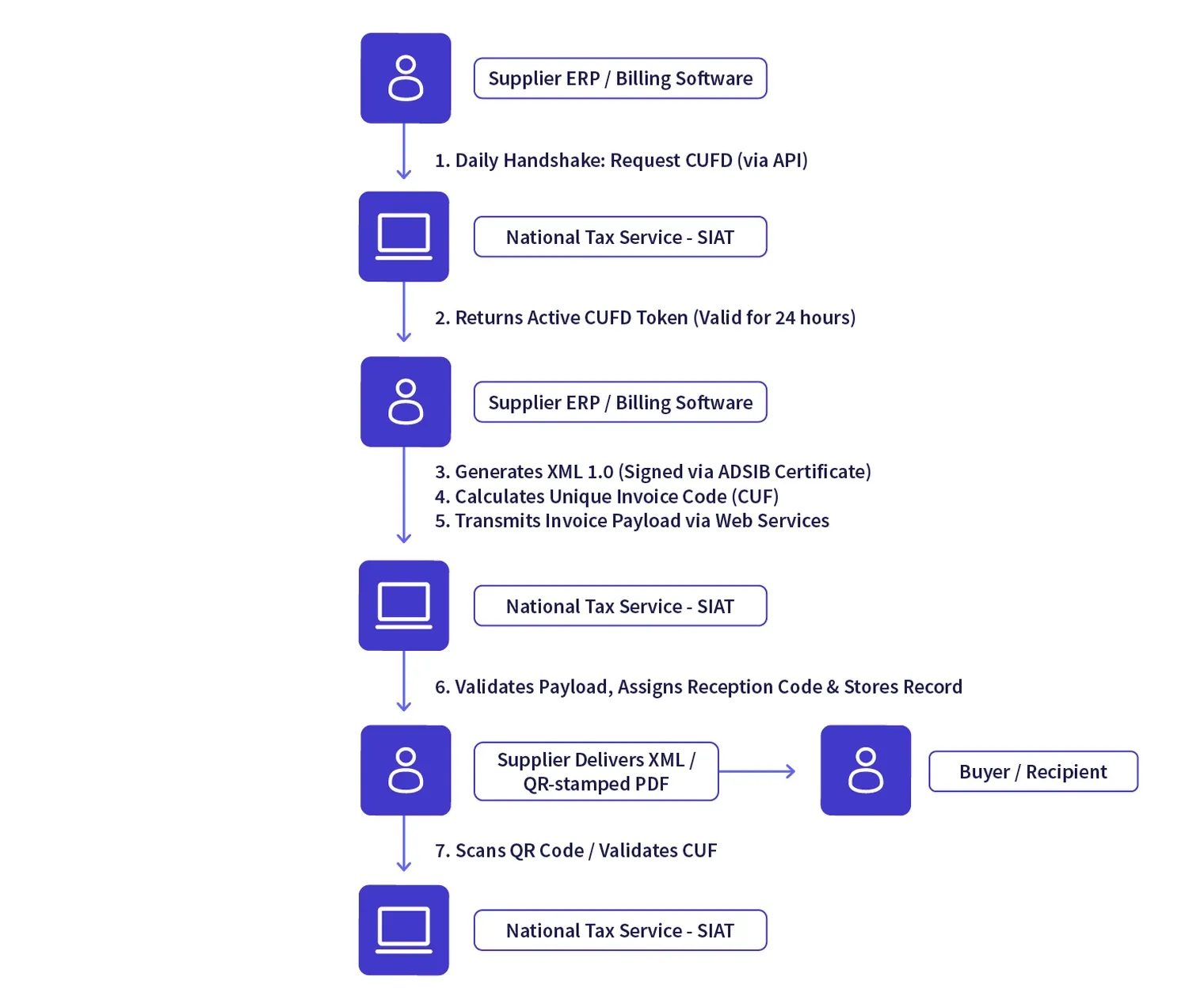
Under a system-based online mode, the issuer sends the applicable fiscal XML to SIN using authorised services. Electrónica en Línea uses a digital signature, while Computarizada en Línea uses a digital fingerprint. The SIN portal has a different issuance workflow. Receipt and document-level validation depend on the mode and submission type:
SIAT verifies the active validity of the taxpayer's CUIS and daily CUFD.
SIAT inspects the XML payload against the assigned sector XSD schema.
SIAT validates the ADSIB digital signature (for Electrónica en Línea).
SIN returns a response according to the submission type, including a receipt code where applicable. A package receipt is not proof that every invoice in that package has passed document-level validation.
How are contingency reporting and package transmissions handled?
Because connectivity outages can occur, Bolivian law establishes strict operational rules for offline contingencies. During an eligible contingency, taxpayers must use the contingency procedure authorised for their invoicing mode and record the relevant significant event. Special CUFD validity and alternative invoice procedures depend on the cause and circumstances of the outage.
After connectivity is restored, the issuer must submit contingency fiscal documents within the period and format required for the relevant event and mode. The 2025 framework compilation describes 48 hours for specified offline digital-document packages, but a separate 72-hour period for manually issued contingency documents. Digital signatures apply to Electrónica en Línea; Computarizada en Línea uses a fingerprint. Any invalidity or sanction must be linked to the applicable offence provision, rather than assumed automatically.
How are purchase and sales ledgers managed?
The SIN Registro de Compras y Ventas IVA (RCV) records fiscal purchases and sales and may receive data from online documents. Taxpayers may still need to review, supplement, confirm or submit records under the applicable rules, including periods without transactions. The RCV and VAT declaration are separate processes; the ordinary day-9 RCV rule in the June 2025 compilation is subject to period-specific extensions.
How are electronic invoices exchanged in Bolivia?
SIN operates a central fiscal-invoicing infrastructure. The process below illustrates a system-based online invoicing mode, not the SIN web portal, manual billing or every contingency case. The specific receipt, document validation and delivery steps depend on the mode and applicable technical rules:
How does the system certification process work?
Systems used for Electrónica en Línea and Computarizada en Línea must meet SIN's applicable system authorisation requirements before production use. The web-portal mode does not require every taxpayer to certify a proprietary ERP. Review the current SIN technical annex for the steps and testing scope.
Software developers must follow the cases and authorisation route required for their applicable SIN mode and technical-annex version. RND No. 102600000034 concerns adjustments to the system, but its original operative text and the reported 1 October to 16 November 2026 pilot window have not been verified in this audit. After completing the applicable SIN system-authorisation process, the software can be enabled for the relevant production mode and obtain the required codes. The exact test cases, approval evidence and CUIS activation steps must be confirmed against current SIN guidance.
What are the penalties for e-invoicing and VAT non-compliance in Bolivia?
Invoicing breaches can attract penalties under Law No. 2492 and applicable SIN sanction resolutions. The penalty depends on the precise breach, procedure, taxpayer and current relief rules. The amounts below must not be published without checking the offence-specific provisions.
RND No. 102600000025 provides routes for requesting cancellation after the ordinary deadline, depending on whether the VAT return has been filed. Approval is not automatic and may require supporting evidence and an administrative decision. Qualifying requests relating to older documents have a transitional cut-off on 30 November 2026.
What are the financial fines for formal duties?
Administrative penalties are calibrated in Housing Development Units (Unidades de Fomento de Vivienda, UFVs), a daily index-linked accounting unit tied to domestic inflation:
Operating an uncertified billing system: Using an unauthorised invoicing system may breach a formal tax duty. The current applicable offence category, amount and taxpayer classification must be confirmed from SIN's sanction schedule before a UFV figure is published.
Late submission of contingency packages: Late contingency submissions may constitute a formal-duty breach where the applicable deadline is missed. Deadlines differ by contingency procedure; a current legal source for the exact UFV penalty has not been established.
Failure to issue invoices under the assigned modality: Failure to use a legally required invoicing mode may trigger sanctions, but only where an applicable current duty and breach are established. The previous common start date for groups 9–12 under the repealed 2024 designations must not be used as an automatic penalty trigger.
When can a business lose its fiscal credit?
An invoice that fails relevant fiscal-document requirements can create VAT input-credit and expense-support risks. Whether a particular document is valid for tax-credit or income-tax purposes depends on the current substantive law, the issuer's applicable mode, the defect and any corrective procedure. There is no verified basis here to claim automatic denial of every credit or a customer's legal right to withhold payment for each technical error.
When do temporary establishment closures apply?
Failure to issue a required fiscal invoice can result in establishment closure under the Bolivian Tax Code. The sanction depends on the procedure and repeat-offence rules. Earlier SIN sanction schedules distinguish a three-day immediate-control procedure from the six-to-48-day range under other procedures, and identify special cases in which a fine may replace closure; their full current application requires checking.
How can businesses prepare for Bolivia's e-invoicing requirements?
Businesses with Bolivian fiscal-invoicing duties should confirm their SIN mode and prepare the required tax, accounting and system processes:
Check the current SIN assignment: Use the official NIT modality consultation service and review any current individual or sector-specific rule. RND No. 102600000038 repealed the original group 9–12 designations on 30 September 2026 and did not set one new date for all taxpayers.
Confirm digital-signature needs: If assigned to Facturación Electrónica en Línea, obtain and configure a certificate accepted under the current SIN and certification rules. Check certificate ownership, expiry and renewal requirements before production use.
Check ERP and schema readiness: For an authorised system-based online mode, assess the applicable SIN XML/XSD version and documented service methods. SIN material describes SOAP services; do not assume REST is an accepted alternative without verifying the current official interface.
For invoices issued in foreign currency: Implement the rate and field rules of RND No. 102600000026. The general rule refers to the Banco Central de Bolivia rate on the transaction date, with express exceptions for financial institutions, free zones, certain international-flight documents and commercial export invoices.
Manage CUFD validity where applicable: Check issuance and expiry for each authorised invoicing system and follow SIN's current renewal and contingency rules. A CUFD normally lasts 24 hours but may be requested more than once a day and may have authorised contingency extensions.
Prepare contingency handling: Record the relevant significant event, use the authorised offline or manual procedure, and submit outstanding documents within the deadline for that procedure. Historic rules distinguish 48-hour digital-package and 72-hour manual-contingency paths; only the electronic-signature mode uses the required digital signature.
Define retention and retrieval controls: Define retention and retrieval controls for fiscal documents, authorisation codes and related evidence. Confirm the applicable legal retention period, accepted storage format, access conditions and any rules on storage outside Bolivia before publishing a fixed number of years or claiming that a PDF alone is sufficient.
Complete any required SIN system authorisation: Businesses using their own or a provider's invoicing system should check the applicable testing and approval steps. Portal-only issuers need not be presented as developers certifying an ERP.
Review the SIN 2026 resolution register and the current technical annex. Confirm the signed text, scope and testing or authorisation dates under RND No. 102600000034 (SIN resolution register) before treating any reported pilot window as a legal deadline.
Conclusion
Bolivia's SIN invoicing framework combines online fiscal-document controls with other authorised modes and separate tax reporting. System-based online modes use XML, but signing, codes, contingency rules and RCV responsibilities depend on the applicable mode and legal requirements.
On 30 September 2026, RND No. 102600000038 repealed the four online-invoicing designations for groups 9–12 and their amendments, removing the basis for the previously planned common 1 October start. Businesses should confirm their current SIN assignment and any special rules, maintain the required VAT and RCV processes, and follow verified technical requirements. The commencement of Law No. 1733's new net-price VAT presentation and the detailed effect of RND No. 102600000034 require separate confirmation.
FAQ
No general group-based start follows from the four 2024 designations after RND No. 102600000038 repealed them and their amendments on 30 September 2026. SIN will periodically assign modes to VAT taxpayers who had not adopted an online mode as at that date. Existing individual and special legal duties may still apply.