
This article was updated on 2 October 2026 to reflect the enactment of the new Law on Fiscalisation of Transactions in the Federation of Bosnia and Herzegovina (published in Službene novine Federacije BiH, No. 9/26), establishing software-based fiscalisation and B2B/B2G electronic invoicing via the Central Fiscal Platform. It also incorporates ongoing rollouts under Republika Srpska's Electronic Fiscal System, the Indirect Taxation Authority's nationwide VAT reporting modernisation, and Bosnia and Herzegovina's alignment with European Union accession standards and the VAT in the Digital Age initiative.
Introduction & digital tax strategy
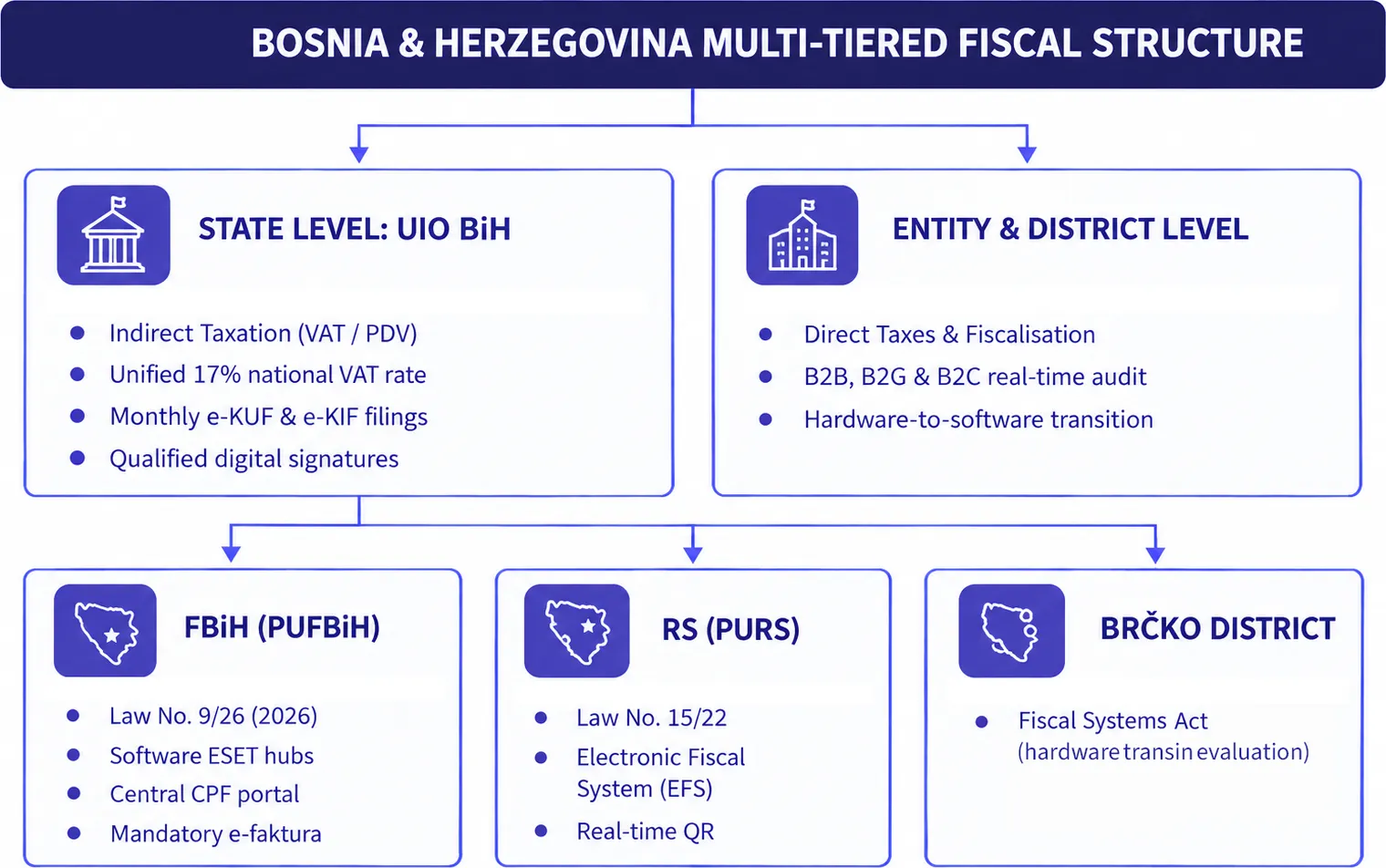
Bosnia and Herzegovina has separate fiscalisation frameworks in the Federation of Bosnia and Herzegovina, Republika Srpska and Brčko District, while VAT reporting is administered at state level by the Indirect Taxation Authority. The Federation enacted new electronic invoicing and transaction reporting legislation in February 2026, with implementation subject to phased deadlines. Commercial enterprises operating in the country face a multi-tiered regulatory framework shaped by the nation's unique constitutional structure. While Value Added Tax (VAT) administration is unified at the state level under the Indirect Taxation Authority of Bosnia and Herzegovina (Uprava za indirektno oporezivanje Bosne i Hercegovine - UIO BiH), direct business transaction recording and fiscal cash register enforcement are administered at the entity level by the Federation of Bosnia and Herzegovina (FBiH), Republika Srpska (RS), and the Brčko District.
The core motivation driving this reform is the eradication of the informal shadow economy, the closure of the domestic VAT collection gap, and the systematic phase-out of legacy hardware cash registers. Historically, businesses relied on offline fiscal printers fitted with physical fiscal memory and GPRS communication modules. These hardware devices created significant maintenance overheads, delayed audit visibility, and left commercial transactions susceptible to manipulation.
To resolve these structural inefficiencies, both primary entities have launched digital transformation roadmaps based on modern Continuous Transaction Controls (CTC):
The Federation of Bosnia and Herzegovina (FBiH) enacted the landmark Law on Fiscalisation of Transactions (Zakon o fiskalizaciji transakcija u Federaciji Bosne i Hercegovine), replacing hardware registers with certified software solutions (Elektronski sistem za evidentiranje transakcija - ESET) and introducing structured electronic invoicing (e-faktura) connected to a Central Fiscal Platform (Centralna fiskalna platforma - CPF).
Republika Srpska (RS) is completing the phased implementation of its new Electronic Fiscal System (Elektronski fiskalni sistem - EFS), linking certified electronic fiscal devices to a central fiscal server administered by the Tax Administration of Republika Srpska (Poreska uprava Republike Srpske - PURS).
At the state level, the Indirect Taxation Authority (UIO BiH) enforces mandatory electronic submission of monthly VAT returns and transactional books of incoming and outgoing invoices (e-KUF and e-KIF) via its digital tax portal, using qualified digital signatures.
This guide provides finance directors, tax advisors, and technology providers with an authoritative overview of how to digitalise invoicing workflows, integrate enterprise resource planning (ERP) engines with entity-level fiscal hubs, and ensure complete compliance across all administrative jurisdictions within Bosnia and Herzegovina.
Historical evolution & EU/global context
Understanding the trajectory of digital compliance in Bosnia and Herzegovina requires examining its constitutional distribution of fiscal powers, its progression from hardware fiscalisation, and its accelerating integration into the European Union regulatory sphere.
The progression from hardware fiscalisation to software Continuous Transaction Controls
The initial wave of transaction control in Bosnia and Herzegovina emerged between 2008 and 2011, when both Republika Srpska and the Federation of Bosnia and Herzegovina enacted their inaugural fiscalisation acts. These legacy frameworks mandated physical fiscal devices containing sealed thermal printers, read-only fiscal memory chips, and mobile SIM cards. Devices compiled end-of-day reports (dnevni izvještaji) and transmitted consolidated financial totals to regional tax servers via cellular networks during scheduled overnight windows.
While this hardware model established basic transactional discipline, it became technologically obsolete. It offered tax inspectors no real-time audit capabilities, failed to capture detailed line-item metadata, and generated considerable operational costs for small businesses required to purchase, service, and re-certify physical hardware annually.
Over the subsequent decade, regional neighbours demonstrated the efficacy of software-based validation. Croatia pioneered online cash register fiscalisation in 2013, followed by comprehensive B2G and B2B electronic invoicing mandates. More recently, Serbia deployed its centralised System eFaktura (SEF) alongside cloud-connected e-Fiskalizacija, creating a unified digital audit loop across all commercial sectors. Drawing from these successful regional models, authorities in Bosnia and Herzegovina initiated regulatory overhauls to transition from isolated hardware registers toward software-driven, cloud-integrated transaction validation.
European Union accession and Western Balkans harmonisation
Bosnia and Herzegovina received official European Union candidate status in December 2022, followed by the European Council's decision in March 2024 to open accession negotiations. This geopolitical convergence obligates the state to harmonise its legal and economic framework with the EU acquis communautaire, with particular emphasis on Chapter 16 (Taxation).
National digital tax initiatives are specifically aligned with two overarching European benchmarks:
Directive 2014/55/EU on electronic invoicing in public procurement: Directs contracting public authorities to receive and process structured electronic invoices conforming to the European standard EN 16931.
VAT in the Digital Age (ViDA): The EU package introduces mandatory digital reporting based on structured electronic invoices for covered intra-EU cross-border B2B transactions from 1 July 2030. Bosnia and Herzegovina is not an EU Member State, so these requirements do not automatically apply to domestic transactions. However, Article 3 of the Federation's 2026 fiscalisation law provides for partial alignment with Directive (EU) 2025/516.
By engineering new entity-level platforms to accept machine-readable XML structures based on European semantic guidelines, Bosnia and Herzegovina ensures that domestic businesses establishing automated digital pipelines today will remain fully compatible with upcoming pan-European interoperability networks.
Complete compliance timeline
The following structured table outlines key historical developments, recently enacted legislation, and upcoming enforcement milestones across all administrative levels in Bosnia and Herzegovina:
Date | Jurisdiction | Regulatory milestone | Operational impact |
1 January 2006 | State level (BiH) | Enactment of the Law on Value Added Tax (Zakon o porezu na dodatu vrijednost). | Replaced the legacy sales tax with a uniform 17% national VAT across all entities, administered by UIO BiH. |
2008 - 2011 | Entity level (RS & FBiH) | Passage of initial fiscalisation laws in Republika Srpska (2008) and the Federation of BiH (2010). | Implemented first-generation physical fiscal cash registers and GPRS communication terminals for retail sales. |
1 January 2019 | State level (BiH) | Mandatory electronic submission of VAT returns (PDV prijava) via the UIO BiH e-Porezi portal. | Phased out paper VAT declarations; digital certificates required for corporate tax filings. |
1 January 2021 | State level (BiH) | Mandatory electronic ledger filing for incoming (e-KUF) and outgoing (e-KIF) invoices. | Taxpayers must upload structured monthly CSV/XML transaction schedules to UIO BiH prior to filing VAT returns. |
February 2022 | Republika Srpska | Adoption of the new Law on Fiscalisation (Zakon o fiskalizaciji RS - Official Gazette No. 15/22). | Established the statutory framework for the Electronic Fiscal System (EFS) and digital transaction validation. |
December 2022 | International | European Union grants official candidate status to Bosnia and Herzegovina. | Formal commitment to harmonise tax laws with EU Directive 2014/55/EU and ViDA specifications. |
June 2024 | Republika Srpska | Rollout of Phase 1 of the Electronic Fiscal System (EFS) across initial taxpayer categories. | Transitioned registered enterprise groups to certified electronic fiscal devices issuing real-time QR codes. |
4 February 2026 | Federation of BiH | Publication of the new Law on Fiscalisation of Transactions in Službene novine FBiH, No. 9/26. | Enacted comprehensive software fiscalisation (ESET), electronic invoicing (e-faktura), and the Central Fiscal Platform. |
12 February 2026 | Federation of BiH | Formal entry into force of the Law on Fiscalisation of Transactions (FBiH). | Initiated the statutory 180-day window for the Federal Ministry of Finance to publish detailed technical rulebooks. |
August 2026 | Federation of BiH | Deadline for secondary implementing regulations and technical rulebooks. | Publication of technical XML schemas, validation rules, digital certificate criteria, and intermediary accreditation standards. |
31 August 2027 | Federation of BiH | Maximum statutory deadline for operational application of the new fiscalisation regime. | Full enforcement of real-time software transaction reporting and structured electronic invoicing via the CPF hub. |
2027 - 2030 | Federation of BiH | Transitional phase-out window for legacy hardware fiscal cash registers. | From the commencement of application, Article 86 provides up to two years for B2C compliance and up to three years for B2B and B2G compliance, subject to the detailed implementation schedule. Article 87 establishes a three-year transition for existing fiscal systems, with certain qualifying legacy systems permitted for up to four years. If application begins on 31 August 2027, the corresponding latest dates would fall in August 2029, August 2030 and August 2031. |
Taxation and commercial billing in Bosnia and Herzegovina are governed by concurrent legislative frameworks operating at both state and entity levels.
1. State-level indirect taxation and VAT legislation
The mandatory VAT registration threshold in Bosnia and Herzegovina is BAM 100,000 in taxable turnover. The threshold increased from BAM 50,000 to BAM 100,000 on 2 December 2023, following an amendment to the national VAT Act. VAT registration and administration are managed centrally by the Indirect Taxation Authority of Bosnia and Herzegovina (UIO BiH).
Law on Value Added Tax of Bosnia and Herzegovina (Zakon o porezu na dodatu vrijednost, published in Službeni glasnik BiH, Nos. 9/05, 35/05, 100/08, 33/17, and 46/23): Governs the general principles of invoice issuance, mandatory invoice content, VAT calculation, input tax deductions, and record-keeping periods.
Rulebook on the Application of the Law on VAT (Pravilnik o primjeni Zakona o porezu na dodatu vrijednost, Službeni glasnik BiH, Nos. 93/05, 21/06, 60/06, 6/07, 100/07, 35/08, 65/10, 85/17, and amendments): Details operational requirements for invoice data fields, credit notes, self-billing mechanisms, and electronic ledger maintenance (e-KUF and e-KIF).
Law on Electronic Signature of Bosnia and Herzegovina (Zakon o elektronskom potpisu BiH, Službeni glasnik BiH, No. 88/05): Sets the legal equivalence between handwritten signatures and advanced or qualified electronic signatures issued by accredited certification bodies.
2. Federation of Bosnia and Herzegovina (FBiH) fiscal legislation
Direct transaction reporting and commercial invoicing in the Federation are regulated under newly enacted legislation:
Law on Fiscalisation of Transactions in the Federation of Bosnia and Herzegovina (Zakon o fiskalizaciji transakcija u Federaciji Bosne i Hercegovine, published in Službene novine Federacije BiH, No. 9/26 on 4 February 2026, entered into force on 12 February 2026): The new law establishes a framework for software-based fiscalisation and electronic invoicing, replacing the legacy fiscal systems legislation through transitional provisions. Under Article 89, the existing Law on Fiscal Systems and its implementing regulations continue to apply until the new law becomes operational. Certain provisions of the previous framework remain applicable during the subsequent transition period. This statutory instrument mandates:
The transition from physical fiscal cash registers to software-based systems (ESET).
The establishment of the Central Fiscal Platform (CPF) operated by the Tax Administration of FBiH.
Real-time automated reporting of cash and non-cash commercial transactions.
Mandatory issuance of electronic invoices (e-faktura) for Business-to-Business (B2B) and Business-to-Government (B2G) commerce.
The technical and operational licensing of authorised intermediaries (ovlašteni posrednici).
Implementing decrees and technical rulebooks (forthcoming 2026): Regulations published by the Federal Ministry of Finance establishing data dictionaries, communication protocols, cryptographic standards, and validation workflows.
3. Republika Srpska (RS) fiscal legislation
Transaction monitoring in Republika Srpska operates under its dedicated modernised framework:
Law on Fiscalisation of Republika Srpska (Zakon o fiskalizaciji, published in Službeni glasnik Republike Srpske, No. 15/22): Governs the Electronic Fiscal System (EFS), defining taxpayer obligations, electronic fiscal device certifications, digital certificate integrations, and direct real-time communication with the Central Fiscal Server.
Secondary Rulebooks on Technical and Functional Specifications: Executive regulations enacted by the Ministry of Finance of Republika Srpska detailing cryptographic security elements, the generation of verifiable two-dimensional QR codes, and offline fallback procedures.
4. Brčko District legislation
Law on Fiscal Systems of the Brčko District of Bosnia and Herzegovina (Zakon o fiskalnim sistemima Brčko distrikta BiH, Službeni glasnik Brčko distrikta BiH, No. 45/16 and subsequent revisions): Governs local retail transaction recording, with administrative reviews underway to align local procedures with software-based reporting frameworks enacted in neighbouring entities.
Authorities
Given Bosnia and Herzegovina's administrative structure, several independent tax authorities and regulatory bodies oversee compliance:
Key regulatory bodies & authorities | ||
UIO BiH (State level) | PUFBiH (Federation level) | PURS (Republika Srpska) |
|
|
|
1. Indirect Taxation Authority of Bosnia and Herzegovina (UIO BiH)
The Indirect Taxation Authority (Uprava za indirektno oporezivanje Bosne i Hercegovine - UIO BiH), headquartered in Banja Luka with regional centres in Sarajevo, Mostar, Banja Luka, and Tuzla, is the sole state-level authority responsible for collecting and administering indirect revenues:
Collects nationwide Value Added Tax, customs duties, and excises.
Operates the central e-Porezi portal for electronic tax filing.
Receives mandatory monthly transaction ledgers (e-KUF and e-KIF).
Serves as an accredited qualified electronic certification service provider (ovjerilac za izdavanje kvalifikovanih elektronskih potvrda), issuing qualified digital certificates for secure electronic tax reporting.
2. Tax Administration of the Federation of Bosnia and Herzegovina (PUFBiH)
The Tax Administration of the Federation of Bosnia and Herzegovina (Porezna uprava Federacije Bosne i Hercegovine - PUFBiH), headquartered in Sarajevo:
Administers direct taxes (corporate income tax, personal income tax) and compulsory social contributions across the ten cantons of the Federation.
Supervises the fiscalisation of business transactions under Law No. 9/26.
Owns, manages, and operates the Central Fiscal Platform (Centralna fiskalna platforma - CPF).
Issues technical certifications for software-based electronic recording systems (ESET) and oversees the licensing of authorised service intermediaries.
3. Tax Administration of Republika Srpska (PURS)
The Tax Administration of Republika Srpska (Poreska uprava Republike Srpske - PURS), based in Banja Luka:
Oversees direct revenue collection and corporate taxation within the territory of Republika Srpska.
Operates the Central Fiscal Server (Centralni fiskalni server - CFS) within the modernized Electronic Fiscal System (EFS).
Monitors real-time transaction streams, validates digital cryptographic signatures, and conducts automated cross-checks against registered commercial accounts.
4. Brčko District Tax Administration
The Tax Administration of the Brčko District (Porezna uprava Brčko distrikta BiH):
Administers local corporate income taxes and supervises local transaction recording systems for entities registered within the autonomous district.
5. Public Procurement Agency of Bosnia and Herzegovina (AJN)
The Public Procurement Agency (Agencija za javne nabavke BiH - AJN):
Operates the national public procurement electronic portal (Portal javnih nabavki - e-Nabavke).
Coordinates regulatory convergence with EU Directive 2014/55/EU, facilitating the reception and processing of electronic invoices by public contracting authorities.
Which e-invoicing and fiscalisation rules apply in Bosnia and Herzegovina?
The compliance scope in Bosnia and Herzegovina encompasses business, government, and consumer commercial transactions, split across entity lines and administrative reporting mechanisms.
Transaction scope mapping table | ||
Transaction type | Legal requirement | Technical transmission mechanism |
B2G (domestic) | Enacted (phased rollout) | Structured e-invoices routed through CPF (FBiH) and public procurement systems |
B2B (domestic) | Enacted (phased rollout) | Real-time software reporting via ESET / CPF in FBiH; EFS in RS; monthly e-KUF/KIF |
B2C (retail) | Mandatory (live) | Real-time digital fiscal receipt with QR code linking to tax authority validation |
Cross-border imports/exports | Excluded from real-time CTC | Documented via customs declarations and recorded in monthly state-level e-KUF/KIF |
Business-to-Government (B2G) transactions
Public procurement supplies are subject to mandatory digital verification:
Under Article 16 of Law No. 9/26, B2G invoices in the Federation of Bosnia and Herzegovina must be issued, sent and accepted electronically once the relevant requirements become applicable. An exemption applies to specific defence and security contracts where procurement or contract performance is classified or requires special security measures and the essential interests concerned cannot be protected by less restrictive measures.
Contracting authorities must possess the technical infrastructure to receive, validate, and electronically archive supplier invoices, preventing public treasury disbursements against non-fiscalised paper or unverified PDF invoices.
Supplying vendors registered in Republika Srpska must issue transactions through certified electronic fiscal devices, generating digital fiscal records registered on the Central Fiscal Server.
Business-to-Business (B2B) transactions
Commercial wholesale and inter-company transactions are transitioning from retrospective paper invoicing to automated Continuous Transaction Controls:
Federation of BiH: Under Article 15 of Law No. 9/26, structured electronic invoices must be issued, exchanged and accepted for B2B transactions paid, or due to be paid, by non-cash or combined payment methods. The requirement becomes operational according to the law's implementation and transitional provisions. Other transactions are subject to the applicable fiscal receipt requirements. The legislation expressly covers non-cash commercial transactions (wire transfers, bank payments, corporate accounts), which were largely exempt from real-time transmission under the previous 2010 fiscal systems act.
Republika Srpska: B2B transactions settled through corporate accounts are recorded within the Electronic Fiscal System, where invoices carry unique fiscal identity codes and verification parameters.
State-level baseline (BiH-wide): Irrespective of entity registration, all VAT-registered businesses engaged in B2B commerce must continue reporting transaction metadata monthly to UIO BiH via structured e-KUF (purchases) and e-KIF (sales) ledger filings.
Business-to-Consumer (B2C) transactions
Retail points of sale, catering establishments, and consumer service providers face universal real-time fiscalisation requirements:
Retail merchants must issue fiscal receipts containing mandatory security elements, including a system-generated cryptographic verification code and a two-dimensional QR code.
Consumers can scan the printed or digital QR code using mobile smartphones to immediately verify that the transaction was officially registered on the tax authority database.
In the Federation of BiH, the transition moves B2C points of sale from physical thermal hardware registers to software-based POS applications integrated with local or cloud fiscal engines.
Cross-border and export transactions
Cross-border supplies (international imports and exports) remain subject to standard customs clearance documentation and national VAT export exemption procedures. While cross-border commercial invoices issued to foreign trading partners do not pass through domestic entity clearance engines (such as CPF), their transactional summaries must be classified and declared within state-level e-KUF and e-KIF ledgers submitted to UIO BiH.
Statutory exemptions
Under entity-level legislation, narrow statutory exemptions apply to specific non-commercial and state activities:
Official administrative and consular operations of public bodies.
Universal postal services provided by designated public operators.
Regulated financial and insurance activities where transaction recording is governed by specialised banking legislation.
Certain non-profit health, educational, and social care services conducted without commercial consideration.
E-invoicing requirements
The transition to electronic invoicing across Bosnia and Herzegovina establishes precise technical criteria for structured data generation, electronic signatures, and long-term digital preservation.
Technical specifications and structured formats
Standard commercial PDFs, scanned image attachments, and word-processing documents do not meet the legal definition of an electronic invoice:
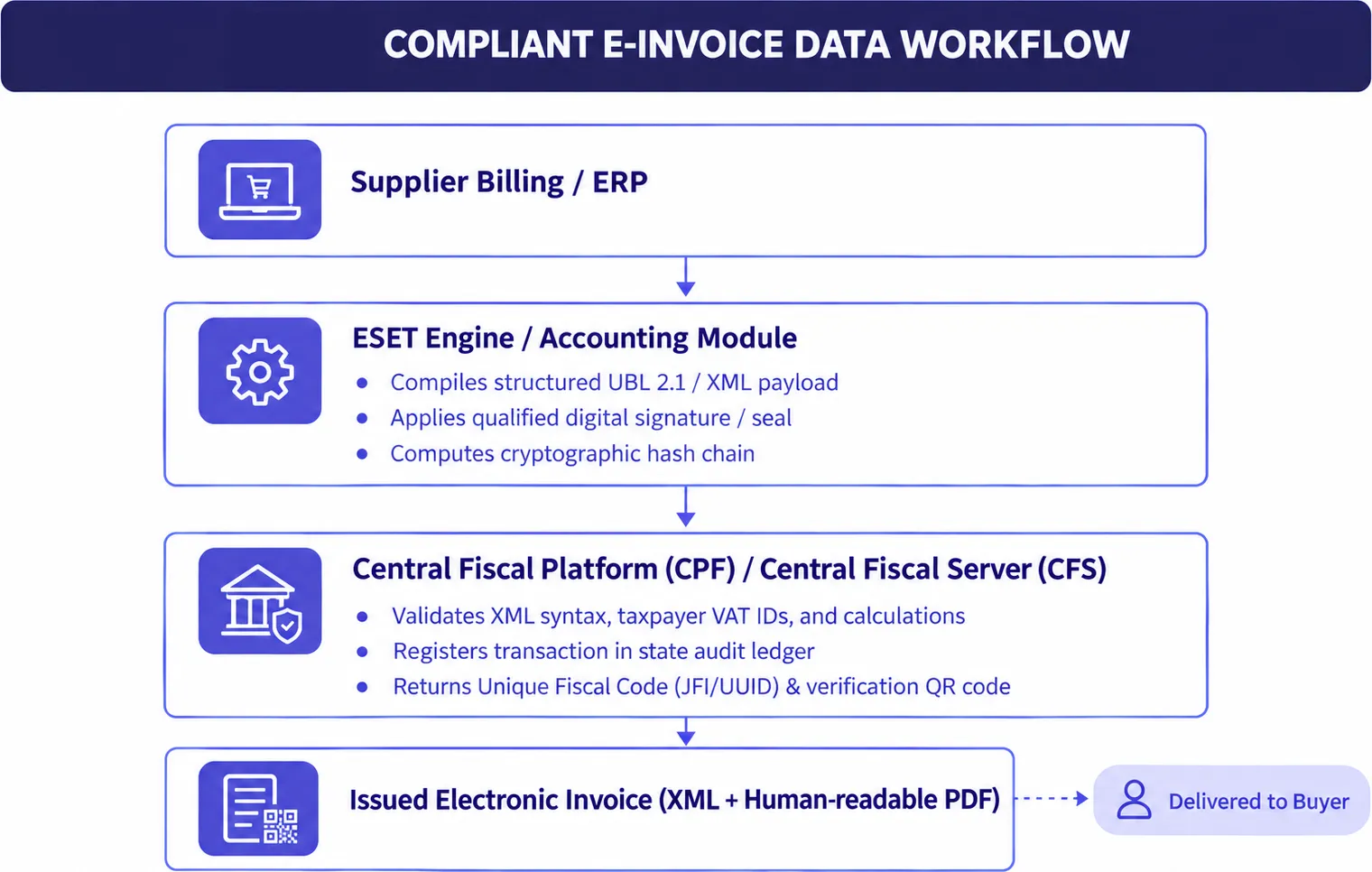
Semantic model: Electronic invoices must conform to structured XML syntax, incorporating the core semantic components of the European standard EN 16931.
Syntax binding: The Federation's Law on Fiscalisation of Transactions requires structured electronic invoices compliant with EN 16931. The legislation does not itself prescribe UBL 2.1 as the exclusive mandatory syntax. Businesses should verify the supported formats, schema versions and validation requirements against the applicable technical regulations before implementing production integrations.
Mandatory invoice fields:
Unique invoice identification number and continuous sequential numbering.
Exact date of issuance and date of supply.
Full corporate name, legal seat, and physical address of both supplier and purchaser.
Unique Tax Identification Number (Jedinstveni identifikacioni broj - JIB) and VAT Registration Number (PDV broj) issued by UIO BiH.
Granular line-item descriptions, including quantities, unit prices net of VAT, and applied VAT rates (standard 17% or statutory exempt categories).
Total taxable base amount, total calculated VAT, and gross invoice sum.
Unique fiscal identification code and dynamic cryptographic QR code containing the verification URL.
Digital signatures and identity verification
To guarantee authenticity of origin and data integrity, electronic invoices must be secured using qualified electronic signatures or digital certificates:
Electronic signatures must comply with the Law on Electronic Signature of Bosnia and Herzegovina.
Digital certificates can be obtained from accredited certification authorities, such as the qualified trust service operated by the Indirect Taxation Authority (UIO BiH) or registered commercial trust service providers (such as the certification centres of BH Pošta and Halcom).
In Republika Srpska's EFS, electronic fiscal devices must incorporate approved security components containing digital cryptographic keys provided during taxpayer device initialisation.
Electronic archiving and record retention
Taxpayers must preserve electronic business records under strict statutory conditions:
Retention period: Invoice retention periods must be assessed under the national VAT provisions and the applicable entity-level accounting legislation. In the Federation of Bosnia and Herzegovina, accounting documents supporting entries in the general ledger and journal must generally be retained for at least ten years, while certain documents supporting subsidiary ledgers are subject to a five-year minimum. Under the Federation's new fiscalisation law, the Tax Administration must retain invoices for at least eleven years.
Format preservation: Invoices must be retained in their original, unmanipulated structured XML format alongside their associated cryptographic signatures, status receipts, and validation logs.
Continuous accessibility: Under Article 26 of the Federation's new fiscalisation law, digital transaction records must be archived in full, remain unchanged and be protected against unauthorised access. The law requires these transaction data archives to be maintained within the territory of the Federation. Businesses considering cloud storage or third-party archiving must therefore verify data residency, security and continuity requirements before selecting a service provider-
What e-reporting is mandatory in Bosnia and Herzegovina?
A central operational distinction in Bosnia and Herzegovina is the parallel co-existence of real-time transaction e-reporting at the entity level and periodic digital ledger reporting at the state level.
1. Entity-level real-time transaction reporting (ESET & EFS)
Under the new Federation Law on Fiscalisation of Transactions (Law No. 9/26), transaction data reporting is directly integrated into the billing lifecycle:
Transmission mechanism: Under the Federation's new fiscalisation framework, ESET will exchange transaction data with the Central Fiscal Platform using the prescribed secure communication mechanisms. The final payload structure, authentication requirements and supported API protocols must be confirmed against the applicable technical regulations and official implementation documentation.
Reporting contents: The payload includes supplier and buyer tax identifiers, line-item tax rates, net sums, VAT totals, and timestamp metadata.
Clearance response: The CPF validates the transmission, registers the record, and returns an electronic verification response containing the official registration code.
Offline fallback protocol: The Federation law establishes separate procedures for internet connection failures, ESET malfunctions and locations without an available internet connection. Under Article 67, an interruption of an established internet connection generally requires restoration and subsequent submission within 48 hours, subject to specified exceptions. Article 68 covers ESET failures, while Article 69 permits an approved offline procedure for locations without connectivity, with monthly reporting by the 10th day of the following month.
Republika Srpska equivalent: The EFS operates on a corresponding principle, wherein electronic fiscal devices securely post each commercial transaction to the Central Fiscal Server, receiving cryptographic confirmation before the sale is finalised.
2. State-level periodic digital ledger reporting (e-KUF and e-KIF)
At the state level, all VAT-registered entities must comply with mandatory monthly transaction reporting to UIO BiH:
The e-KUF schedule: The Electronic Book of Received Invoices (Knjiga ulaznih faktura) captures every inbound commercial bill, customs import document, and input VAT credit claimed during the tax period.
The e-KIF schedule: The Electronic Book of Issued Invoices (Knjiga izlaznih faktura) details every outbound commercial invoice, retail daily summary, export declaration, and calculated output VAT liability.
Submission deadline: VAT-registered businesses must submit their monthly VAT returns through the UIO BiH e-Porezi portal by the 10th day of the following month, subject to applicable deadline adjustments. Electronic purchase and sales ledger records are submitted separately by the 20th day of the following month. These electronic ledger submissions use the prescribed CSV format.
Reconciliation and audit controls: The Indirect Taxation Authority deploys automated server algorithms to cross-check suppliers' reported e-KIF records against buyers' claimed e-KUF deductions. Unmatched tax identification numbers, duplicate invoice sequences, or divergent VAT amounts trigger automated audit flags and immediate administrative inquiries.
Technical architecture
The digital tax architecture of Bosnia and Herzegovina combines elements of centralised clearance and decentralised communication via accredited intermediaries.
Architectural models across jurisdictions
Centralised Clearance Component (FBiH CPF & RS CFS): Unlike purely decentralised four-corner Peppol frameworks that operate without central government hubs, transaction recording in Bosnia and Herzegovina routes critical tax data through state-managed platforms. The Central Fiscal Platform (CPF) in the Federation and the Central Fiscal Server (CFS) in Republika Srpska act as authoritative state clearinghouses. A document is not legally recognized as a compliant fiscal invoice until it has been registered, stamped, or issued with a validated fiscal verification code.
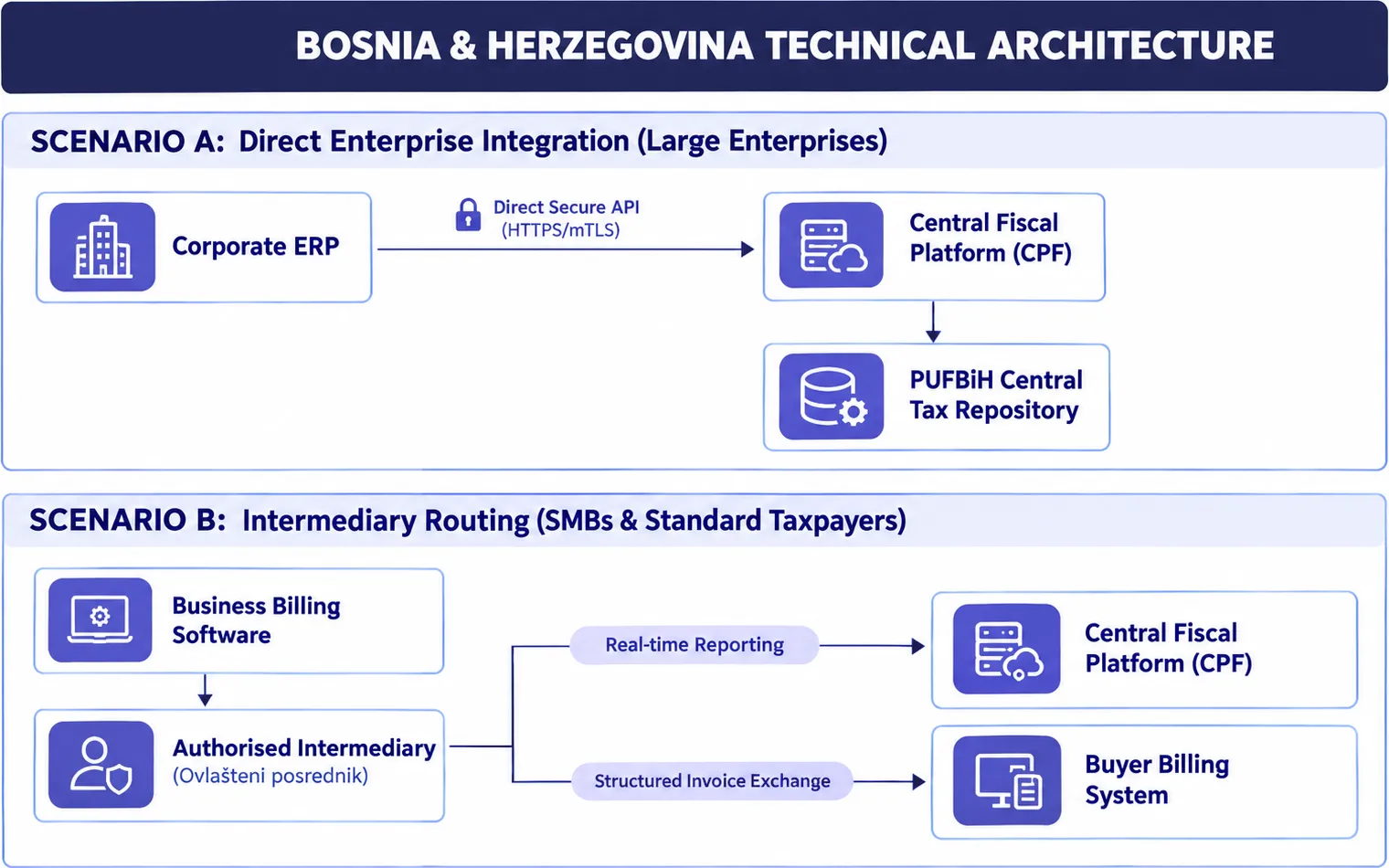
Direct Integration Model: Large corporations, financial institutions, and telecommunication operators possessing mature IT environments can integrate their enterprise systems (such as SAP, Oracle, or Microsoft Dynamics 365) directly with the tax authority API. Communication relies on secure web services (REST/JSON or SOAP/XML) secured via mutual TLS (mTLS) and qualified corporate digital certificates.
Authorised Intermediary Model (Ovlašteni posrednici): To protect small and medium-sized enterprises (SMBs) from excessive software development costs, the FBiH framework establishes a formal licensing regime for commercial information intermediaries (posrednici). These certified service providers host secure cloud hubs that:
Ingest diverse invoicing data from local billing engines.
Map proprietary accounting records into compliant EN 16931-aligned XML payloads.
Apply cryptographic signatures and route data streams to the CPF.
Transmit the validated electronic invoice directly to the purchaser's accounting application.
Comparison with regional implementations: Bosnia's emerging framework shares structural similarities with the centralized model deployed in Serbia (System eFaktura - SEF), which concentrates invoice clearance and status management inside a single public cloud platform. However, because Bosnia and Herzegovina must concurrently navigate multiple entity tax jurisdictions, software vendors must maintain modular architectures capable of interfacing with the FBiH CPF, the RS CFS, and the nationwide UIO BiH VAT repository.
Penalties
Statutory compliance across Bosnia and Herzegovina is enforced through severe monetary fines, administrative sanctions, and commercial operating prohibitions.
1. Federation of Bosnia and Herzegovina statutory fines (Law No. 9/26)
Chapter IV of the Law on Fiscalisation of Transactions details penalties for non-compliance:
Legal entities (pravna lica): Under Article 83 of the Federation's Law on Fiscalisation of Transactions, legal entities face fines of BAM 8,000 to BAM 30,000 for serious offences, including failures to issue, exchange or accept electronic invoices where required. Article 84 provides fines of BAM 5,000 to BAM 18,000 for specified less serious offences. The applicable penalty depends on the particular statutory breach. .
Escalation for repeated offences: If a business commits a repeat violation within two years of a previous sanction, the statutory fine is automatically increased by 50% of the prescribed amount.
Sole traders and individual entrepreneurs (fizička lica / preduzetnici): Independent sole proprietors face fines between BAM 2,000 and BAM 10,000 for corresponding fiscalisation breaches.
Responsible corporate officers (odgovorna lica): Company directors and finance managers face personal liability fines ranging from BAM 1,000 to BAM 6,000.
Authorised intermediaries (ovlašteni posrednici): Intermediary service providers that fail to maintain system security, misreport transaction streams, or violate service level continuity rules face dedicated penalties up to BAM 40,000, alongside immediate revocation of their operating license.
2. Operational prohibitions and business closures
Beyond financial penalties, tax administrations wield extensive executive authority to halt commercial activity:
Temporary business closures: In the Federation of Bosnia and Herzegovina, Articles 79 and 80 of Law No. 9/26 prescribe a 90-day prohibition on business operations for specified breaches involving unapproved or missing ESET systems and failures to issue required fiscal documents. A repeated offence within one year can result in a 120-day prohibition. Republika Srpska's enforcement provisions must be assessed separately under its own legislation.
Hardware confiscation: Any unapproved, tampered, or modified billing devices found on commercial premises are subject to immediate seizure.
3. Disallowance of input VAT deductions
The most significant commercial liability for corporate buyers is the potential disqualification of input tax credits:
Under Article 32 of the Law on Value Added Tax, taxable persons can only claim input VAT deductions based on legally valid invoices containing all mandatory statutory particulars.
Input VAT deductions are governed by Article 32 of the national VAT Act and the applicable implementing rules. Businesses must hold appropriate supporting documentation and satisfy the statutory conditions for deduction. Failures to comply with entity-level fiscalisation requirements may create additional legal and audit risks, but the loss of input VAT deduction should not be presented as an automatic consequence of every missing platform validation or unstructured invoice.
For the commercial buyer, this converts a routine operational cost into an immediate 17% non-deductible tax assessment, accompanied by statutory late-payment interest charges and administrative tax penalties.
How businesses can prepare
Businesses operating in Bosnia and Herzegovina should identify the fiscalisation rules that apply in each jurisdiction and assess their invoicing, reporting and archiving systems against the relevant requirements and implementation deadlines.
1. Perform a comprehensive jurisdictional footprint assessment
Because transaction rules differ by administrative territory, enterprises must analyse where their operational branches, sales offices, and subsidiaries reside:
Identify all entities registered in the Federation of BiH, evaluating their timeline for transitioning from legacy fiscal printers to certified software ESET solutions.
Audit business locations in Republika Srpska to confirm that electronic fiscal devices comply with the active requirements of PURS.
Segregate commercial billing pipelines between B2C consumer cash registers, B2B wholesale ledgers, and B2G public procurement contracts.
2. Cleanse and validate enterprise master data
Tax authority platforms instantly reject transaction payloads containing invalid tax identifiers or malformed directory records:
Verify that customer and vendor master files maintain complete 13-digit Unique Tax Identification Numbers (Jedinstveni identifikacioni broj - JIB).
Confirm 12-digit VAT identification numbers (PDV broj) against the active online registers of the Indirect Taxation Authority (UIO BiH).
Standardise billing line items, ensuring product and service codes map correctly to standard VAT classifications (17% standard rate vs exempt codes).
3. Acquire qualified digital certificates
Businesses must obtain approved digital credentials to sign electronic transactions and access administrative tax portals:
Verify the currently authorised providers and supported certificate types before obtaining qualified electronic signing credentials. In July 2026, UIO BiH confirmed that certificates it had already issued would remain valid until expiry, following a personal data protection decision restricting the authority's processing of personal data for issuing qualified certificates. Businesses should confirm current certificate issuance arrangements directly with the relevant authorities and trust service providers.
Ensure digital signing components integrate directly with internal ERP systems or billing engines to enable automated, non-manual document signing.
4. Evaluate billing systems and select an integration path
Enterprises must decide between establishing direct technical connections or partnering with an accredited service provider:
Large enterprise route: If operating high transaction volumes, review internal IT capabilities to build and maintain direct API interfaces with the FBiH Central Fiscal Platform (CPF) using secure HTTPS/mTLS protocols.
SMB and intermediary route: For the vast majority of commercial operators, partner with an authorised intermediary (ovlašteni posrednik). A certified intermediary abstracts complex XML schemas, handles real-time tax validation routines, and routes structured electronic invoices directly between trading partners.
5. Automate accounts payable (AP) verification
Given that input VAT recovery depends strictly on receiving valid, verified fiscal records, finance departments must automate incoming invoice controls:
Establish automated workflows to ingest, validate, and verify incoming structured XML invoices.
Implement verification checks to confirm that the supplier's invoice carries the mandatory registration code issued by the entity platform (CPF or EFS).
Integrate accounts payable sub-ledgers directly with the monthly e-KUF reporting engine to eliminate discrepancies prior to submission to UIO BiH.
6. Establish compliant long-term digital archiving
Replace physical filing binders with secure, tamper-proof electronic storage:
Ensure archiving systems store the native structured XML file, the associated electronic signature, and the tax authority verification receipt.
Enforce storage integrity protocols to satisfy the statutory 5-year retention mandate under the Law on VAT.
Conclusion
The digital tax transformation of Bosnia and Herzegovina represents a fundamental shift in how commercial enterprises record sales, validate invoices, and report fiscal data. The transition moves the national economy away from outdated, disconnected hardware registers toward modern, software-driven Continuous Transaction Controls (CTC).
By enacting the Law on Fiscalisation of Transactions (Law No. 9/26), the Federation of Bosnia and Herzegovina has established a modern foundation for software-based transaction recording and structured B2B/B2G electronic invoicing centered on the Central Fiscal Platform (CPF). Concurrently, Republika Srpska continues to consolidate transaction oversight through its Electronic Fiscal System (EFS), while the Indirect Taxation Authority (UIO BiH) enforces digital ledger reconciliation (e-KUF and e-KIF) across the entire state.
For businesses operating across the country, compliance requires navigating both state-level indirect tax rules and distinct entity-level fiscal architectures. Ensuring success demands immediate action: cleansing enterprise master data, upgrading accounting and ERP systems to support EN 16931-aligned XML generation, securing qualified digital certificates, and selecting an experienced technology partner or authorised intermediary. Organisations that proactively modernise their billing processes today will not only insulate themselves against severe financial penalties and VAT deduction disallowances, but also achieve streamlined operations, lower administrative overhead, and full readiness for Europe's unified digital marketplace.
FAQ
No. An unstructured PDF invoice delivered via email does not satisfy the legal definition of an electronic invoice under the new regulatory frameworks. Under the FBiH Law on Fiscalisation of Transactions (Law No. 9/26) and EU-aligned standards, an electronic invoice must be generated in a structured, machine-readable format (such as UBL 2.1 XML), digitally signed, and registered on the Central Fiscal Platform (CPF) or Electronic Fiscal System (EFS). Standard PDFs remain acceptable purely as human-readable visual copies accompanying the underlying structured XML file.