
This article was updated on 2 October 2026 to reflect the operational enforcement of Croatia's mandatory B2B electronic invoicing and continuous transaction reporting regime under the Fiskalizacija 2.0 framework. It incorporates enacted provisions from the Fiscalisation Act (Zakon o fiskalizaciji, Narodne novine No. 89/2025), the implementing Ordinance on e-Invoices (Pravilnik o eRačunu, Narodne novine No. 11/2026), the operational rollout of the Address Management System (AMS), dual fiscalisation mechanics (JIR and ZKI), and preparation guidelines for the upcoming 1 January 2027 Phase 2 mandate.
Introduction & digital tax strategy
Croatia introduced mandatory structured electronic invoicing and transaction-level digital reporting for covered domestic B2B transactions on 1 January 2026. The first phase applies to VAT-registered taxpayers, while additional issuance obligations for non-VAT taxpayers begin on 1 January 2027. Building upon more than a decade of experience with cash-register fiscalisation and public procurement electronic billing, the Croatian Government has extended Continuous Transaction Controls (CTCs) and structured electronic invoicing across the entire domestic private sector. The strategic momentum behind this mandate is clear: eliminating the national Value Added Tax (VAT) collection shortfall, eradicating carousel fraud, modernising corporate accounting workflows, and automating tax reporting directly from source ledgers.
Unlike clearance architectures that require government pre-approval before a commercial document can reach a buyer, Croatia has established a decentralised Continuous Transaction Controls (CTC) and exchange model. Commercial entities exchange structured electronic invoices (e-Račun) directly or through accredited information intermediaries (informacijski posrednici) and the Peppol network, while simultaneously clearing cryptographic transaction payloads with the Tax Administration (Porezna uprava).
Crucially, the reform introduces an innovative dual fiscalisation mechanism. Both the invoice issuer and the invoice recipient must electronically register document lifecycle events with the central tax authority database. By verifying both sales and purchases in near real-time, the Tax Administration achieves complete transactional symmetry across domestic supply chains.
The Croatian government has co-funded the Fiskalizacija 2.0 project through the European Union Recovery and Resilience Facility (RRF). The comprehensive project scope goes far beyond simple invoice exchange: it introduces a national Address Management System (AMS), integrated digital e-archiving, automated bookkeeping reconciliations, and the future phase-out of traditional periodic VAT control returns (Obrazac U-RA and Obrazac I-RA). For domestic enterprises and multinational businesses registered for VAT in Croatia, compliance is an operational necessity.
Historical evolution & EU/global context
Croatia's transition to mandatory business-to-business electronic invoicing represents the culmination of a multi-stage legislative evolution that spans over thirteen years:
Cash fiscalisation (Fiskalizacija 1.0, 2013): On 1 January 2013, Croatia introduced the Law on Fiscalisation in Cash Transactions (Zakon o fiskalizaciji u prometu gotovinom). This framework pioneered real-time electronic fiscalisation for point-of-sale cash and card transactions, requiring cash registers to communicate with the Tax Administration via internet protocols to obtain a Unique Invoice Identifier (Jedinstveni identifikator računa - JIR).
Public sector e-invoicing (B2G e-Račun, 2019): Transposing European Union Directive 2014/55/EU, Croatia enacted the Law on Electronic Invoicing in Public Procurement (Zakon o elektroničkom izdavanju računa u javnoj nabavi, Narodne novine No. 94/2018). Effective from 1 July 2019, all suppliers to public bodies became legally obligated to issue structured electronic invoices compliant with the European standard EN 16931 via the central state portal Servis e-Račun za državu, operated by the Financial Agency (Financijska agencija - FINA).
National Recovery and Resilience Plan & Fiskalizacija 2.0 (2021 - 2025): Recognising that unstructured paper and PDF invoices across the private sector hindered tax transparency, the Croatian Government formally initiated Projekt Fiskalizacija 2.0. Parliament approved the legislative package in June 2025, modernising the entire fiscalisation code.
Alignment with the European Union ViDA initiative: Croatia designed Fiskalizacija 2.0 to align seamlessly with the European Commission's VAT in the Digital Age (ViDA) package. By establishing structured semantic standards based on EN 16931 (UBL 2.1 syntax) and building a decentralised exchange infrastructure, Croatia ensures domestic businesses can adapt effortlessly when mandatory digital reporting requirements (DRR) for intra-Community supplies take effect across the European Union on 1 July 2030.
Complete compliance timeline
The following table summarises the historical milestones and mandatory implementation phases defining Croatia's electronic invoicing and digital fiscalisation roadmap:
Date | Milestone | Legal & operational scope |
1 January 2013 | Fiskalizacija 1.0 Go-Live | Mandatory online fiscalisation of cash and payment card receipts for retail (B2C) transactions. |
1 July 2019 | Mandatory B2G E-Invoicing | Public procurement suppliers must issue structured electronic invoices (e-Račun) via FINA or connected intermediaries. |
6 June 2025 | Enactment of the Fiscalisation Act | Croatian Parliament (Hrvatski sabor) passes the new Fiscalisation Act (Zakon o fiskalizaciji), published in Narodne novine No. 89/2025. |
1 September 2025 | Statutory Entry into Force | Formal entry into legal force of the Fiscalisation Act, opening registration for the Address Management System (AMS). |
1 January 2026 | Phase 1 Go-Live: VAT-Registered Entities | Mandatory domestic B2B e-invoice issuance and receipt for all VAT-registered taxpayers, combined with dual fiscalisation. Mandatory reception for non-VAT businesses. Expansion of B2C fiscalisation to all non-cash payment methods. |
30 January 2026 | Publication of the Ordinance on e-Invoices | The Ministry of Finance published the Ordinance on e-Invoices (NN 11/2026), establishing detailed rules for e-invoice exchange, application certificates, AS4 communication, metadata services and fiscalisation procedures. Technical specifications and validators are maintained separately through official Tax Administration documentation. |
1 January 2027 | Phase 2 Go-Live: Universal Mandate | Mandatory issuance of fiscalised electronic invoices extends to non-VAT registered businesses, sole traders (obrtnici), liberal professions, and non-VAT public entities. Complete domestic phase-out of commercial paper billing. |
1 July 2030 | EU ViDA Harmonisation | Full operational alignment with EU-wide digital reporting requirements for cross-border intra-Community transactions. |
Legal framework
Croatia's digital compliance framework is anchored in comprehensive primary and secondary statutes that define the legal validity, formatting standards, and audit requirements for electronic documents:
Primary legislation
The Fiscalisation Act (Zakon o fiskalizaciji): Passed by the Croatian Parliament on 6 June 2025 and promulgated in the Official Gazette (Narodne novine No. 89/2025). This act replaces legacy cash fiscalisation rules and establishes the legal mandate for B2B structured electronic invoicing, dual fiscalisation reporting, the Address Management System (AMS), and automated tax ledger creation.
The Value Added Tax Act (Zakon o porezu na dodanu vrijednost): Published in Narodne novine No. 73/2013 with subsequent amendments. The act defines taxable events, invoice issuance timeframes, deduction rights, and mandatory VAT invoice elements.
The Law on Electronic Invoicing in Public Procurement (Zakon o elektroničkom izdavanju računa u javnoj nabavi): Published in Narodne novine No. 94/2018. It transposes Directive 2014/55/EU into Croatian domestic law and regulates public sector (B2G) electronic billing.
Secondary regulations and executive ordinances
The Ordinance on e-Invoices (Pravilnik o eRačunu, NN 11/2026) sets out the detailed rules for e-invoice exchange and fiscalisation, including AS4 communication, application certificates, metadata services and technical interoperability. The Tax Administration publishes the relevant e-invoice specifications, schemas and validation tools separately.
Ordinance on Fiscalisation (Pravilnik o fiskalizaciji): Specifies technical communication protocols between taxpayer billing systems and the central servers of the Tax Administration, defining XML message payloads, encryption cyphers, and validation responses.
European Semantic Standard EN 16931: Standard EN 16931-1:2017 defines the underlying data dictionary and semantic model, applied in Croatia via the national Croatian Core Invoice Usage Specification (HR-CIUS).
Competent authorities & system operators
The governance of Croatia's electronic invoicing and fiscalisation infrastructure involves several specialised statutory bodies:
Ministry of Finance - Tax Administration (Ministarstvo financija - Porezna uprava): The central statutory authority responsible for tax policy, fiscal audits, and the operation of the Fiskalizacija 2.0 receiving system. Porezna uprava validates incoming fiscalisation payloads, issues unique JIR identification codes, and manages the FiskAplikacija portal.
Financial Agency (Financijska agencija - FINA): The state-owned enterprise responsible for public payment and digital infrastructure. FINA operates the central public procurement gateway (Servis e-Račun za državu), serves as a primary accredited information intermediary, and manages components of the central directory routing.
Accredited Information Intermediaries (Informacijski posrednici): Private software service providers certified and registered with the Tax Administration. Intermediaries route structured electronic invoices between suppliers and purchasers, interface with the national Address Management System (AMS), and automate the transmission of dual fiscalisation records to the tax authority.
Croatian Peppol Authority: Oversees the accreditation and technical governance of Peppol Access Points operating within the Republic of Croatia, ensuring compliance with international transport standards.
Scope of the mandate
The Fiskalizacija 2.0 mandate covers virtually all domestic commercial transactions, structured across distinct taxpayer categories and transaction channels:
1. Business-to-Business (B2B) transactions
Phase 1 (Enforced from 1 January 2026): From 1 January 2026, VAT-registered taxpayers with their registered office, residence or habitual residence in Croatia must issue and receive structured e-invoices for transactions covered by the domestic mandate. Under Article 39 of the Fiscalisation Act, a transaction paid in cash or by card may be exempt from e-invoice issuance and fiscalisation where a compliant invoice has already been issued and fiscalised under the consumer transaction rules. Such transactions must not also be fiscalised as e-invoices. Non-VAT registered corporate entities and sole proprietors are legally obligated to receive structured electronic invoices through the AMS.
Phase 2 (Enforced from 1 January 2027): From 1 January 2027, the obligation to issue structured e-invoices extends to the categories of non-VAT-registered taxpayers specified in Article 38 of the Fiscalisation Act, including relevant sole traders and self-employed professionals. The obligation applies to covered domestic transactions, subject to statutory exemptions. Paper invoices remain permissible in specific circumstances, including where an e-invoice cannot be issued because the recipient has no available identifier in the Address Management System.
2. Business-to-Government (B2G) transactions
Public sector billing has been mandatory since 1 July 2019 under Zakon o elektroničkom izdavanju računa u javnoj nabavi. However, under Fiskalizacija 2.0, B2G transactions are fully integrated into the dual fiscalisation mechanism. Suppliers to government departments and municipal bodies must exchange invoices via certified channels and clear them through Porezna uprava.
3. Business-to-Consumer (B2C) transactions
Retail transactions delivered to end consumers do not require a structured B2B XML e-invoice unless requested by the buyer. However, since 1 January 2026, fiscalisation applies to every B2C sale regardless of the payment method (cash, payment card, bank transfer, or digital wallet). Every consumer receipt must contain a unique JIR identifier, a ZKI code, and a verifiable dynamic QR code.
4. Cross-border transactions
Cross-border supplies (intra-Community supplies within the EU and international exports/imports with third countries) are currently exempt from domestic e-Račun exchange rules. Foreign suppliers cannot be compelled to connect to Croatia's domestic Address Management System (AMS). Consequently, Croatian businesses may continue to issue and receive standard PDF or paper invoices for international trade until the EU ViDA digital reporting rules take effect on 1 July 2030.
Transaction type | Mandatory e-invoicing | Reporting / Fiscalisation mechanism | Applicable framework |
Domestic B2B (VAT-registered) | Yes, since 1 January 2026 | Issuer and recipient e-invoice fiscalisation | Fiskalizacija 2.0 (EN 16931) |
Domestic B2B (Non-VAT entities) | Receive: 2026 Issue: 2027 | Recipient fiscalisation (2026); issuer and recipient (2027) | Fiskalizacija 2.0 (Phase 2) |
Domestic B2G | Yes, since 1 July 2019 | Structured e-invoice exchange and fiscalisation reporting | Act NN 94/2018 & Act NN 89/2025 |
Domestic B2C | No structured B2B e-invoice mandate | Consumer fiscalisation (JIR / ZKI / QR code) | Fiskalizacija 2.0 |
Cross-border EU / Export | No, Outside domestic e-invoicing mandate | VAT reporting; EU sales lists where applicable | VAT Act / EU rules |
Croatia's e-invoicing requirements
To comply with the Fiskalizacija 2.0 framework, an electronic invoice must be created, delivered, and stored as an authentic, structured digital document. Unstructured formats, such as scanned paper images or standard PDFs sent via email, have no legal validity for domestic B2B transactions.
Accepted invoice formats and semantic standards
In alignment with European Union norms, Croatia mandates strict compliance with EN 16931-1:2017:
OASIS UBL 2.1 (Universal Business Language): The predominant XML syntax used across the Croatian economy, configured under the Croatian Core Invoice Usage Specification (HR-CIUS).
Cross-industry invoice: Croatia's domestic e-invoicing implementation uses UBL 2.1 together with the Croatian Core Invoice Usage Specification and its extensions (HR-CIUS-EXT). Although UN/CEFACT CII is recognised under the broader European e-invoicing framework, its acceptance should not be presented as an operationally supported alternative under the Croatian domestic implementation without confirmation in the official technical specifications.
Peppol BIS Billing 3.0: The primary standard utilised for document routing through certified Peppol Access Points.
Mandatory data elements
Every structured Croatian e-Račun must contain the core business terms mandated by the Value Added Tax Act and HR-CIUS:
Three-part sequential invoice number: Formatted strictly as [Numerical identifier]/[Business premises designation]/[Payment device code] (e.g. 1042/POS1/DEV01).
Identification numbers: Personal Identification Number (Osobni identifikacijski broj - OIB) and VAT identification numbers for both supplier and purchaser.
Issuer Security Code (Zaštitni kod izdavatelja - ZKI): Consumer transaction fiscalisation: The ZKI is generated by the issuer's software for invoices subject to consumer transaction fiscalisation. It is not a mandatory data element of every structured B2B e-invoice under Fiskalizacija 2.0.
Unique Invoice Identifier (Jedinstveni identifikator računa - JIR): JIR is generated by the Croatian Tax Administration for invoices fiscalised under the consumer transaction rules. Structured B2B e-invoice fiscalisation follows a separate procedure under Articles 47 and 48 and does not require a JIR to be embedded in every e-invoice.
Detailed line-item attributes must include product or service descriptions, quantities, unit prices, applicable VAT treatment and tax breakdowns. Under Article 42 of the Fiscalisation Act and Article 11 of the Ordinance on e-Invoices, products and services must also be mapped to the appropriate six-digit classification code under Croatia's Classification of Products by Activity (KPD 2025).
Payment data and AMS routing metadata: Target bank identifiers (IBAN) and verified recipient electronic delivery identifiers.
Digital signatures and electronic seals
Croatian e-invoice exchange and fiscalisation require the appropriate application certificates for secure electronic communication and the signing of prescribed messages. Under Articles 7 and 10 of the Ordinance on e-Invoices, application certificates are used to authenticate access points and sign AS4 and fiscalisation messages. The legislation does not impose a universal requirement for each underlying e-invoice to carry a qualified electronic signature or qualified electronic seal.
Statutory archiving rules
Under Article 35 of the Croatian Fiscalisation Act (NN 89/2025), taxpayers must retain issued and received e-invoices in their original form for six years after the end of the year of issuance, provided the e-invoices have been fiscalised. Separate accounting and tax legislation may impose additional retention requirements on related business records. Authenticity of origin, integrity of content and legibility must be maintained throughout the applicable retention period.
How does Croatia's B2B e-invoice fiscalisation and reporting work?
The defining innovation of Croatia's Fiskalizacija 2.0 regime is dual fiscalisation (dvojna fiskalizacija). Rather than treating tax reporting as a one-sided declaration by the supplier, the Tax Administration requires both trading counterparties to validate the transaction electronically.
Croatia's B2B e-invoice fiscalisation process
1. Issuer fiscalisation (at issuance)
The supplier generates a structured e-invoice compliant with EN 16931 and Croatian requirements.
The invoice is exchanged with the buyer through the applicable electronic delivery infrastructure.
Separately, the issuer submits the prescribed invoice data to Porezna uprava at the time of issuance.
The B2B e-invoice fiscalisation process does not require the generation of a JIR or ZKI.
2. Recipient fiscalisation (within five working days)
The buyer receives the structured e-invoice through its registered access point.
The recipient separately submits the prescribed data from the received e-invoice to Porezna uprava within five working days.
This obligation does not constitute a mandatory acceptance or rejection decision within five working days.
3. Subsequent e-reporting
Rejected e-invoices: The recipient reports invoices rejected during the previous month by the 20th day of the following month.
Paid e-invoices: The issuer reports the prescribed payment information by the 20th day of the following month.
Transactions for which an e-invoice could not be issued under Article 40 are subject to the reporting requirements of Article 51.
1. Supplier fiscalisation (Issuance reporting)
Before or immediately upon transmitting the electronic invoice to the buyer, the supplier's billing system must dispatch an XML fiscalisation message to the web services of Porezna uprava.
Under Articles 47 and 48 of the Fiscalisation Act, suppliers must submit the prescribed e-invoice data to the Tax Administration separately from the electronic invoice exchange process. Fiscalisation is performed at the time of issuance, with specific exceptions for self-billing and technical interruptions. The JIR and ZKI identifiers belong to the fiscalisation procedure for consumer transactions and must not be presented as mandatory identifiers generated and embedded in every B2B e-invoice.
2. Recipient fiscalisation (Buyer confirmation)
When a buyer receives a domestic B2B e-Račun, compliance responsibilities continue:
Under Article 48(4) of the Fiscalisation Act, recipients must fiscalise the prescribed data from received e-invoices separately from the invoice exchange process, no later than five working days after receipt. This is not a general obligation to accept or reject each invoice within five working days. Under Article 52, recipients must report e-invoices rejected during the previous month by the 20th day of the following month, including the rejection date and reason.
3. Periodic monthly e-reporting obligations
To ensure full reconciliations across ledger anomalies, businesses must submit supplementary digital reports via Porezna uprava web interfaces:
Payment execution reporting: Issuers must report payment dates and settlement amounts for issued e-invoices by the 20th day of the month following payment receipt.
Undelivered invoices report: If an electronic invoice could not be routed because the buyer failed to maintain an active address in the AMS, the supplier must report the undelivered document monthly.
Refused invoices report: Rejections of disputed invoices must be documented to prevent unauthorised VAT adjustments.
Technical architecture: Decentralised CTC exchange
Croatia has deliberately rejected the fully centralised clearance model utilised in jurisdictions like Italy or Serbia. Instead, the country operates an advanced decentralised Continuous Transaction Controls (CTC) model, preserving commercial privacy and enterprise routing flexibility while maintaining comprehensive statutory oversight.
To understand how Croatia's architecture compares with international clearance or Peppol frameworks, explore our comprehensive analysis of global e-invoicing compliance models.
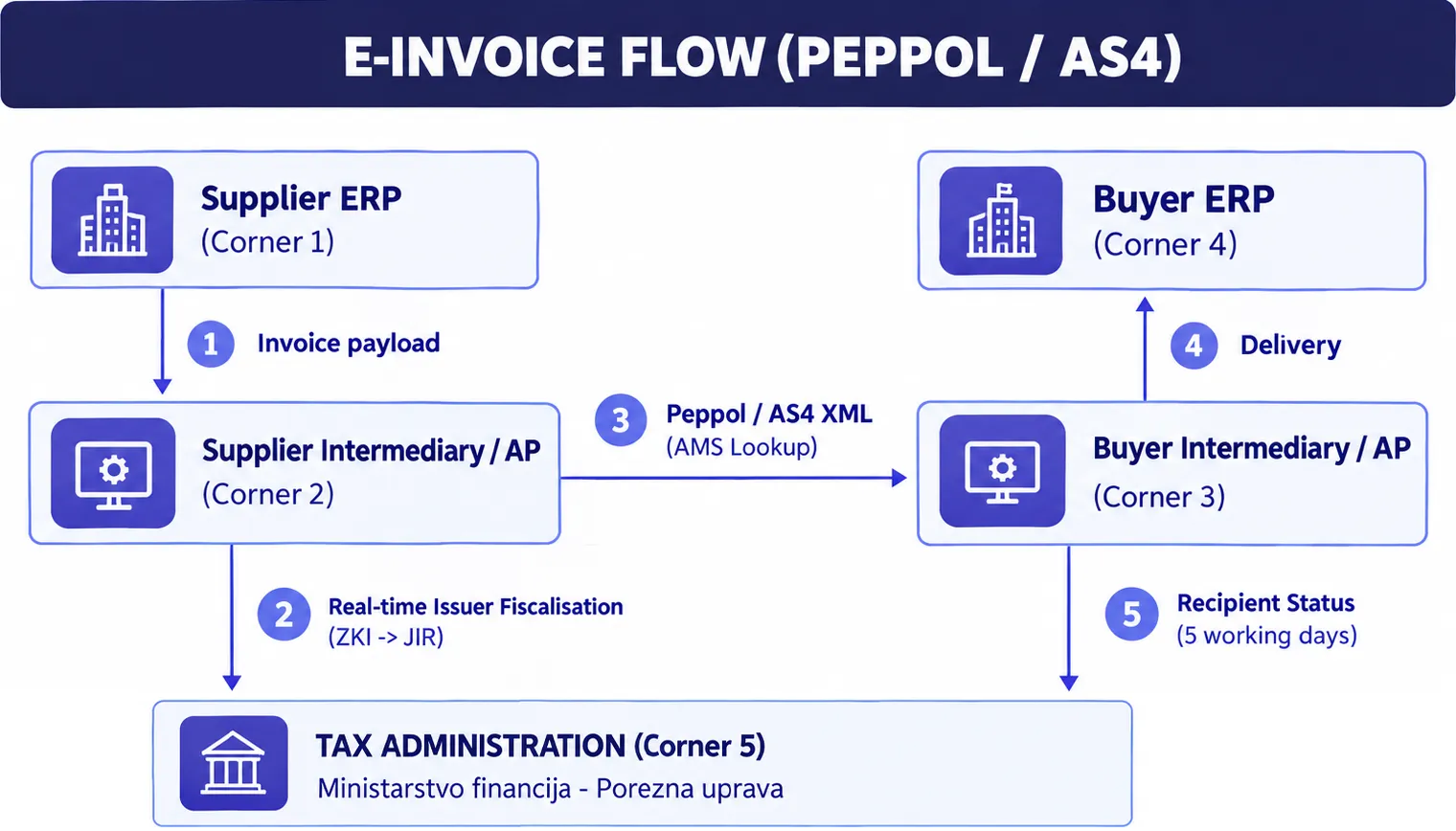
Core architectural components
The Address Management System (Sustav za upravljanje adresama - AMS): Operated under the authority of the Ministry of Finance, the AMS serves as the national directory of electronic receiving addresses. Every business subject to the mandate must register its unique identifier (such as its OIB or Peppol Participant ID) and designate its primary electronic endpoint or accredited intermediary.
Accredited Information Intermediaries (Informacijski posrednici): Enterprises connect their internal ERP and accounting software to certified private intermediaries or public gateways. Intermediaries validate HR-CIUS schemas, resolve routing endpoints via the AMS, and execute AS4 message transfers.
The Peppol eDelivery Network: Croatia's domestic e-invoice exchange uses access points, AS4 messaging and the national Address Management System (AMS), supported by metadata services (MPS) for recipient discovery. The Ordinance on e-Invoices (NN 11/2026) prescribes the interoperability and communication requirements for this national framework. Peppol connectivity may support broader interoperability but should not be described as the mandatory transport network for every Croatian e-invoice.
State Receiving Gateway (Corner 5): Operates as a background validation engine. Instead of intercepting the business transaction, Porezna uprava ingests dual fiscalisation streams alongside the commercial exchange, ensuring zero latency for enterprise logistics.
Government-Provided Free Portals: The Croatian Tax Administration provides MIKROeRAČUN as a free application for eligible non-VAT taxpayers. During 2026, it supports the receipt, viewing, rejection, storage and fiscalisation of incoming e-invoices. The ability to issue and fiscalise outgoing e-invoices becomes mandatory for the relevant taxpayer categories from 1 January 2027. According to the Tax Administration's announcement of 2 September 2026, an upgraded version supporting invoice issuance is scheduled to become available for testing in October 2026. FiskAplikacija serves separate fiscalisation monitoring and e-reporting functions.
Penalties for non-compliance
Non-compliance with the Fiscalisation Act (Zakon o fiskalizaciji, NN 89/2025) and secondary invoicing rules triggers severe administrative fines and commercial sanctions. Penalties are categorised according to the severity of the offence and the legal structure of the taxpayer:
Offence category | Legal entity fine (EUR) | Responsible person fine (EUR) | Sole trader / Craft fine (EUR) |
Failure to issue or receive an e-invoice Issuing paper/PDF invoices for in-scope B2B transactions; refusing to receive structured invoices via the AMS. | EUR 3,980 - EUR 66,360 | EUR 660 - EUR 6,630 | EUR 3,980 - EUR 39,810 |
Fiscalisation breaches Failure to comply with prescribed consumer invoice fiscalisation requirements, including the use of mandatory invoice identifiers. Failure to fiscalise e-invoices correctly or within the deadlines prescribed by Article 48. Failure to provide adequate software and hardware support for e-invoice exchange and fiscalisation. | EUR 2,650 to EUR 66,360 | EUR 390 to EUR 6,630 | EUR 1,320 to EUR 39,810 |
Recipient confirmation failure Failure to fiscalise a received e-invoice within five working days is an offence under Article 72(1)(9). Failure to report an e-invoice rejection by the 20th day of the following month is an offence under Article 73(1)(23). The law does not establish a general requirement to confirm acceptance or rejection of every incoming e-invoice within five working days. | Article 72: EUR 2,650 to EUR 66,360 Article 73: EUR 1,320 to EUR 26,540 | EUR 260 - EUR 2,650 | EUR 660 - EUR 13,270 |
Address Management System (AMS) non-compliance Failure to submit the required taxpayer identifier to AMS or to update relevant intermediary information constitutes an offence under Article 73(1), points 19 and 20. | EUR 1,320 to EUR 26,540 | EUR 260 to EUR 2,650 | The sole trader penalty range in Article 73(3) does not expressly cover the AMS offences listed in points 19 and 20. |
Public procurement non-compliance Executing payments against public contracts without valid e-Račun verification (under NN 94/2018). | EUR 1,327 - EUR 13,272 | EUR 663 - EUR 2,654 | N/A |
Commercial and operational repercussions
Beyond direct statutory fines, non-compliant organisations face critical commercial liabilities:
Input VAT deduction depends on compliance with the requirements of Croatian VAT legislation. E-invoice and fiscalisation failures can create additional reporting, documentation and audit risks, but they should not be presented as automatically eliminating input VAT deduction rights. Under Article 52(3) of the Fiscalisation Act, reporting an e-invoice as rejected is deemed to constitute a declaration by the recipient that it will not exercise the right to deduct input VAT on that invoice.
Public procurement suppliers must comply with the applicable structured e-invoicing requirements under the Law on Electronic Invoicing in Public Procurement (NN 94/2018) and the relevant provisions of the Fiscalisation Act. Non-compliant invoices may be rejected or require correction, potentially delaying payment. Automatic statutory payment blocks should not be assumed without a specific legal or technical basis.
Corporate tax expense disqualification: Business operating expenses evidenced by non-compliant documentation may be disallowed for corporate profit tax (porez na dobit) calculations during comprehensive audits.
How businesses can prepare
Businesses must verify their e-invoicing obligations, configure compliant invoice exchange and fiscalisation processes, and ensure that their reporting systems meet the applicable requirements. Organisations should follow a structured five-step implementation roadmap:
1. Classify tax status and implementation wave
Establish your mandatory compliance tier:
If your business is VAT-registered in Croatia, full issuance, reception, and dual fiscalisation obligations are already active.
If your business is a non-VAT sole trader (obrtnik) or public entity, ensure your systems can receive electronic invoices immediately, and plan system deployments for mandatory invoice issuance ahead of 1 January 2027.
2. Audit ERP architecture and master data
Review your core billing engines (SAP, Microsoft Dynamics, Oracle, or local software platforms):
Verify that your ERP and billing systems can generate compliant UBL 2.1 XML invoices in accordance with Croatia's HR-CIUS and applicable extensions. Ensure that all relevant product and service master data are mapped to the correct six-digit KPD 2025 classification codes, as required by Article 42 of the Fiscalisation Act. Implement automated validation checks before issuing and transmitting e-invoices.
Cleanse customer and supplier master data directories. Ensure every Croatian trading partner profile includes an accurate Personal Identification Number (OIB) and verified billing address.
Configure sequential invoice numbering to reflect the strict three-part statutory pattern (Number/Premises/Device).
3. Procure digital certificates and integrate with an accredited intermediary
Ensure that the selected access point and fiscalisation solution use valid application certificates meeting the requirements of the Croatian Tax Administration. Under Article 10 of the Ordinance on e-Invoices, these certificates are used to sign exchange and fiscalisation messages. Verify the certificate's OIB attributes, the authorisation of the relevant access point and compatibility with the applicable technical specifications.
Rather than maintaining complex bilateral point-to-point connections, integrate your systems with a certified information intermediary connected to the Peppol network and the national Address Management System (AMS).
4. Configure dual fiscalisation and inbound AP workflows
Configure automated fiscalisation messages for issued and received e-invoices using the official e-invoice fiscalisation and e-reporting specifications. Ensure that the system submits the prescribed invoice data, handles technical responses and meets the relevant statutory deadlines. JIR and ZKI processing should remain part of the separate consumer transaction fiscalisation workflow.
Establish automated accounts payable workflows to inspect incoming e-Račun files and transmit recipient status confirmations (acceptance or rejection) to the tax authority within the statutory 5-working-day deadline.
5. Establish compliant electronic invoice archiving
Implement a secure electronic archiving system that preserves issued and received e-invoices in their original structured format and maintains authenticity, integrity and legibility. Under Article 35 of the Croatian Fiscalisation Act, fiscalised e-invoices must be retained for six years after the end of the year in which they were issued. Businesses must also assess whether separate accounting or tax legislation requires longer retention of related records.
Conclusion
Croatia's Fiskalizacija 2.0 reform marks a definitive leap forward in European digital tax governance. By combining a decentralised Peppol-compatible exchange infrastructure with real-time dual fiscalisation, the Croatian Tax Administration has designed a robust framework that closes VAT collection loopholes while preserving commercial efficiency for trading enterprises.
With mandatory B2B e-invoicing and dual transaction reporting fully active for VAT-registered entities, and Phase 2 expanding to non-VAT businesses and sole traders on 1 January 2027, businesses must treat compliance as a top strategic priority. Organisations that proactively upgrade their ERP software, connect with accredited information intermediaries, and establish automated AP/AR workflows will protect their operations against substantial statutory fines while capitalising on the speed, accuracy, and operational savings of end-to-end digital trade.
FAQ
No. Standard PDF invoices sent via email or physical paper documents no longer have legal validity for domestic B2B commercial transactions involving VAT-registered taxpayers. Invoices must be issued, exchanged, and archived in structured XML formats compliant with EN 16931 (HR-CIUS) and fiscalised with Porezna uprava.