
This article was updated on 2 October 2026 to incorporate the latest regulatory guidance from the Ministry of Finance of the Czech Republic and the Financial Administration, including the status of electronic invoicing under the Public Procurement Act, technical specifications for ISDOC 6.0.2 and EN 16931, mandatory electronic VAT reporting under the VAT Control Statement (Kontrolní hlášení), and preparations for the European Union's VAT in the Digital Age (ViDA) package under Council Directive (EU) 2025/516.
How does electronic invoicing and digital VAT reporting work in the Czech Republic?
Domestic B2B electronic invoicing remains voluntary in the Czech Republic and generally requires recipient consent under Section 26 of the VAT Act. The country does not operate a centralised invoice clearance system. Instead, VAT payers meeting the conditions in Section 101c must submit the electronic VAT Control Statement (Kontrolní hlášení), which provides transaction-level data to the Financial Administration. Not every VAT payer is required to submit a statement for every reporting period.
The strategic motive behind the Czech framework centres on data-driven fiscal oversight. Rather than interposing a state validation gateway between trading partners to approve commercial documents, the Ministry of Finance (Ministerstvo financí České republiky) and the Financial Administration (Finanční správa České republiky) leverage automated cross-checking algorithms. By matching input and output invoices reported across complementary tax declarations, revenue authorities systematically detect carousel schemes, fictitious invoicing, and undeclared value-added tax without disrupting standard commercial exchange.
In public procurement, Section 221 of Act No. 134/2016 Coll. requires contracting authorities to accept electronic invoices that comply with the European standard EN 16931. The Czech government also supports ISDOC/ISDOCX version 5.2 and later under separate national administrative rules, including Government Resolution No. 347/2017 and Decree No. 194/2009 Coll. The European standard and national ISDOC requirements must therefore be distinguished. However, private contractors retain the legal right to submit paper or unstructured invoices unless contractual agreements dictate otherwise.
The EU's VAT in the Digital Age package, including Council Directive (EU) 2025/516, introduces new electronic invoicing and digital reporting requirements in stages. Covered intra-EU cross-border B2B transactions become subject to the principal digital reporting framework from 1 July 2030. Businesses should distinguish these EU obligations from the Czech Republic's existing domestic VAT Control Statement system. While domestic B2B e-invoicing remains market-driven today, enterprise organisations operating across the Czech market must maintain systems capable of handling structured XML data, automated data validation, and continuous digital reporting.
How has e-invoicing and VAT reporting developed in the Czech Republic?
The Czech Republic's path toward tax digitalisation has evolved through legislative milestones designed to balance regulatory oversight with business operational autonomy:
Development of the national ISDOC standard (2009): ISDOC (Information System Document) was developed as an open XML format for exchanging electronic invoices between Czech accounting and ERP systems. The standard was originally defined by a working group of ICT Unie and is now maintained by the Czech Ministry of the Interior. Historical ISDOC version 5.2 was published in 2009, while the current published specification is version 6.0.2, dated 23 March 2022. The official ISDOC specification and schemas are publicly available.
Transposition of Directive 2010/45/EU (2013): Act No. 502/2012 Coll. amended the Czech VAT Act to establish the formal legal equality of paper and electronic invoices, codifying the principles of authenticity of origin, integrity of content, and legibility through business controls, advanced electronic signatures, or Electronic Data Interchange (EDI).
Launch of the VAT Control Statement (1 January 2016): Under Act No. 360/2014 Coll., the Czech Republic rolled out the mandatory VAT Control Statement (Kontrolní hlášení). This reform fundamentally reshaped Czech tax reporting by replacing aggregated periodic summaries with detailed, invoice-level electronic data returns for all domestic taxable supplies exceeding CZK 10,000.
Electronic Records of Sales and EET 2.0 (2016–2027): The original Electronic Records of Sales system (Elektronická evidence tržeb, EET) began operating on 1 December 2016 under Act No. 112/2016 Coll. It was abolished with effect from 1 January 2023 under Act No. 458/2022 Coll. A new framework was enacted through Act No. 180/2026 Coll. on the Recording of Sales, officially published on 7 October 2026. The principal obligations take effect from 1 January 2027 and apply to qualifying contact payments, including cash and payment cards, subject to statutory exceptions. Ordinary remote bank transfers are not generally covered.
B2G transposition of Directive 2014/55/EU (2019): Through amendments to Act No. 134/2016 Coll. on Public Procurement, Czech contracting authorities were mandated to receive and process electronic invoices complying with the European standard EN 16931.
EU VAT in the Digital Age (ViDA): Council Directive (EU) 2025/516 amends the EU VAT framework in stages. From 14 April 2025, Member States may introduce domestic electronic invoicing obligations without obtaining a special derogation under the previous approval framework. Further changes to electronic invoicing and digital reporting apply from 1 July 2030. The Czech Republic has not introduced a general domestic B2B e-invoicing mandate as of October 2026. National implementation measures should not be described as enacted or finalised without a corresponding published Czech legal instrument.
Unlike clearance frameworks in Southern Europe and Latin America, the Czech Republic demonstrates how a modern revenue body can achieve high tax compliance by coupling market-led electronic invoicing with rigorous, automated back-end data reconciliation.
What are the key Czech e-invoicing and VAT compliance dates?
The table below illustrates the historical progression, current operational requirements, and confirmed future milestones governing e-invoicing and digital VAT compliance in the Czech Republic:
Date | Milestone | Regulatory scope & taxpayer impact |
2009 | Development of the ISDOC national e-invoicing format | ISDOC became an open XML standard for domestic electronic invoice exchange. Historical version 5.2 specifications are documented from July and October 2009. The standard was developed by ICT Unie and is now maintained by the Ministry of the Interior. See the official ISDOC version archive. |
1 January 2013 | Act No. 502/2012 Coll. takes effect | Amends the Czech VAT Act to codify legal parity between paper and electronic invoices based on recipient consent. |
1 January 2016 | Introduction of the VAT Control Statement | Act No. 360/2014 Coll. introduced electronic VAT Control Statements (Kontrolní hlášení) for VAT payers meeting the conditions now set out in Sections 101c to 101k of the VAT Act. The filing obligation depends on the reportable transactions and deductions in the relevant period. See the Financial Administration's reporting guidance. |
1 December 2016 | Rollout of EET (Phase 1) | Real-time electronic registration of cash payments launches for catering and accommodation sectors under Act No. 112/2016 Coll. |
1 April 2019 | EN 16931 invoice reception for central government | Central government contracting authorities and the Czech National Bank became subject to the EN 16931 invoice reception requirement under Sections 221 and 279(5)(a) of Act No. 134/2016 Coll. |
1 April 2020 | EN 16931 invoice reception for other contracting authorities | The requirement was extended to the remaining contracting authorities under Section 279(5)(b). See the Ministry of Finance's official implementation timeline. |
1 January 2023 | Official repeal of EET | Act No. 458/2022 Coll. enters into force, completely terminating the electronic registration of cash sales. |
23 March 2023 | ISDOC 6.0.2 released | The Czech Ministry of the Interior published the ISDOC 6.0.2 specification and updated schemas, adding ISDOC.PDF support based on PDF/A-3, clarifying time-stamping requirements and introducing further schema validation improvements. See the official ISDOC 6.0.2 documentation. |
1 January 2025 | Introduction of the Section 74b overdue invoice adjustment | Section 74b(3) of the VAT Act requires VAT-registered debtors to reduce previously claimed input VAT deductions where the relevant liability remains unpaid, in whole or in part, on the final day of the sixth calendar month following the calendar month in which payment became due. Transitional conditions and specific exemptions apply. See the General Financial Directorate's guidance on Section 74b. |
7 October 2026 | Publication of the new EET 2.0 legislation | Act No. 180/2026 Coll. was published, establishing the new electronic sales recording framework. |
1 January 2027 | Principal EET 2.0 obligations commence | Qualifying contact payments become subject to electronic recording under the new legislation. The system covers payment methods such as cash and payment cards, subject to statutory exemptions. The new EET legislation does not introduce mandatory domestic B2B electronic invoicing and must not be presented as the national implementation of the EU ViDA cross-border reporting rules. |
1 July 2030 | EU ViDA digital reporting mandate | Mandatory e-invoicing and near real-time Digital Reporting Requirements (DRRs) take effect for all intra-Community cross-border B2B supplies. |
Which laws govern e-invoicing and electronic tax reporting in the Czech Republic?
Digital invoicing, VAT reporting and electronic sales recording in the Czech Republic are governed by separate national statutes and EU requirements. These include the VAT Act, the Public Procurement Act, the rules governing electronic documents and trust services, and Act No. 180/2026 Coll. on the Recording of Sales, published on 7 October 2026. The latter introduces EET 2.0 from 1 January 2027 but does not establish a general B2B e-invoicing mandate.
Act No. 235/2004 Coll. on Value Added Tax (Zákon č. 235/2004 Sb., o dani z přidané hodnoty):
Section 26: Establishes the legal definition of an invoice (tax document - daňový doklad) and specifies under Subsection 3 that a tax document may be issued in electronic form only with the consent of the recipient.
Section 28: Governs the obligation to issue tax documents, including the situations in which a document must be issued. The applicable deadline is generally 15 days from the relevant statutory event, subject to specific rules and exceptions. Section 29 sets out the mandatory particulars of a standard tax document.
Section 34: Outlines methods for ensuring authenticity of origin, integrity of content, and legibility, including recognised electronic signatures, recognised electronic seals, EDI, or robust business control mechanisms (kontrolní mechanismy vytvářející spolehlivou vazbu).
Section 35: Establishes a ten-year retention period for tax documents, calculated from the end of the tax period in which the relevant supply took place. Sections 34 to 35 address authenticity, integrity, legibility and the retention of tax documents. These requirements do not impose a universal obligation to store every electronic invoice exclusively as its original XML file.
Sections 101c to 101i: Govern the VAT Control Statement (Kontrolní hlášení), including the conditions for filing, submission periods, electronic filing requirements, responses to tax authority notices, statutory penalties and the possibility of penalty remission.
Act No. 134/2016 Coll. on Public Procurement (Zákon č. 134/2016 Sb., o zadávání veřejných zakázek):
Section 221: Prohibits contracting authorities from rejecting electronic invoices for the performance of public contracts on the grounds of format where the invoice complies with the European standard EN 16931. Acceptance of ISDOC/ISDOCX version 5.2 and later is supported by separate Czech government requirements, including Government Resolution No. 347/2017 and Decree No. 194/2009 Coll.
Act No. 300/2008 Coll. on Electronic Acts and Authorised Document Conversion (Zákon č. 300/2008 Sb., o elektronických úkonech a autorizované konverzi dokumentů):
Governs the operational and legal status of state Data Boxes (Datové schránky), providing the statutory framework for legally binding, secure electronic delivery between public bodies and commercial legal entities.
Act No. 297/2016 Coll. on Trust Services for Electronic Transactions (Zákon č. 297/2016 Sb., o službách vytvářejících důvěru pro elektronické transakce):
Supplements the directly applicable EU eIDAS framework by regulating selected national requirements for trust services in electronic transactions. Regulation (EU) No 910/2014 applies directly and establishes the EU rules for electronic identification and trust services, including electronic signatures, seals and electronic time stamps.
Council Directive (EU) 2025/516 (VAT in the Digital Age):
Amends Directive 2006/112/EC in stages. It permits Member States to introduce domestic electronic invoicing mandates without the previous special derogation procedure from 14 April 2025. From 1 July 2030, the amended framework introduces structured electronic invoicing and digital reporting requirements for covered intra-EU cross-border transactions, alongside changes to the EU rules on recipient consent for qualifying electronic invoices. National transposition and implementation requirements must be distinguished from the direct effect of an EU regulation.
Which authorities oversee e-invoicing and VAT reporting in the Czech Republic?
Administrative oversight and technical standardisation for tax compliance and electronic documentation in the Czech Republic involve several key public institutions:
Ministry of Finance of the Czech Republic (Ministerstvo financí České republiky)
The Ministry of Finance develops national tax legislation, formulates fiscal strategy, and sponsors bills transposing European tax directives. It defines regulatory policy for electronic billing and oversees the broader digitalisation of Czech tax administration.
Financial Administration of the Czech Republic (Finanční správa České republiky)
Operating under the Ministry of Finance, the Financial Administration executes tax enforcement and manages the operational infrastructure for digital reporting. Led by the General Financial Directorate (Generální finanční ředitelství - GFŘ), it administers the MOJE daně taxpayer portal, processes electronic filings via the Electronic Tax Submissions portal (EPO), and monitors automated matching within the Kontrolní hlášení system.
Ministry of the Interior of the Czech Republic (Ministerstvo vnitra České republiky)
The Ministry of the Interior is responsible for the maintenance of the national ISDOC electronic invoicing standard, with the technical specification, XML schemas and related documentation published through isdoc.cz. The Digital and Information Agency (DIA) is responsible for key digital public administration services, including the operation and development of the Data Box system (Informační systém datových schránek, ISDS).
Digital and Information Agency (Digitální a informační agentura - DIA)
The Digital and Information Agency (Digitální a informační agentura, DIA) coordinates key digital public administration services, including digital identity, data exchange and the Data Box system. These services support secure electronic communication between businesses and public authorities, but they do not constitute a national B2B invoice clearance network.
OpenPeppol and Peppol Authority Network
While the Czech Republic has not established a dedicated domestic Peppol Authority within its ministries, Czech commercial entities and public authorities interact with the international Peppol network via certified Access Points. Peppol interoperability enables Czech suppliers to deliver EN 16931-compliant documents across European public and private procurement networks.
Which e-invoicing and VAT reporting obligations apply in the Czech Republic?
Understanding the scope of compliance in the Czech Republic requires distinguishing between commercial electronic invoicing and statutory tax reporting:
1. Business-to-Government (B2G) transactions
Public authority obligation: Under Section 221 of the Public Procurement Act, contracting authorities must accept EN 16931-compliant electronic invoices for the performance of public contracts. The statutory obligation was introduced in stages, beginning on 1 April 2019 for central government authorities and the Czech National Bank and extending to other contracting authorities on 1 April 2020. ISDOC/ISDOCX acceptance is separately supported under Czech government administrative requirements.
Supplier obligation: Voluntary. Suppliers are not legally mandated to issue electronic invoices to public contracting authorities unless the underlying public procurement tender contract specifically stipulates electronic submission. Suppliers may continue submitting paper or PDF invoices.
2. Business-to-Business (B2B) transactions
Electronic invoicing status: Voluntary. Domestic B2B electronic invoicing is permitted under Section 26(3) of the VAT Act, subject strictly to the recipient's explicit or implicit consent.
VAT Control Statement status: Mandatory when the statutory reporting conditions are met. Czech VAT payers must submit an electronic VAT Control Statement (Kontrolní hlášení) where relevant domestic taxable transactions, reverse-charge operations, deductible input VAT or other transactions covered by Section 101c arise. VAT-registered entities with no relevant reportable transactions in the period are not automatically required to submit a nil statement. Legal entities file for each relevant calendar month, while natural persons follow their applicable monthly or quarterly VAT reporting period.
3. Business-to-Consumer (B2C) transactions
Electronic invoices to private consumers are voluntary and subject to agreement.
Under Act No. 180/2026 Coll., electronic sales recording (EET 2.0) begins on 1 January 2027 for qualifying contact payments, including cash, payment cards and relevant on-site QR payments. Ordinary remote bank transfers are generally outside the scope. The new framework does not introduce a general requirement to print receipts solely for EET purposes. The Financial Administration provides implementation information through eet.gov.cz and is preparing the free MOJE EET application. Separately, reportable B2C supplies may be included in Part A.5 of the VAT Control Statement where the relevant conditions are satisfied.
4. Cross-border supplies
Cross-border transactions are reported through the applicable Czech VAT return and, where relevant, the VAT Control Statement. Recapitulative Statements (Souhrnné hlášení) primarily report specified intra-Community supplies and services, not all imports, exports or acquisitions. Certain received intra-Community transactions and reverse-charge services must also be reported in Part A.2 of the VAT Control Statement.
Structured cross-border e-invoicing remains optional until 1 July 2030, when the EU ViDA framework mandates structured electronic invoicing and Digital Reporting Requirements (DRRs) for all intra-EU B2B transactions.
Scope breakdown
Transaction category | E-invoicing mandate | Applicable electronic format | Mandatory reporting mechanism |
Domestic B2B | Voluntary (consent required) | ISDOC, UBL 2.1, UN/CEFACT CII, PDF | VAT Control Statement (Kontrolní hlášení) |
B2G (supplier to public contracting authority) | Generally voluntary for suppliers unless contractually required; mandatory acceptance of EN 16931-compliant invoices by contracting authorities | EN 16931 (UBL 2.1 or UN/CEFACT CII); ISDOC/ISDOCX 5.2+ under separate government requirements | VAT Control Statement where relevant; public procurement e-invoicing requirements |
B2C (retail and private consumers) | No general structured e-invoicing mandate | Paper or electronic invoices under the applicable invoicing rules | Relevant domestic taxable sales reported in Part A.5 of the VAT Control Statement where applicable; qualifying contact payments subject to EET 2.0 from 1 January 2027 |
Covered intra-EU cross-border B2B transactions | No general structured e-invoicing mandate under current Czech rules; EU ViDA requirements from 1 July 2030 | Structured electronic invoices meeting the applicable EU requirements from 2030 | Current VAT returns, VAT Control Statements or Recapitulative Statements as applicable; future ViDA digital reporting requirements for covered transactions |
What are the electronic invoicing requirements in the Czech Republic?
Czech law permits domestic B2B electronic invoices with recipient consent, subject to the requirements of the VAT Act. Standard PDFs and structured formats such as ISDOC, UBL and CII may be used where legally appropriate. Businesses must ensure authenticity of origin, integrity of content and legibility, but the VAT Act does not generally require domestic commercial invoices to use a particular structured XML format.
Is recipient consent required for electronic invoices in the Czech Republic?
Under Section 26(3) of the Czech VAT Act, an electronic tax document is issued and received electronically, and its use requires the recipient's consent. Consent may be expressly documented or inferred from the parties' conduct, depending on the circumstances. Businesses should record the agreed invoice delivery method and ensure that recipients can access and read the documents throughout the relevant business process.
How must businesses ensure the authenticity and integrity of electronic invoices?
In accordance with Section 34 of the VAT Act, the issuer must guarantee three fundamental properties from the moment of issuance until the end of the archiving period:
Authenticity of origin: Certainty of the identity of the supplier or invoice issuer.
Integrity of content: Guarantee that the content required under VAT rules has not been altered.
Legibility: The invoice must remain readable by humans directly or via technical conversion.
Taxpayers can establish these criteria through:
Business controls: Establishing a reliable audit trail (spolehlivá vazba) between the invoice and the underlying supply of goods or services (matching the invoice against purchase orders, delivery notes, and bank payment confirmations).
Recognised electronic signature: Applying an advanced electronic signature based on a qualified certificate or a qualified electronic signature under the eIDAS framework.
Recognised electronic seal: Using an electronic seal that meets the applicable legal requirements and supports verification of the document's origin and integrity. Under Section 34 of the VAT Act, electronic seals are one possible method of providing assurance, alongside electronic signatures, EDI and reliable business controls.
Electronic Data Interchange (EDI): Transmitting documents through secure EDI agreements that ensure data integrity.
What information must Czech invoices contain, and when must they be issued?
Sections 28 and 29 of the Czech VAT Act govern invoice issuance obligations and mandatory tax document particulars. A tax document generally has to be issued within 15 days of the relevant statutory event, subject to transaction-specific rules and exceptions. The required content depends on the type of tax document, including whether simplified invoicing provisions apply. A standard tax document generally includes the following information:
Full legal business name, registered address, and Tax Identification Number (DIČ) of the supplier.
Full legal business name, registered address, and DIČ of the buyer.
Evidenční číslo daňového dokladu (sequential invoice number).
Date of issuance and date of taxable supply (DUZP - datum uskutečnění zdanitelného plnění).
Scope and description of goods or services supplied.
Unit price excluding tax and applicable discounts.
Tax base (základ daně) and applicable VAT treatment, including the standard 21% rate, the reduced 12% rate, exemptions and other specific statutory treatments where relevant. A zero-rated or exempt transaction must not be treated as interchangeable without assessing the applicable legal provision.
Applicable VAT rate and total tax amount expressed in Czech Koruna (CZK).
Where invoices are issued in a foreign currency, VAT amounts must be determined and presented in accordance with the Czech VAT Act's currency conversion rules. Businesses should apply the legally permitted exchange-rate method consistently, rather than assuming that only the exchange rate published by the Czech National Bank may be used in every case.
How long must electronic invoices be retained in the Czech Republic?
Under Section 35 of the Czech VAT Act, tax documents must generally be retained for ten years from the end of the tax period in which the relevant transaction took place. Throughout the retention period, businesses must preserve authenticity of origin, integrity of content and legibility. The law does not impose a universal requirement to archive all electronic invoices in structured XML format or to retain cryptographic validation certificates for every invoice. The chosen archiving method must meet the applicable statutory requirements and allow access to the tax documents when requested by the authorities.
How does the Czech VAT Control Statement reporting system work?
The VAT Control Statement (Kontrolní hlášení) is a periodic electronic VAT reporting obligation introduced on 1 January 2016 and governed by Sections 101c to 101k of the VAT Act. It requires VAT payers meeting the statutory conditions to report prescribed transaction data electronically. The system operates through periodic submissions and automated cross-checks rather than real-time invoice clearance.
Who must submit the VAT Control Statement?
Czech VAT payers, including foreign entities registered as VAT payers in the Czech Republic, must submit a VAT Control Statement when they meet the conditions in Section 101c of the VAT Act. These conditions include relevant domestic taxable supplies, domestic reverse-charge transactions, selected received supplies for which the recipient must account for VAT, or the exercise of input VAT deduction rights. The conditions apply to both legal entities and natural persons. VAT payers with no relevant reportable transactions in a given period are not automatically obliged to submit a nil statement. Identified persons (identifikované osoby) are not subject to this obligation.
How often must businesses submit the VAT Control Statement?
The filing schedule depends strictly on the legal structure of the business:
Legal entities: Where a VAT Control Statement filing obligation arises, the reporting period is one calendar month, regardless of whether the taxpayer files its VAT return monthly or quarterly. The statement must generally be submitted by the 25th day after the end of the reporting month. Legal entities are not required to file a statement for a period in which the statutory reporting conditions are not met.
Natural persons: Where a VAT Control Statement is required, the reporting period follows the taxpayer's VAT return period, which may be monthly or quarterly. The filing deadline is generally the 25th day after the relevant period ends, subject to the applicable rules on statutory deadline extensions.
Filing deadlines are strictly enforced. If the 25th falls on a weekend or public holiday, the deadline shifts to the next business day. Submissions must be executed exclusively in structured XML format via official government channels.
Which transactions are reported in each section of the VAT Control Statement?
The Kontrolní hlášení categorises transactional data into distinct functional modules:
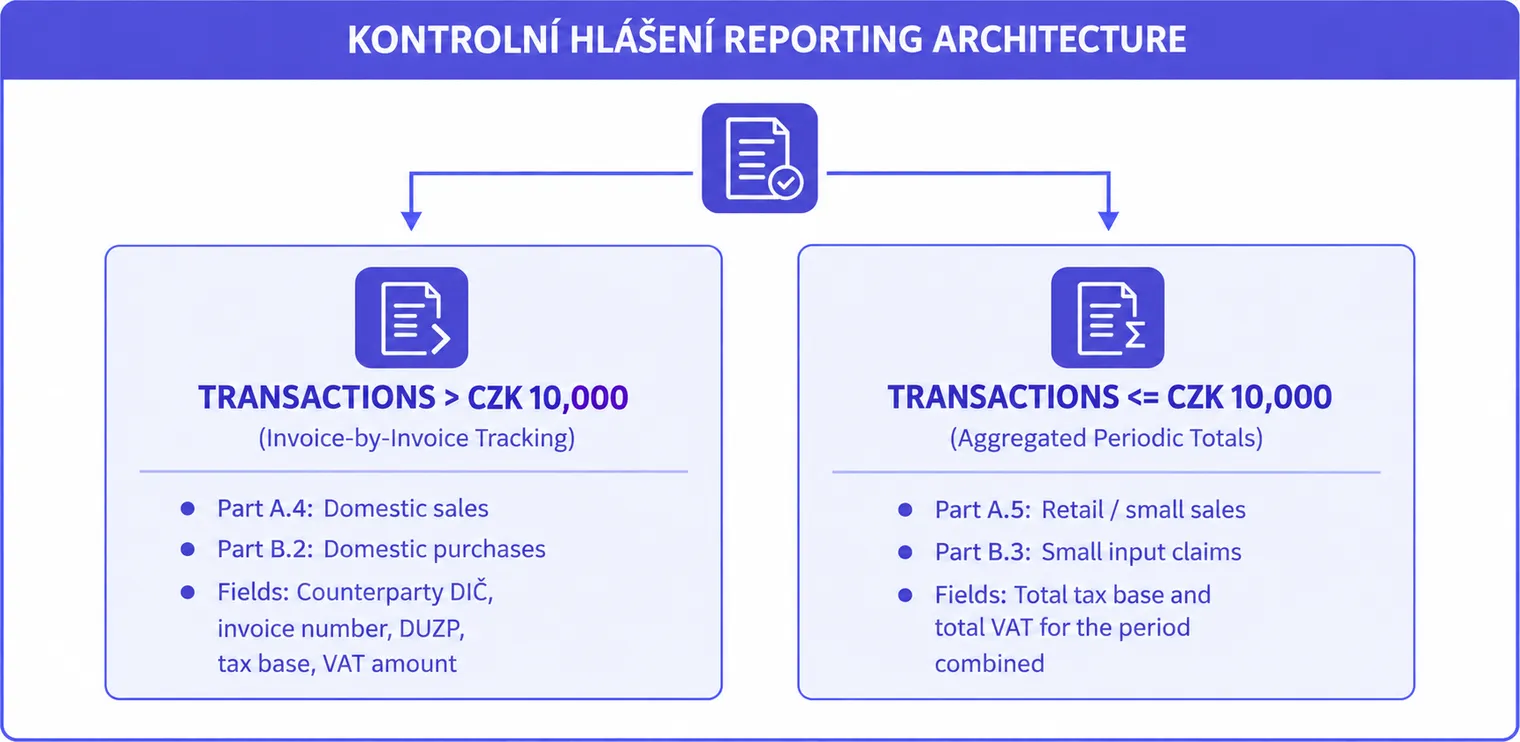
Section | Reporting content | Granularity & threshold |
Part A.1 | Supplies subject to the domestic reverse-charge regime where the supplier is liable to report. | Individual invoice reporting, regardless of transaction amount. |
Part A.2 | Received taxable supplies, including relevant intra-Community acquisitions and services supplied by foreign taxable persons, where the Czech recipient must declare VAT under the applicable reverse-charge or acquisition rules. | Transaction-level reporting in accordance with the prescribed data fields, including the applicable foreign supplier identification and the date on which the obligation to declare VAT arises. |
Part A.4 | Domestic taxable supplies and received advance payments subject to the relevant reporting rules where the total tax document value exceeds CZK 10,000 including VAT. | Individual tax document reporting, including customer tax identification, tax document number, relevant tax date and tax base and VAT amounts. The threshold is assessed using the total value of the tax document rather than only the taxable amount. |
Part A.5 | Relevant domestic taxable supplies and advance payments reported in aggregate, including qualifying simplified tax documents and transactions whose tax document value does not exceed CZK 10,000 including VAT. | Aggregate tax bases and VAT amounts by the applicable VAT treatment for the reporting period, following the Financial Administration's completion instructions. |
Part B.1 | Supplies received under the domestic reverse-charge regime where the recipient is liable to declare tax. | Individual invoice reporting. |
Part B.2 | Received domestic taxable supplies and advance payments for which input VAT deduction is claimed and the total tax document amount exceeds CZK 10,000 including VAT. | Individual tax document reporting, including supplier tax identification, the original tax document number, the relevant date for VAT reporting, the tax base and the input VAT amount claimed. The reporting period is linked to the deduction claimed, while the document date fields must follow the prescribed VAT Control Statement instructions. |
Part B.3 | Received domestic supplies where input tax is claimed and the total invoice amount is CZK 10,000 or less. | Aggregated reporting: sum of tax bases and claimed VAT amounts. |
Part C | Control calculations reconciling reported values against the standard VAT return (DPH přiznání). | Algorithmic totals cross-checked against tax return lines. |
When must input VAT be adjusted for unpaid invoices under Section 74b?
Section 74b of the Czech VAT Act, effective from 1 January 2025, requires VAT-registered debtors to reduce previously claimed input VAT deductions on qualifying unpaid liabilities. Under Section 74b(3), the relevant test is whether the liability remains wholly or partly unpaid on the final day of the sixth calendar month following the calendar month in which payment became due. The deduction adjustment is calculated by reference to the unpaid amount and must be recognised in the relevant VAT period. If the liability is subsequently settled, Section 74b(4) allows the taxpayer to increase the adjusted deduction, subject to the applicable conditions and deadlines. Special provisions apply to quarterly VAT payers. Businesses should configure accounts payable systems to monitor due dates, partial payments, VAT deduction adjustments and subsequent settlement events. The General Financial Directorate's official guidance on Section 74b provides detailed examples and transitional guidance.
How are electronic invoices exchanged and VAT reports submitted in the Czech Republic?
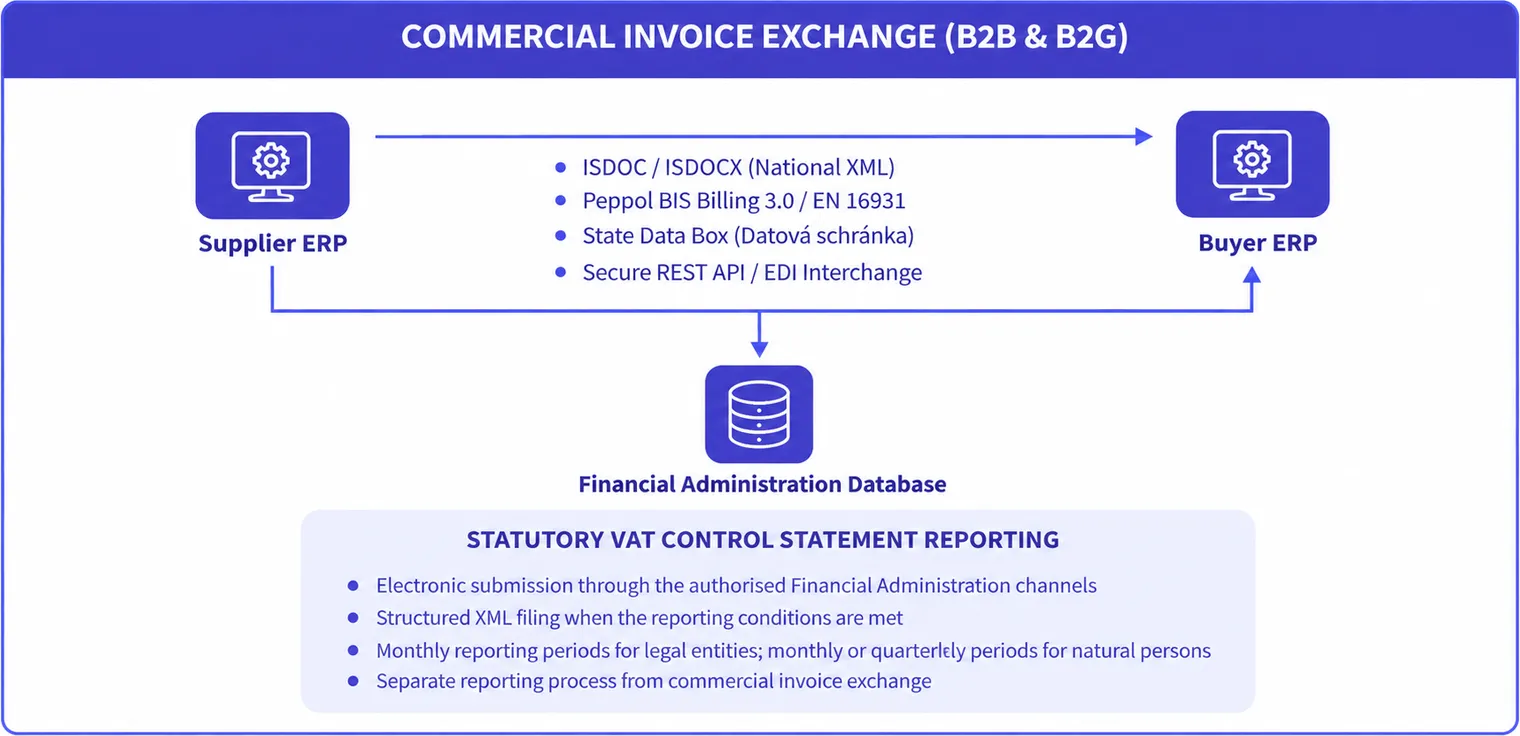
Unlike centralised clearance regimes, the Czech Republic does not route commercial B2B invoices through a central government server. Instead, transactions rely on direct document exchange between commercial trading partners, coupled with direct electronic transmission of tax reports to the Financial Administration.
How can businesses send electronic invoices in the Czech Republic?
Businesses operating in the Czech Republic exchange electronic invoices through four primary delivery mechanisms:
State Data Boxes (Datové schránky): Regulated by Act No. 300/2008 Coll., Data Boxes provide an authenticated electronic communication channel for public authorities, legal entities and specified natural persons. Mandatory establishment depends on the applicable legal category. Statutory delivery effects and deemed-delivery rules depend on the nature of the message and relevant legal provisions. Data Boxes may be used to exchange electronic invoices, including ISDOC files, where suitable, but they do not form a dedicated national electronic invoice clearance system.
The Peppol network: For cross-border transactions and public contracting, organisations connect to certified Peppol Access Points. Invoices are routed securely using the Peppol 4-corner network, converting billing data into standardised Peppol BIS Billing 3.0 payloads compliant with EN 16931.
National Electronic Tool (Národní elektronický nástroj - NEN): NEN is a public procurement communication platform used for procurement procedures and related documentation. It should not be presented as a generally mandatory channel for submitting B2G invoices. Suppliers must follow the invoicing and delivery instructions specified by the relevant contracting authority.
Direct EDI and API connections: Large commercial operators and retail supply chains utilize secure AS2, SFTP, or REST API connections to exchange electronic documents directly between ERP systems.
Which electronic invoice formats are supported in the Czech Republic?
Czech legislation and procurement standards accommodate several structured formats:
ISDOC and ISDOCX: ISDOC is the Czech national XML-based electronic invoicing format, currently published as version 6.0.2. ISDOCX is a ZIP-based container format that can package an ISDOC document with additional files where supported by the specification. A PDF visualisation is not universally required inside every ISDOCX container. Version 6.0.2 also introduces ISDOC.PDF, allowing structured ISDOC data to be embedded in a PDF/A-3 document. ISDOC is a separate national format and should not automatically be treated as equivalent to an EN 16931-compliant UBL or CII document. The official ISDOC 6.0.2 specification defines the supported representations, document types and validation rules.
UBL 2.1 (Universal Business Language): One of the XML syntaxes recognised under the European e-invoicing framework for representing EN 16931-compliant invoices. Conformity depends on the applicable semantic data requirements, business rules and validation specifications, not merely on the use of UBL XML. UBL is also used by Peppol BIS Billing 3.0.
UN/CEFACT CII (Cross Industry Invoice): The second XML syntax approved under EN 16931, widely implemented across European enterprise supply chains.
Traditional EDIFACT: Retained across manufacturing, automotive, and large retail sectors under established commercial interchange agreements.
How can businesses submit the Czech VAT Control Statement electronically?
The VAT Control Statement (Kontrolní hlášení) must be submitted electronically in the prescribed data format and structure. Taxpayers can use the authorised electronic filing channels provided by the Financial Administration, including the EPO application on the MOJE daně portal or an appropriate Data Box submission. Submission must satisfy the relevant authentication and technical requirements. Taxpayers should verify successful receipt of the filing and address any validation errors or official notices.
What are the penalties for VAT Control Statement non-compliance in the Czech Republic?
Sections 101h to 101k of the Czech VAT Act establish penalties and relief mechanisms for VAT Control Statement non-compliance. Statutory fixed penalties apply to specified filing failures, while other penalties may be imposed following administrative assessment. Since 2023, qualifying taxpayers benefit from reduced penalties under Section 101h(2). Section 101j provides statutory relief for certain first filing defaults, while Section 101k allows applications for remission of eligible penalties.
Offence | General statutory amount | Important exceptions |
Late filing before a tax authority reminder | CZK 1,000 | No penalty arises for the first qualifying default of this type in a calendar year |
Filing in the substitute period following a reminder | CZK 10,000 | Reduced to CZK 5,000 for qualifying taxpayers; first qualifying default of this type in a calendar year may also be exempt |
Failure to submit a subsequent statement following a request to correct or confirm data | CZK 30,000 | Reduced to CZK 15,000 for qualifying taxpayers |
Failure to file within the substitute deadline after a reminder | CZK 50,000 | Reduced to CZK 25,000 for qualifying taxpayers |
Failure to correct or supplement inaccurate information following a request | Up to CZK 50,000 | Discretionary penalty under Section 101h(3) |
Serious obstruction of VAT administration by failing to submit the statement | Up to CZK 500,000 | Discretionary penalty under Section 101h(4) |
Reduced fixed penalties under Section 101h(2) apply to qualifying natural persons, quarterly VAT payers and certain single-member limited liability companies. Eligible taxpayers may apply for remission of specific penalties under Section 101k.
Which statutory penalties apply under Section 101h of the Czech VAT Act?
CZK 1,000: A statutory penalty generally arises where a taxpayer files a VAT Control Statement after the deadline but before receiving a tax authority reminder. Under Section 101j, no obligation to pay this penalty arises for the first qualifying default of this type in a calendar year. The provision operates as a statutory exemption rather than an application-based discretionary remission.
CZK 10,000: Applies where a taxpayer submits the required VAT Control Statement within the substitute deadline after receiving an official reminder (výzva). Under Section 101h(2), qualifying taxpayers are subject to a reduced amount of CZK 5,000. Under Section 101j, no penalty obligation arises for the first qualifying default of this type in a calendar year.
CZK 30,000: Applies where a taxpayer fails to submit a subsequent VAT Control Statement in response to a request to amend, supplement or confirm previously reported data. Under Section 101h(2), the penalty is reduced to CZK 15,000 for qualifying taxpayers. A separate discretionary penalty of up to CZK 50,000 may apply under Section 101h(3) where the taxpayer fails to correct or supplement inaccurate or incomplete information.
CZK 50,000: Applies where a taxpayer fails to submit the required VAT Control Statement within the substitute deadline specified following an official reminder. Under Section 101h(2), the amount is reduced to CZK 25,000 for qualifying taxpayers.
Discretionary penalties and remission: Under Section 101h(3), the Financial Administration may impose a penalty of up to CZK 50,000 for failure to correct or supplement inaccurate data following a formal request. Under Section 101h(4), a penalty of up to CZK 500,000 may be imposed where a taxpayer seriously obstructs VAT administration through failure to file. In addition, Section 101k allows eligible taxpayers to request full or partial remission of penalties arising under Section 101h(1)(b) to (d). Applications must generally be submitted within three months after the penalty assessment becomes final, and a statutory administrative fee applies.
How quickly must businesses respond to VAT Control Statement notices?
When the Financial Administration identifies discrepancies between matching supplier and buyer filings, it issues an electronic summons (výzva). The taxpayer is subject to an uncompromising statutory response window:
Requests to correct, supplement or confirm previously filed VAT Control Statement data: Under Section 101g(3) of the VAT Act, where the request is delivered through a Data Box (Datová schránka), the response deadline is 17 calendar days from the date on which the message is delivered into the Data Box. Where another delivery method is used, the response period generally remains five working days from notification or service. Businesses must distinguish the delivery method and statutory notice type when calculating deadlines.
Failure-to-file requests: Under Section 101g(1), a taxpayer receiving an official request to submit an outstanding VAT Control Statement must respond within five calendar days of notification. If no filing obligation arose for the period, the taxpayer may use the Financial Administration's electronic response option to declare that no VAT Control Statement was required.
Data Box monitoring remains essential because official VAT Control Statement notices can trigger short statutory response periods. For correction or confirmation requests delivered through a Data Box, the deadline is 17 calendar days from the date on which the message enters the Data Box. Failure-to-file requests follow a separate five-calendar-day response period. Businesses should distinguish message delivery, deemed delivery and the specific VAT Act deadline rather than applying a universal five-day rule.
Operational and fiscal consequences
Beyond statutory monetary penalties, reporting errors generate substantial operational exposure:
Input VAT verification: Discrepancies between a supplier's reported output VAT and a purchaser's claimed input VAT can prompt automated risk checks, requests for clarification or further tax administration procedures. However, a discrepancy does not automatically mean that an input VAT deduction must be disallowed or that a formal tax audit will begin. The legal conditions for deduction and any subsequent tax administration action must be assessed separately.
Unreliable taxpayer designation (Nespolehlivý plátce): Serious breaches of VAT obligations may lead the Financial Administration to designate a taxpayer as unreliable under the applicable VAT Act provisions. The designation is publicly accessible and may affect trading relationships. Under Section 109 of the VAT Act, customers can face liability for unpaid VAT where the statutory conditions for recipient liability are met, including relevant transactions involving a supplier designated as unreliable. Liability must not be described as automatically extending to every commercial customer or every unpaid VAT amount.
How can businesses prepare for Czech e-invoicing and VAT reporting?
Businesses should assess their current electronic invoicing and VAT reporting processes against Czech legal requirements. The main priorities are accurate transaction data, reliable submission of VAT Control Statements, monitoring of tax authority notices, overdue invoice controls and readiness for future EU ViDA obligations.
1. Automate Data Box (Datová schránka) monitoring
Official VAT Control Statement notices can trigger different response periods depending on the notice type and delivery method. Under Section 101g(3) of the VAT Act, correction or confirmation requests delivered through a Data Box generally allow 17 calendar days from the date the message enters the Data Box. Requests to submit an outstanding statement follow a separate five-calendar-day response period. Businesses should automate Data Box monitoring, classify incoming notices by legal type, calculate the relevant deadline and assign responsibility for a timely response.
2. Standardise master data management
Because the Financial Administration's algorithmic cross-checking matches buyer and supplier details down to individual invoice numbers, errors in data entry immediately trigger tax summonses. Businesses should:
Validate Czech VAT identification numbers (DIČ) against the relevant Czech VAT registers and use the EU VAT Information Exchange System (VIES) to verify qualifying intra-EU VAT identifiers. VIES does not replace national validation of domestic tax registration, and failed verification results should be investigated before changing supplier or customer master data.
Preserve the supplier's original tax document number (evidenční číslo daňového dokladu) exactly as required by the Financial Administration's reporting instructions. Do not automatically remove leading zeroes or modify valid invoice identifiers during ERP data cleansing. Apply consistent field validation and ensure that invoice numbers used in the VAT Control Statement correspond to the underlying tax documents.
Verify that transactional thresholds are correctly categorised into individual lines (> CZK 10,000) versus aggregated totals (<= CZK 10,000).
3. Deploy Section 74b overdue liability tracking
Organisations should configure accounts payable systems to monitor invoice due dates, outstanding balances, partial payments and the amount of input VAT previously deducted. Under Section 74b(3), the relevant test date is the final day of the sixth calendar month following the month in which the liability became due. Systems should calculate the required deduction reduction using the unpaid amount and track subsequent settlement events that may permit an increase in the deduction under Section 74b(4). Special rules for quarterly VAT payers and applicable transitional provisions must also be reflected.
4. Enable dual format generation (ISDOC and EN 16931)
Businesses should assess support for the national ISDOC/ISDOCX format and EN 16931-compliant invoices using UBL 2.1 or UN/CEFACT CII. The official ISDOC specification provides the Czech national format requirements, while Commission Implementing Decision (EU) 2017/1870 identifies the recognised European syntaxes. Supporting these formats can improve interoperability, but successful exchange also depends on recipient capabilities, validation rules, delivery channels and contractual arrangements.
5. Connect to an accredited Peppol Access Point
Businesses may consider a certified Peppol Access Point where their trading partners or public-sector customers support Peppol-based document exchange. Peppol can provide interoperable transport for structured electronic invoices, but it is not a mandatory transmission network for all Czech B2G transactions. The EU ViDA framework does not impose a universal requirement to use Peppol for cross-border digital reporting. Businesses should select transmission infrastructure based on the relevant recipient requirements, applicable standards and future regulatory developments.
What should Czech businesses prioritise for e-invoicing and VAT compliance?
The Czech Republic currently combines voluntary domestic B2B electronic invoicing with periodic digital VAT reporting through the VAT Control Statement (Kontrolní hlášení). The country does not require commercial invoices to pass through a central government clearance platform. Public contracting authorities must accept EN 16931-compliant electronic invoices, while VAT payers must submit VAT Control Statements when the statutory reporting conditions are met. This framework allows businesses to select suitable electronic invoice exchange methods while meeting their tax reporting obligations.
Compliance requires accurate transaction data, reliable VAT Control Statement submissions and effective monitoring of official tax notices. Businesses must distinguish between the five-calendar-day response period for failure-to-file requests and the 17-calendar-day deadline for correction or confirmation requests delivered through a Data Box. Accounts payable systems should also monitor overdue liabilities under Section 74b, including the statutory month-end calculation and subsequent payment adjustments. These controls reduce reporting errors and help businesses respond to tax authority requests within the applicable deadlines.
The EU VAT in the Digital Age framework introduces structured electronic invoicing and digital reporting requirements for covered intra-EU cross-border transactions from 1 July 2030. Czech businesses should assess their ability to generate and process EN 16931-compliant documents while maintaining support for the national ISDOC format where required by trading partners. Interoperable electronic invoice exchange services, including Peppol where appropriate, can support cross-border operations. However, compliance will depend on the final applicable national implementation requirements, data standards and reporting procedures.
FAQ
No. Domestic B2B electronic invoicing remains voluntary under Section 26(3) of the Czech VAT Act, and recipient consent is generally required. Separately, VAT payers must submit the electronic VAT Control Statement (Kontrolní hlášení) when the statutory reporting conditions are met. Legal entities generally report monthly, while natural persons follow their VAT reporting period. No statement is required for periods without relevant reportable transactions.