
This article was updated on 2 October 2026 to reflect Estonia's buyer-choice e-invoicing regime under the Accounting Act amendments (RT I, 10.10.2024, 1). Since 1 July 2025, accounting entities registered as e-invoice recipients may request structured invoices from suppliers. EN 16931-1 is the presumed compliant standard unless the parties agree otherwise. Estonia continues to use periodic VAT reporting while assessing further digitalisation ahead of the EU's VAT in the Digital Age (ViDA) requirements.
Introduction & digital tax strategy
Estonia has operated a buyer-choice electronic invoicing regime since 1 July 2025. Accounting entities registered as e-invoice recipients may require their suppliers to issue structured electronic invoices. The framework builds on Estonia's established digital infrastructure, including the X-tee data exchange layer, digital identity services and the national e-Business Register. Estonia's Real-Time Economy initiative (reaalaja majandus) aims to improve automated business data exchange and reduce administrative work. The Ministry of Finance and the Estonian Tax and Customs Board contribute to digital accounting and tax reporting initiatives. However, Estonia does not currently require general real-time reporting of domestic B2B invoices to the tax administration.
Estonia uses a decentralised electronic invoice exchange model without a general government clearance platform. Since 1 July 2025, the buyer-choice rules under the Accounting Act apply to accounting entities in both B2G and B2B transactions. Buyers registered as e-invoice recipients in the e-Business Register (e-Äriregister) may require their suppliers to issue machine-readable electronic invoices for purchased goods or services.
The buyer-choice reform aims to increase electronic invoice adoption and reduce manual processing. Under Section 7¹(7) of the Accounting Act, an e-invoice is presumed to be properly formatted if it complies with EN 16931-1, while trading partners may agree on another relevant standard. This supports interoperability but does not automatically ensure compliance with every EU country's invoicing requirements.
How has e-invoicing developed in Estonia?
Estonia's e-invoicing framework has developed through national XML standards, public-sector requirements and the buyer-choice amendments introduced in July 2025.
National standardisation (2014 - 2017): Estonia adopted the national electronic invoicing profile EVS 923:2014 on 5 June 2014, followed by corrigendum EVS 923:2014/AC:2017 on 5 July 2017. The standard supports structured electronic invoice exchange between Estonian businesses and public authorities. Domestic accounting software and e-invoicing operators continue to support the national format.
Public procurement e-invoicing (2019): Estonia introduced mandatory electronic invoicing for supplies to covered public-sector buyers on 1 July 2019 through amendments to the Accounting Act. The former Section 7¹(7) required suppliers to issue structured e-invoices to specified public bodies. From 1 July 2025, the revised buyer-choice framework extended the same general principle to registered e-invoice recipients across both public and private sectors.
Decentralised invoice exchange: Estonia uses private e-invoicing operators and interoperable roaming networks rather than a central tax clearance platform. The Centre of Registers and Information Systems (RIK) provides the e-Financials service, allowing businesses to send electronic invoices to public authorities free of charge. Commercial providers also support cross-border exchange through Peppol where the relevant trading partners are connected.
Buyer-choice legislation (2024–2025): The Riigikogu adopted the Accounting Act amendment on 18 September 2024, published as RT I, 10.10.2024, 1. Effective from 1 July 2025, it introduced the right for accounting entities registered as e-invoice recipients to request structured invoices from suppliers. Under Section 7¹(7), EN 16931-1 is the presumed compliant standard, although the parties may agree on another appropriate standard. The reform established a common framework for B2G and B2B invoice requests.
EU ViDA and reporting developments (2026–2030): Estonia is assessing further digital VAT reporting options while maintaining its monthly KMD and KMD INF filing system. The Tax and Customs Board describes a planned option from 2027 to submit standardised VAT source data through X-tee using XBRL GL, alongside existing filing methods. Separately, Council Directive (EU) 2025/516 introduces digital reporting requirements for covered intra-EU cross-border transactions from 1 July 2030.
What are Estonia's key e-invoicing and VAT reporting dates?
Estonia's main e-invoicing milestones are the 2019 public-sector requirement and the buyer-choice reform effective from 1 July 2025. The timeline also covers current VAT reporting and upcoming EU requirements:
Date | Category | Milestone |
1 January 2017 | Accounting Act reform | Amendments to the Accounting Act introduce general rules for machine-processable source documents and their retention, subject to statutory exceptions. |
1 July 2019 | Public-sector e-invoicing | Covered suppliers become obliged to issue structured e-invoices to specified public-sector buyers under the former Section 7¹(7) of the Accounting Act. This regime is replaced by the common buyer-choice provisions from July 2025. |
18 September 2024 | Parliamentary adoption | The Riigikogu adopts the Accounting Act amendment, introducing the buyer-choice framework for registered e-invoice recipients. |
10 October 2024 | Official publication | The Accounting Act amendment is published in Riigi Teataja, RT I, 10.10.2024, 1, with effect from 1 July 2025. |
1 July 2025 | Buyer-choice rules apply | Section 7¹(7) allows registered e-invoice recipients to request structured invoices. EN 16931-1 is presumed compliant unless another relevant standard is agreed. Section 7¹(8) provides statutory exceptions. |
2026 | Operational buyer-choice regime | Businesses register e-invoice receiving details in the e-Business Register. Electronic invoices are exchanged through domestic operators and Peppol where supported. |
2027 (Planned) | VAT reporting modernisation | The Tax and Customs Board describes an optional XBRL GL source-data submission channel via X-tee. A general B2B e-invoicing mandate for 2027 has not been enacted. |
1 July 2030 | EU ViDA reporting | Structured e-invoicing and digital reporting requirements apply to covered intra-EU cross-border transactions under Directive (EU) 2025/516. |
Which laws govern electronic invoicing and VAT reporting in Estonia?
Estonia's e-invoicing and tax reporting rules are governed by the Accounting Act, the Value-Added Tax Act and the Taxation Act (Maksukorralduse seadus), alongside applicable EU law. The Taxation Act also governs tax interest, filing enforcement and specific administrative offences.
Accounting Act (Raamatupidamise seadus): Estonia's primary legislation on accounting records, source documents, retention and structured electronic invoices. Sections 7, 7¹ and 12 are particularly relevant:
Section 7: Defines accounting source documents (raamatupidamise algdokument), including the transaction date, economic content and relevant figures. Additional invoice identification and counterparty details apply to transactions between specified accounting entities.
Section 7¹: Governs machine-processable source documents and e-invoices. Subsection 3 establishes registration as an e-invoice recipient. Subsection 7 allows registered recipients to request e-invoices and presumes conformity where EN 16931-1 is used, while permitting other agreed standards. Subsection 8 establishes exceptions for security-related, classified, confidential or otherwise specially regulated documents. See the Accounting Act amendment.
Act Amending the Accounting Act (RT I, 10.10.2024, 1): Adopted by the Riigikogu on 18 September 2024 and effective from 1 July 2025. It revised e-invoice recipient registration and the right to request electronic invoices, repealed several earlier provisions and established common buyer-choice rules for public and private accounting entities.
Value-Added Tax Act (Käibemaksuseadus, KMS): Governs VAT rates, taxable supplies, invoice content and issuance deadlines, input VAT deductions, and the VAT return and KMD INF reporting requirements.
Directive 2014/55/EU: Establishes EU requirements for receiving and processing structured electronic invoices in covered public procurement. It provides the legal foundation for the European e-invoicing standard used in public-sector exchanges.
European standard EN 16931-1: Defines the semantic data model for the core electronic invoice. The recognised UBL 2.1 and UN/CEFACT CII syntax bindings are identified in Commission Implementing Decision (EU) 2017/1870.
Which authorities oversee e-invoicing and VAT reporting in Estonia?
Estonia's electronic invoicing and VAT reporting framework involves separate authorities responsible for legislation, tax administration, business registers and invoice exchange infrastructure:
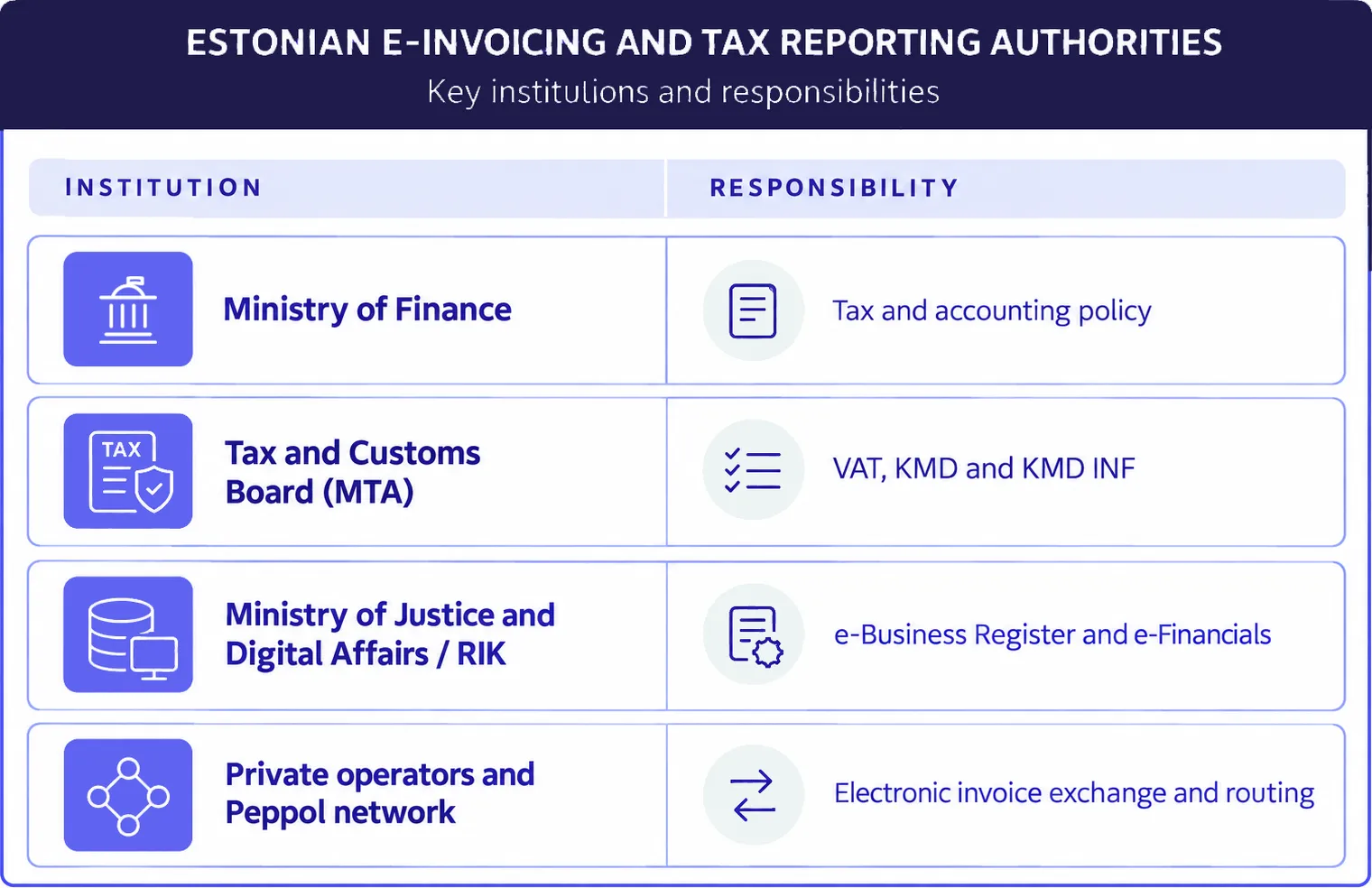
1. Ministry of Finance (Rahandusministeerium)
The Ministry of Finance (Rahandusministeerium) develops national tax and accounting policy and prepares related legislation. It also contributes to digital reporting initiatives and Estonia's implementation of relevant EU VAT requirements."
2. Estonian Tax and Customs Board (Maksu- ja Tolliamet - MTA)
The Estonian Tax and Customs Board (MTA) administers VAT registration, returns, audits and related compliance. It receives form KMD and the KMD INF annex, but does not operate a general real-time B2B invoice clearance system.
3. Centre of Registers and Information Systems (Registrite ja Infosüsteemide Keskus - RIK)
The Centre of Registers and Information Systems (RIK) is an agency of the Ministry of Justice and Digital Affairs. It operates the e-Business Register (e-Äriregister), where accounting entities record their e-invoice recipient status and receiving channel details. RIK also provides e-Financials, including a service for sending electronic invoices to public authorities.
4. OpenPeppol and accredited private service providers
Estonia's decentralised model uses domestic e-invoicing operators, reciprocal roaming arrangements and Peppol connectivity. Peppol Access Points operate under network-specific requirements, while local operators provide domestic invoice exchange services. Businesses are not universally required to connect to Peppol. See the European Commission's Estonia e-invoicing overview.
Which transactions require e-invoicing in Estonia?
Estonia applies buyer-choice e-invoicing requirements to registered accounting entities in B2B and B2G transactions. Consumer transactions and cross-border supplies follow separate rules:
Transaction classification | Invoicing obligation | Operational mechanism |
Business-to-Government (B2G) | Mandatory upon request | Public bodies are registered e-invoice recipients and may request structured invoices under Section 7¹(7). |
Government-to-Government (G2G) | Buyer-choice rules apply | Public-sector accounting entities may require structured e-invoices for relevant transactions, subject to statutory exceptions. |
Business-to-Business (B2B) | Mandatory upon buyer request | A registered e-invoice recipient may request a structured invoice under Section 7¹(7), subject to statutory exceptions. |
Business-to-Consumer (B2C) | No structured e-invoice mandate | Consumer sales remain subject to applicable VAT and receipt rules; no general EN 16931 requirement applies. |
Intra-EU cross-border | Current VAT and procurement rules | Invoice format and delivery depend on the buyer and applicable national law. ViDA adds covered cross-border B2B reporting from July 2030. |
Non-EU export/import | Customs and VAT rules | Invoice formats depend on the parties and applicable trade requirements; customs and VAT documentation obligations continue to apply. |
How does Estonia's B2B buyer-choice e-invoicing model work?
Under Section 7¹(7) of the Accounting Act, registered e-invoice recipients can require suppliers to issue structured invoices for purchased goods or services:
Registration: An accounting entity may register as an e-invoice recipient through the e-Business Register, either directly or through its authorised e-invoicing service provider. The registered entry identifies the relevant processing operator or other electronic receiving channel.
Statutory trigger: Once registered as an e-invoice recipient, an accounting entity may require a seller to issue an e-invoice for purchased goods or services under Section 7¹(7), subject to the exemptions in Section 7¹(8).
Supplier obligation: When a valid request is made by a registered recipient, the seller must provide an e-invoice unless a statutory exception applies. EN 16931-1 is presumed compliant, while the parties may agree to another suitable standard.
What are Estonia's electronic invoicing requirements?
E-invoices requested under the buyer-choice regime must meet the applicable format requirements. VAT invoice content and accounting retention duties are governed separately by national legislation.
Which electronic invoice formats are accepted in Estonia?
Under Section 7¹(7) of the Accounting Act, EN 16931-1 is presumed compliant. Trading partners may agree to another suitable e-invoicing standard:
The European standard EN 16931 (presumed compliant):
EN 16931-1 is the European semantic standard recognised under Estonia's Accounting Act.
Structured invoices may use compliant UBL 2.1 or UN/CEFACT CII syntax implementations. Peppol BIS Billing 3.0 uses UBL.
When no alternative standard is agreed, suppliers should use EN 16931-1 to satisfy the statutory presumption of correct formatting.
Source: Accounting Act, Section 7¹(7).
Estonian national e-invoicing standard (EVS 923:2014/AC:2017):
EVS 923:2014 defines the Estonian e-invoicing profile, supplemented by the 2017 corrigendum.
The national XML format may be used where both trading partners agree to an alternative relevant standard under Section 7¹(7).
Domestic software providers continue to support Estonian XML formats. Peppol BIS Billing 3.0 offers an additional option for interoperable exchanges with participating organisations.
Source: Estonian standardisation body, EVS 923:2014/AC:2017.
Which documents are not structured e-invoices?
The following formats do not satisfy a request for a machine-processable e-invoice under Section 7¹ of the Accounting Act:
Unstructured PDF attachments.
Word or spreadsheet documents (.docx, .xlsx).
Scanned invoices and image files (.jpg, .png).
Paper invoices.
These documents may still be used where structured e-invoicing is not required and the applicable accounting and VAT rules permit their use.
What information must Estonian invoices contain, and when must they be issued?
Under Section 37(1) of the Value-Added Tax Act, taxable persons generally must issue invoices within seven calendar days of the relevant supply event, subject to statutory exceptions. Invoice content requirements depend on the transaction and the applicable VAT rules.
The Accounting Act, Section 7, and the Value-Added Tax Act, Section 37, establish the relevant accounting and VAT invoice particulars. Required fields depend on the transaction and invoice type:
Invoice identifier: A unique invoice number identifying the tax document.
Dates: Invoice issuance date and supply or payment date where required under Section 37 of the VAT Act.
Party identification: Supplier and buyer names, addresses and relevant identification details as required by the VAT Act and the applicable e-invoice specification.
VAT identification: The supplier's VAT number where required, and the customer's VAT identification number in the transaction types specified by Section 37 of the VAT Act.
Supply details: Description and quantity or extent of goods or services, taxable amount, unit price and applicable discounts where required.
Financial breakdown: Taxable amounts by the applicable VAT rates, including the standard 24% rate, reduced rates of 13% and 9%, zero-rated supplies and exemptions where relevant, plus VAT and invoice totals.
Routing identifiers: Peppol exchanges use a registered participant identifier, commonly the Estonian organisation code under scheme 0191 (EE:CC). The recipient's actual identifier and network registration must be verified.
How long must electronic invoices be retained in Estonia?
According to Section 12 (§ 12) of the Accounting Act:
Under Section 12 of the Accounting Act, accounting source documents must generally be retained for seven years from the end of the financial year in which they were recorded. Separate rules apply to documents concerning long-term rights and obligations.
Section 12(5) generally requires machine-processable preservation of accounting documents, while allowing other permanently readable formats where machine-processable retention is not feasible without disproportionate costs or effort. Legibility and evidential value must remain intact.
Electronic archives may use suitable local or cloud infrastructure, provided the statutory retention, readability and accessibility requirements are met. Relevant accounting documents must be made available to the tax authority within a reasonable period upon request.
What electronic VAT reporting is mandatory in Estonia?
Estonia does not operate a general real-time invoice reporting or clearance system. Instead, VAT-registered businesses submit periodic tax returns using form KMD and report specified invoice data through the KMD INF annex.
Which transactions must businesses report through KMD INF?
Under Section 27 of the Value-Added Tax Act, VAT payers submit the monthly VAT return (käibedeklaratsioon, KMD) and its KMD INF annex. The annex contains prescribed invoice data, subject to reporting thresholds and exemptions:
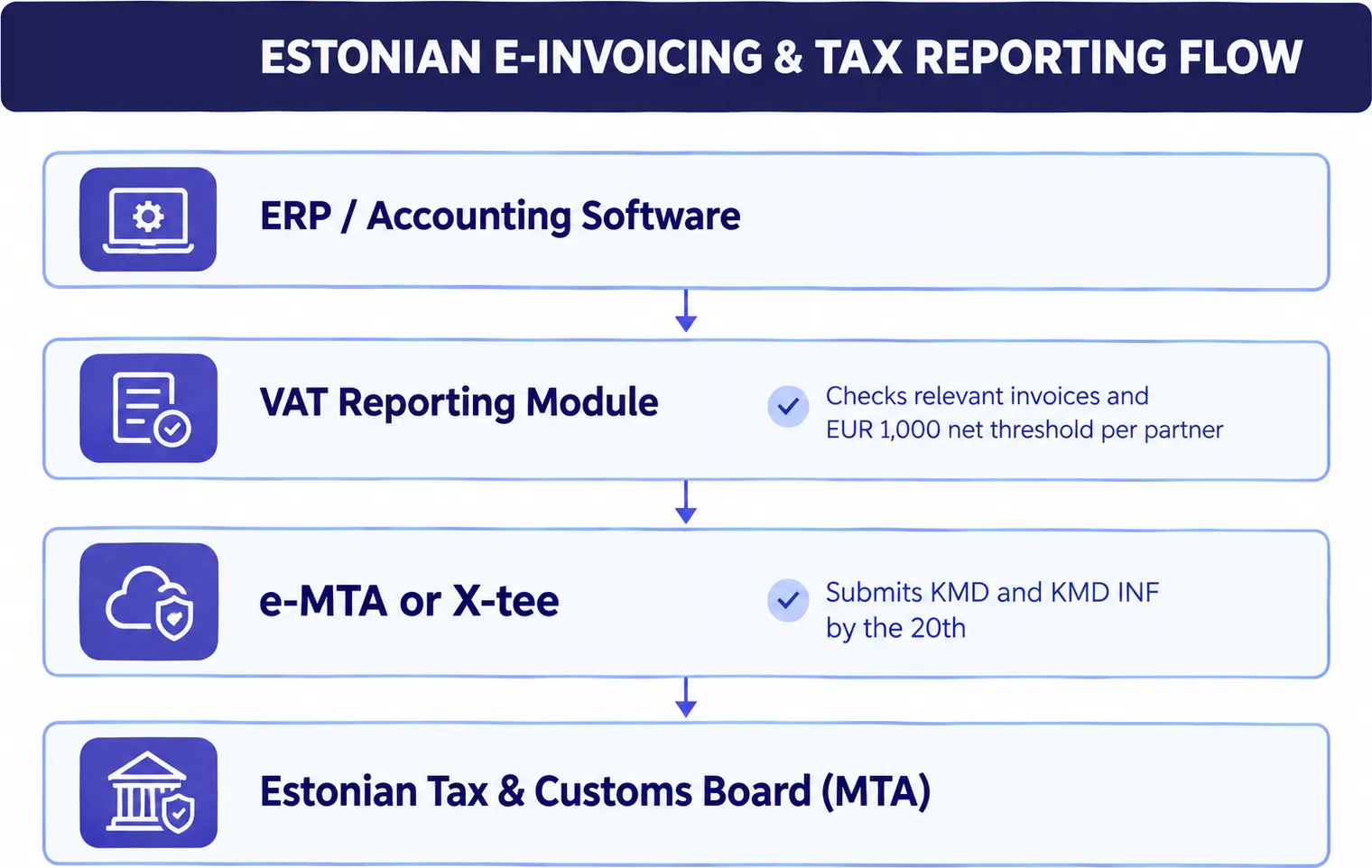
Reporting threshold: Relevant sales or purchase invoices must be reported where their combined value excluding VAT reaches at least EUR 1,000 per trading partner during the reporting period, subject to statutory exclusions.
Part A (Sales): Invoice-level reporting of relevant taxable sales where the combined net invoice value per business partner reaches EUR 1,000 during the reporting period.
Part B (Purchases): Invoice-level reporting of relevant domestic purchases where input VAT is deducted and the combined net value per supplier reaches the EUR 1,000 threshold.
Filing deadline: Submit KMD and KMD INF by the 20th day of the following month through e-MTA or an authorised electronic filing interface.
How can businesses automate VAT reporting through X-tee?
The Estonian Tax and Customs Board supports machine-to-machine filing of KMD and KMD INF through X-tee. Compatible accounting software can prepare and transmit the required VAT reporting data without manual portal entry. Businesses may alternatively enter information or upload XML or CSV files through e-MTA. Available automation depends on the accounting software and its supported integrations.
Is Estonia planning real-time VAT reporting?
Estonia has discussed further digital VAT reporting reforms, but no general domestic real-time invoice reporting mandate is in force as of October 2026. The Tax and Customs Board's VAT guidance describes a planned option from 2027 to submit standardised VAT source data through X-tee in XBRL GL format, while existing filing methods remain available. Separately, EU ViDA introduces digital reporting requirements for covered intra-EU cross-border transactions from 1 July 2030.
How does Estonia's decentralised e-invoicing network work?
"Estonia uses decentralised electronic invoice exchange through domestic service providers and roaming agreements, with Peppol supporting additional interoperability. The state does not require invoices to pass through a central tax clearance platform:
How are e-invoices exchanged between service providers?
Supplier: The supplier creates an invoice in its ERP or accounting software and exports structured data using EN 16931-compliant XML or another relevant format agreed with the buyer.
Sending operator: The supplier's service provider receives the invoice, performs the supported validation checks and determines the recipient's delivery channel through the relevant directory or routing arrangement.
Recipient lookup: Operators use registered e-invoice receiving details in the e-Business Register (e-Äriregister) or Peppol metadata services, as appropriate. The recipient's business identifier and network registration determine the available delivery route.
Receiving operator: The invoice is transmitted securely to the recipient's operator. Peppol uses its prescribed network protocols, while domestic roaming connections may use other supported methods.
Buyer: The receiving operator makes the structured invoice available to the buyer's accounting system. Subsequent validation, approval and ledger matching depend on the buyer's configured workflows.
How do domestic roaming and Peppol work together in Estonia?
Estonian e-invoicing providers support domestic interoperability through roaming arrangements. Where sending and receiving operators are interconnected, invoices can be transferred between their systems. Cross-border transactions may use Peppol when the relevant participants and service providers support the network. Routing does not automatically switch to Peppol for every international invoice. The European Commission's Estonia overview describes the country's decentralised model and available exchange options.
What are the penalties for e-invoicing and VAT reporting non-compliance in Estonia?
Non-compliance with Estonian invoicing and VAT reporting rules may result in contractual disputes, tax administration measures or statutory penalties, depending on the specific breach:
Risk category | Potential consequence |
Invoice non-compliance | Correction requests and payment disputes |
Tax reporting breaches | Statutory fines and enforcement measures |
Unsupported VAT deductions | Tax adjustments, interest and audit checks |
1. Commercial payment refusal and breach of statutory rules
Under Section 7¹(7) of the Accounting Act, a seller must provide an e-invoice when a registered recipient validly requests one, unless a statutory exception applies. A paper invoice or unstructured PDF alone does not satisfy that request.
The buyer may request a compliant e-invoice. Whether payment may be withheld depends on the contract and applicable civil law; Section 7¹ does not establish an automatic general right to refuse payment.
Failure to provide the requested invoice may lead to correction requests, processing delays or contractual disputes, potentially affecting the supplier's cash flow.
2. Administrative penalties under the Taxation Act (Maksukorralduse seadus)
Tax penalties depend on the specific statutory offence. In particular, Sections 153¹ and 154 of the Taxation Act distinguish false tax information affecting liabilities from failures to meet filing or record-keeping duties:
Under Section 154 of the Taxation Act, legal entities may face fines of up to EUR 3,200 for specified failures to submit returns, maintain required records or comply with tax authority instructions. Intentional false information that reduces tax liability or increases a refund claim may instead fall under Section 153¹, with fines of up to EUR 32,000 for legal entities.
The Tax and Customs Board may apply administrative enforcement measures, including penalty payments (sunniraha), where the statutory requirements are met. Such measures depend on the relevant order, breach and applicable procedural rules.
3. Audit scrutiny and input VAT deduction risks
The Estonian Tax and Customs Board uses KMD INF data to assess VAT reporting consistency and identify discrepancies between suppliers' declared sales and purchasers' input VAT claims.
Input VAT deduction depends on the substantive and documentary conditions of the VAT Act. An e-invoicing format error does not automatically invalidate a deduction, although inadequate evidence may create audit risks.
Unsupported VAT deductions may lead to tax adjustments, audits and interest on resulting tax arrears. Under Section 117 of the Taxation Act, the general tax interest rate is 0.06% per day, subject to applicable exceptions.
How can businesses prepare for Estonia's e-invoicing rules?
Businesses should prepare for Estonia's current buyer-choice requirements and future EU reporting obligations by reviewing invoice formats, registered receiving channels, master data and accounting workflows:
Step | Recommended action |
1. Register | Publish e-invoice receiving details |
2. Configure ERP | Support EN16931 and agreed formats |
3. Validate master data | Check registry and VAT identifiers |
4. Select an operator | Enable domestic or Peppol exchange |
5. Automate AP | Process and archive structured invoices |
1. Register as an e-invoice recipient in the e-Business Register
Businesses wishing to request structured invoices should register as e-invoice recipients through the e-Business Register. The registration should include the chosen electronic invoice receiving channel or operator. Under Section 7¹(3), the authorised service provider may also submit the registration details. Businesses should verify that their published information is current and that their receiving service is operational.
2. Upgrade enterprise ERP and accounting software
Check whether ERP and accounting systems can generate, validate and receive EN 16931-compliant invoices and other formats agreed with trading partners. Domestic EVS 923 support may remain relevant. Peppol BIS Billing 3.0 can improve interoperability with participating organisations but is not universally mandatory for Estonian businesses.
3. Review and cleanse customer and vendor master data
Reliable e-invoice exchange requires accurate recipient identifiers and delivery details. Validate relevant customer and supplier records, including the following fields where applicable:
Valid Estonian registry codes (registrikood) for domestic legal entities.
Valid Estonian VAT numbers (EE plus nine digits) where the partner is VAT-registered.
Peppol participant identifiers (commonly scheme 0191) where Peppol routing is used.
4. Select an e-invoicing service provider
Select an e-invoicing provider that supports the required invoice standards and delivery channels. Domestic operators can provide interoperable invoice exchange through roaming arrangements, while Peppol connectivity may support international trading partners. Before implementation, verify supported formats, recipient discovery, service availability and integration with existing accounting systems. The European Commission's Estonia overview explains the available infrastructure.
5. Automate accounts payable (AP) ingestion
Automating invoice receipt can complement compliant electronic invoice issuance. Finance teams should configure accounts payable workflows to import structured invoice data, validate relevant fields and route documents for approval. This can reduce manual processing and the need for OCR extraction.
What should businesses prioritise for Estonian e-invoicing compliance?
Estonia operates a decentralised e-invoicing framework without general government invoice clearance. Since 1 July 2025, the Accounting Act's buyer-choice provisions have applied to registered e-invoice recipients in both B2B and B2G transactions. Businesses exchange invoices through domestic operators and supported networks, while VAT reporting remains separate.
Estonia has not enacted a universal domestic B2B e-invoicing mandate for 2027. Businesses must nevertheless meet the current buyer-choice requirements where applicable. Registered e-invoice recipients may request structured invoices, with EN 16931-1 presumed compliant unless another appropriate standard is agreed. Companies should ensure that their accounting systems can meet these requirements and retain supporting records in accordance with the Accounting Act.
Businesses can improve readiness by validating master data, supporting agreed structured invoice formats and automating accounts payable processes. Peppol connectivity may support interoperability where relevant. Future EU ViDA requirements will introduce additional cross-border digital reporting obligations, but current Estonian compliance does not depend on universal Peppol adoption.
FAQ
No. Estonia does not have a general automatic B2B e-invoicing mandate for every domestic transaction. Since 1 July 2025, Section 7¹(7) of the Accounting Act allows accounting entities registered as e-invoice recipients to request structured invoices from suppliers. The right applies subject to statutory exceptions, including certain security-related and confidential transactions.