
This guide reflects the regulatory position assessed as at 9 October 2026. It incorporates the standard VAT rate increase to 25.5%, the reduced VAT rate adjustment to 13.5% effective from 1 January 2026, and the small-business VAT registration threshold of EUR 20,000. It also explains the statutory right to request structured electronic invoices under Act 241/2019, including the conditions applying to eligible buyers and suppliers.
Is electronic invoicing mandatory in Finland?
Electronic invoicing is not mandatory by default for all domestic business-to-business (B2B) transactions in Finland. Under Sections 2 and 4 of Act 241/2019, contracting authorities and traders meeting the statutory definition may request an EN 16931-compliant invoice from another covered entity. The EUR 10,000 financial-year turnover threshold applies to traders, not to contracting authorities generally. A valid request must be fulfilled, subject to the Act's exceptions. If no such request is made, trading partners remain free to agree on other formats, including paper or electronic PDF files, in accordance with Section 209 c of the Value Added Tax Act (1501/1993).
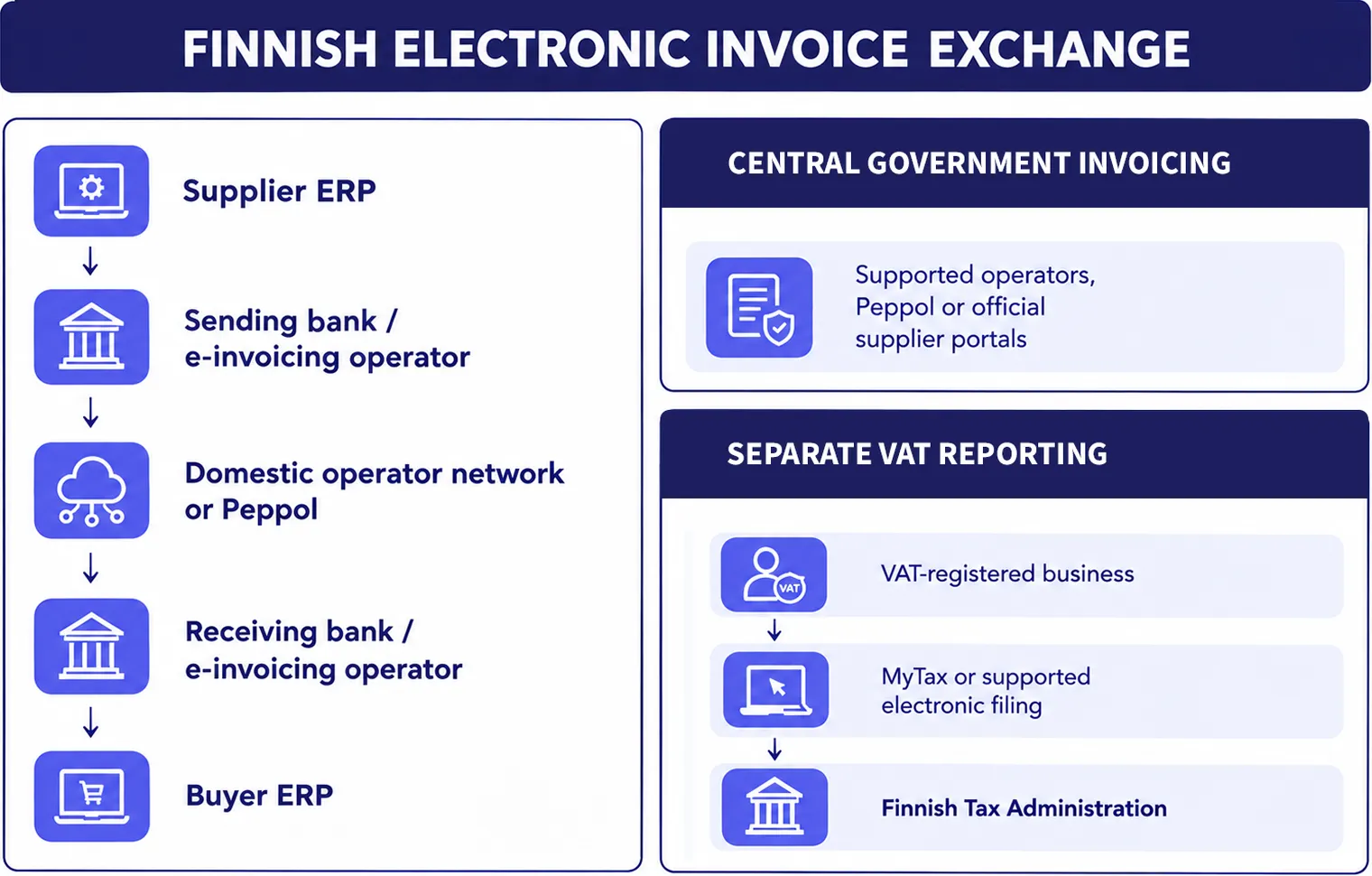
For B2G transactions, Section 3 of Act 241/2019 requires covered contracting authorities to receive and process EN 16931-compliant invoices relating to contracts within the applicable public procurement legislation. Invoice issuance obligations and central government submission requirements must be assessed separately. Finnish central government agencies generally accept only structured electronic invoices under the State Treasury's supplier invoicing instructions. Suppliers may use supported operators, Peppol or designated supplier portals, including free options for creating compliant e-invoices.
Electronic reporting is strictly decoupled from invoice transmission in Finland. The country does not operate a clearance model, continuous transaction controls (CTC), or real-time sales ledger reporting to the tax administration. VAT-registered businesses submit periodic self-assessed VAT returns through the Finnish Tax Administration's MyTax service or supported electronic filing channels. Invoice exchange remains separate from the submission of VAT returns. Businesses must also account for recent fiscal changes: the standard VAT rate is 25.5% under Law 462/2024, the reduced rate on food, restaurant services, books, and passenger transport is 13.5% under Law 1358/2025, and the small-business VAT threshold is EUR 20,000, subject to the applicable current- and previous-calendar-year tests under Finnish VAT exemption guidance.
How did Finland's e-invoicing framework develop within the EU?
Finland began developing electronic invoicing infrastructure in the early 2000s, driven primarily by commercial banks and software providers rather than direct state mandates. Financial institutions established the Finvoice standard to automate commercial accounting, while the telecommunications and software sectors developed TEAPPSXML. This development established electronic invoice exchange through banks and private operators before Finland introduced its statutory B2B request rights and public procurement reception requirements.
The legal landscape shifted following the adoption of Directive 2014/55/EU on electronic invoicing in public procurement. When transposing the directive through Act 241/2019, the Finnish Parliament went beyond the minimum requirements of EU public procurement law. In addition to mandating that public authorities accept EN 16931-compliant e-invoices, lawmakers inserted Section 4 into the statute. This provision created an enforceable right for private enterprises with an annual turnover exceeding EUR 10,000 to demand structured electronic invoices from their suppliers, effective from 1 April 2020.
At EU level, Council Directive (EU) 2025/516 establishes digital reporting requirements for covered intra-EU transactions from 1 July 2030. The ViDA reforms also change the EU rules governing national mandatory e-invoicing schemes, separately from Finland's current domestic requirements. While Finland participates in regional digitalisation programmes such as the Nordic Smart Government and Business (NSG&B) project and national Real-Time Economy (Yrityksen digitalous) studies, the Finnish government has not enacted early domestic transaction-level clearance or sales ledger reporting mandates ahead of the EU ViDA timeline.
What is the compliance timeline for Finnish e-invoicing and VAT?
The following table outlines the statutory milestones governing electronic invoicing, retail receipts, and VAT administration in Finland.
Date | Legal status | Milestone | Business impact |
|---|---|---|---|
1 January 2014 | Legislation in force | Receipt offering obligation under Act 658/2013 | Traders with turnover over EUR 10,000 must offer paper or digital receipts for cash and card sales. |
1 April 2019 | Operational mandate | B2G e-invoicing reception for central government under Act 241/2019 | Central government authorities must receive and process EN 16931 structured e-invoices. |
1 April 2020 | Applicable | Act 241/2019 extends e-invoice reception duties to other covered contracting authorities. | Includes eligible municipal and public utility contracting bodies. |
1 April 2020 | Operational mandate | Statutory B2B buyer-demand right under Act 241/2019, Section 4 | Qualifying traders can legally demand structured EN 16931 e-invoices from suppliers. |
1 September 2024 | Legislation in force | Standard VAT rate increased to 25.5% under Law 462/2024 | Taxpayers must update enterprise systems and apply 25.5% to standard-rated transactions. |
1 January 2025 | Legislation in force | VAT registration threshold raised to EUR 20,000 under Law 448/2024 | Small-business registration threshold increases; the graduated tax relief scheme is repealed. |
1 January 2026 | Legislation in force | Reduced VAT rate lowered to 13.5% under Law 1358/2025 | Groceries, restaurant meals, books, medicines, and transport transition from 14% to 13.5%. |
9 October 2026 | Reference date | Regulatory position assessed for this guide. | Current legal requirements are distinguished from future EU measures. |
1 July 2030 | Future enacted | Directive (EU) 2025/516 introduces EU digital reporting requirements. | Covered intra-EU cross-border transactions become subject to the new e-invoicing and reporting rules. |
Which laws govern e-invoicing and VAT reporting in Finland?
Finland's e-invoicing, VAT reporting, receipt and accounting requirements are governed by national legislation, applicable EU measures and official administrative guidance:
Act on Electronic Invoicing of Contracting Authorities and Traders (Laki hankintayksiköiden ja elinkeinonharjoittajien sähköisestä laskutuksesta 241/2019): Transposes Directive 2014/55/EU into Finnish law. Under Sections 3 and 4, it establishes the obligation for contracting authorities to receive structured electronic invoices conforming to EN 16931 and grants qualifying traders the legal right to demand structured e-invoices from their commercial suppliers.
Value Added Tax Act (Arvonlisäverolaki 1501/1993, AVL): Regulates VAT liability, registration thresholds, and mandatory invoice particulars under Sections 209 a through 209 u. Section 209 c governs electronic invoicing consent and related requirements under the VAT Act. Separately, Section 4 of Act 241/2019 establishes the right of covered contracting entities to request a structured e-invoice. Both provisions must be interpreted within their respective scopes.
Act on Assessment Procedure for Self-Assessed Taxes (Laki oma-aloitteisten verojen verotusmenettelystä 768/2016, OVML): Governs administrative filing procedures, electronic transmission requirements, and late-submission penalties for periodic VAT returns under Sections 16, 32, 35, 36, 37, 38, and 39.
Act on the Obligation to Offer a Receipt in Cash Transactions (Laki kuitintarjoamisvelvollisuudesta käteiskaupassa 658/2013): Requires commercial traders with annual turnover exceeding EUR 10,000 to provide paper or digital receipts for payments made by cash, payment cards, or equivalent immediate payment methods.
Accounting Act (Kirjanpitolaki 1336/1997, KPL): Regulates the maintenance of accounting records, verification audit trails, and document retention rules under Chapter 2, Sections 7, 9, 10, and 10 a.
Åland Tax Border Act (Laki Ahvenanmaan maakuntaa koskevista poikkeuksista arvonlisävero- ja valmisteverolainsäädäntöön 1266/1996): Sets out specific fiscal derogations for the autonomous province of the Åland Islands, which remains outside the EU VAT and excise territory under Protocol No 2 to Finland's EU Accession Treaty.
Which authorities oversee e-invoicing and tax compliance in Finland?
The administration of electronic invoicing, public procurement standards, and tax compliance involves several public authorities and standardisation bodies.
Institution | Institutional role | Key compliance responsibility |
|---|---|---|
Ministry of Finance (Valtiovarainministeriö) | Fiscal policy and preparation of legislation | Prepares tax and finance policy and relevant legislative proposals. |
Finnish Tax Administration (Verohallinto) | Tax assessment, administration, and audit | Manages MyTax and Vero API systems, audits VAT returns, and enforces cash receipt rules. |
State Treasury (Valtiokonttori) | Central government financial administration | Directs central public procurement e-invoicing and oversees state receiving channels. |
E-invoicing interoperability and directory services | Maintains the national e-invoice address directory; Finance Finland publishes Finvoice. | |
Peppol network and national authority | OpenPeppol maintains network specifications; the State Treasury acts as Finland's Peppol Authority. | |
Finnish Tax Administration, Police and Finnish Supervisory Agency | Receipt compliance supervision | Tax Administration and Police enforce receipt rules; the Supervisory Agency also oversees licensed alcohol-serving premises. |
Which transactions are covered by Finland's e-invoicing rules?
The legal scope of electronic invoicing in Finland depends on the contracting parties, turnover thresholds, and transaction classifications.
Transaction type | Issuance requirement | Reception requirement | Reporting requirement | Effective date | Main exceptions |
|---|---|---|---|---|---|
Domestic B2B | Issuance on qualifying buyer request | Eligible buyers may request structured invoices | VAT returns for registered taxpayers | 1 April 2020 | EUR 10,000 trader threshold; statutory confidentiality exceptions. |
Domestic B2G | Structured invoices under applicable request and state rules | EN 16931 reception for covered procurements | VAT returns where applicable | 1 April 2019 / 1 April 2020 | Statutory security and confidentiality exceptions. |
Domestic B2C | E-invoicing optional; receipts offered for covered payments | Consumer e-receipts optional | VAT returns where registered | 1 January 2014 | EUR 10,000 threshold and statutory retail exceptions. |
Intra-EU cross-border | Applicable national and EU invoicing rules | Recipient and transaction requirements | EU Sales List for reportable supplies; VAT return where applicable | Current rules | Transaction-specific exemptions. |
Third-country cross-border | Invoicing depends on place-of-supply rules | Recipient requirements vary | VAT and customs reporting where applicable | Current rules | Export, import and special-procedure conditions. |
Foreign suppliers | Assess Act 241/2019 and applicable invoicing rules | Depends on transaction and recipient | Finnish VAT reporting or reverse charge where applicable | Current rules | No blanket establishment-based exemption confirmed. |
Which businesses qualify for B2B e-invoicing requests in Finland?
Under Sections 2 and 4 of Act 241/2019, the EUR 10,000 financial-year turnover threshold determines whether an undertaking qualifies as a trader for the Act. Covered contracting authorities also have the request right. Businesses below the threshold do not qualify as traders under this definition, but other VAT and accounting obligations may still apply.
How do Finland's VAT and e-invoicing rules affect foreign suppliers?
Under Section 9 of the Finnish VAT Act, reverse charge may shift VAT liability to the buyer for qualifying supplies by a non-established seller. Exceptions apply, including certain consumer and transaction categories. Whether a foreign supplier falls within Act 241/2019 must be assessed separately. The Act does not expressly provide a universal exemption solely because the supplier lacks a Finnish fixed establishment.
How does the Åland tax border affect invoicing and VAT?
The autonomous province of the Åland Islands holds special status under Protocol No 2 to Finland's EU Act of Accession. While domestic Finnish VAT rates and general bookkeeping standards apply in Åland, the territory sits outside the EU VAT and excise area under the Åland Tax Border Act (1266/1996). Consequently, movements of goods between mainland Finland and Åland generally cross a VAT and excise tax border. Export, import and declaration procedures apply according to the relevant transaction and Åland-specific rules, with applicable simplifications and exceptions.
What are the technical e-invoicing requirements in Finland?
When a structured e-invoice is required under Act 241/2019, it must meet the applicable European standard and syntax requirements. A standard emailed PDF does not fulfil this structured-invoice requirement.
When must invoices be issued in Finland?
Under the Finnish VAT invoicing guidance, invoices for intra-Community goods supplies and specified cross-border services must generally be issued by the 15th day of the following month. The VAT Act does not establish an equivalent universal deadline for all other supplies.
Format or specification | Technical status | Applicable transaction scope | Specification version |
|---|---|---|---|
Finvoice | National XML format supporting EN 16931 when correctly validated | Domestic B2B and B2G | Version 3.0 |
TEAPPSXML | National XML format supporting EN 16931-compliant invoices | Domestic B2B, B2G and operator exchange | Version 3.0 |
Peppol BIS Billing | EN 16931-aligned interoperability specification | B2G and B2B where supported | Version 3.0, using UBL 2.1 |
UBL / UN/CEFACT CII | European standard syntax bindings, subject to validation | Depends on recipient and delivery channel | Applicable EN 16931 syntax specification |
Unstructured PDF | Not compliant with a valid structured e-invoice request | Other transactions where legally permitted | Not applicable |
What information must Finnish VAT invoices contain?
Under Section 209 e of the Value Added Tax Act (AVL), every full tax invoice must contain the following core particulars:
Date of issue (laskun antamispäivä).
Sequential invoice number based on one or more series (juokseva tunniste).
Supplier's VAT identification number or corresponding Business ID, as required by Section 209 e of the VAT Act.
Customer's VAT identification number where the customer is liable for tax via reverse charge or in intra-Community supplies.
Full legal names and addresses of both supplier and customer.
Quantity and description of goods supplied, or extent and nature of services performed.
Date of supply or date of advance payment, where distinct from the issuance date.
Taxable amount (veron peruste) broken down by VAT rate or exemption.
Unit price exclusive of VAT, along with discounts or rebates not included in the unit price.
Applicable VAT rates (such as 25.5%, 13.5%, 10%, or 0%).
Total VAT payable expressed in euros.
Applicable exemption or reverse-charge reference, using the required wording or legal reference for the transaction.
Required self-billing wording (itselaskutus) where applicable, along with margin-scheme references, corrective invoice references and other prescribed transaction-specific particulars.
Under Section 209 f of the VAT Act, simplified invoice particulars may be used for invoices totalling up to EUR 400, subject to statutory exclusions. They also apply in certain retail, catering, passenger transport and parking transactions. Required information includes the issue date, supplier details, supply description, VAT information and correction references where applicable.
Are electronic signatures required for Finnish e-invoices?
Electronic signatures are not legally mandatory for electronic invoices in Finland. The Finnish Tax Administration's VAT invoice guidance explains that authenticity of origin, integrity of content and legibility can be maintained through reliable business controls and a verifiable audit trail linking the invoice to the underlying transaction. While advanced electronic signatures conforming to the EU eIDAS Regulation are legally recognised, they remain voluntary. In Peppol network transmissions, transport security is secured using AS4 protocol digital certificates.
How long must electronic invoices be retained in Finland?
Under Chapter 2, Section 10 of the Accounting Act, accounting vouchers generally must be retained for six years from the end of the calendar year in which the financial year ended. Financial statements and specified accounting records must be retained for ten years. VAT invoices also have separate retention requirements, while certain property-related records require longer retention.
Archiving may be conducted entirely in electronic format under Sections 9 and 10 a of the Accounting Act. Converting paper vouchers into electronic files, or transforming invoices between electronic formats, is permitted provided that the audit trail (kirjausketju) remains verifiable and the data can be reproduced in human-readable visual form upon request. Electronically stored invoices held abroad are subject to specific accessibility requirements under Section 209 o of the VAT Act. The Finnish Tax Administration requires complete real-time computer access to such records. Domestic invoice archives must be accessible for examination without undue delay.
What electronic VAT reporting is required in Finland?
Finland does not operate a transaction-by-transaction digital reporting system, invoice clearance hub, or electronic sales ledger for domestic trade. Tax reporting is carried out through periodic self-assessed tax returns and EU recapitulative statements.
Reporting mechanism | Covered taxpayers | Reported data | Reporting frequency | Statutory deadline | Official submission channel |
|---|---|---|---|---|---|
VAT return (arvonlisäveroilmoitus) | VAT-registered taxpayers | Taxable sales, output VAT, deductions and applicable cross-border data | Monthly, quarterly or annual | Monthly/quarterly: 12th of the second following month; annual: end of February | MyTax or supported e-filing |
EU VAT recapitulative statement (yhteenvetoilmoitus) | Taxpayers with reportable EU supplies | Customer VAT identifiers, supply values and triangulation data | Monthly | 20th of the following month, or next business day | MyTax or supported electronic service |
OSS / IOSS returns | Businesses registered for applicable special schemes | Covered B2C sales and qualifying imported distance sales | Quarterly for Union/non-Union OSS; monthly for IOSS | End of following month | MyTax special schemes |
Domestic transaction clearance | None | Not applicable in Finland | Not applicable | Not applicable | No domestic clearance platform exists |
Which VAT filing periods and turnover thresholds apply in Finland?
Finnish VAT reporting periods are generally monthly, with quarterly or annual periods available to eligible taxpayers according to turnover and special activity rules. The Finnish Tax Administration's official tax-period guidance explains the eligibility conditions and application procedure:
Monthly filing: The standard tax period applicable to all VAT-registered taxpayers by default. It is mandatory for businesses with annual turnover exceeding EUR 100,000.
Quarterly filing: Available upon application for businesses whose annual turnover does not exceed EUR 100,000.
Annual calendar-year filing: Available to eligible businesses with turnover up to EUR 30,000. Agricultural and forestry operators, certain primary producers and visual artists generally use annual periods where their activities meet the special conditions.
Monthly and quarterly VAT returns are generally due by the 12th day of the second month following the tax period. Annual VAT returns are due at the end of February of the following year. If a deadline falls on a weekend or public holiday, it normally moves to the next business day. See the official VAT filing deadlines.
When must Finnish retailers offer cash or card payment receipts?
Finland does not operate a certified cash register hardware regime, digital fiscal memory rules, or real-time fiscal transmission to tax authorities. However, under the Act on the Obligation to Offer a Receipt in Cash Transactions (658/2013), businesses with an annual financial year turnover exceeding EUR 10,000 must offer a receipt to customers paying by cash, debit card, or credit card. The receipt may be delivered on paper or electronically (such as by email, SMS, or mobile application). Receipts must detail the trader's name, Business ID, date, sequential number, item descriptions, and VAT breakdown. Statutory exemptions include certain outdoor market sales, vending machines and unattended automated payment arrangements. The exact exceptions, including those affecting alcohol sales, are set out in Act 658/2013.
How are electronic invoices exchanged in Finland?
Finland uses decentralised electronic invoice exchange through banks, domestic operators and Peppol services. Peppol follows a four-corner network model, while domestic banking and operator arrangements may use different routing structures. Commercial invoices do not pass through a general government clearance platform.
Which OVT and Peppol identifiers are used in Finland?
The Finnish OVT identifier consists of the fixed prefix 0037, an eight-digit Business ID without its hyphen and an optional suffix of up to five characters. For Peppol routing, Finnish organisations use the participant identifier scheme 0216, followed by their registered OVT code, for example 0216:003712345678. The service provider manages the relevant network registration and participant discovery. The Finnish State Treasury specifies scheme 0216 for official Peppol addressing.
Tieke maintains the Finnish e-invoice address directory (Verkkolaskuosoitteisto), which provides recipient addressing and operator information for participating organisations. Peppol participant registrations and supported document services are managed separately through Peppol's discovery infrastructure.
How do suppliers send e-invoices to Finnish central government?
Finnish central government agencies receive structured e-invoices through supported operators, Peppol and designated supplier portals. State Treasury guidance identifies Posti Messaging as an operator used for central government invoice exchange. Suppliers must use a receiving channel and compliant invoice format accepted by the relevant government agency. Options include domestic e-invoicing operators, Peppol and official supplier portals. The recipient's e-invoice address and technical requirements should be verified before transmission. Central government systems automatically reject invoices submitted in non-structured formats.
What are the penalties for e-invoicing and VAT non-compliance in Finland?
Finnish law provides separate sanctions for specified VAT reporting, invoice documentation and receipt offences. Under Section 39 of Act 768/2016, failure to fulfil certain tax-related invoicing or record-keeping obligations following an authority's request may result in a negligence penalty of up to EUR 5,000. Different provisions govern late VAT returns, tax increases and retail receipt offences. Finnish tax reporting and receipt obligations are subject to specific statutory penalties. A failure to meet a valid e-invoice request may also lead to correction requests or contractual disputes, depending on the circumstances.
Offence | Liable taxpayer | Penalty or operational sanction | Legal basis |
|---|---|---|---|
Failure to fulfil a valid structured e-invoice request | Covered contracting entities and traders | Request for a compliant invoice; contractual remedies depend on the circumstances | |
Non-compliant central government invoice | Government suppliers | Rejection and request for correction under applicable invoicing procedures | |
Late VAT return | VAT taxpayers | EUR 3 daily, maximum EUR 135; after 45 days, an additional 2% of late-reported payable tax, capped at EUR 15,000 per tax type and period | |
Incorrect or omitted VAT reporting | Liable taxpayers | Tax increase generally 10% of additional tax; 15–50% for specified repeated or serious neglect, with statutory reductions and minimums | |
Failure to offer a required receipt | Traders subject to Act 658/2013 | EUR 300–1,000 negligence fee; reduction or waiver possible for qualifying minor breaches | |
Late payment of VAT | Taxpayers with overdue tax | Statutory late-payment interest from the day after the due date until payment |
What happens if a supplier fails to provide a required e-invoice?
Act 241/2019 establishes the right of covered buyers to request structured electronic invoices but does not prescribe a specific administrative fine for breach of that request right. Businesses receiving a non-compliant invoice may request correction. Whether payment can be withheld, or whether interest and collection charges arise, depends on the applicable contract and civil law. These consequences must not be treated as automatic under Section 4.
Can invoice errors affect input VAT deductions in Finland?
Under Sections 102 and 102 a of the AVL, a buyer's right to deduct input VAT requires the possession of an invoice containing the particulars prescribed by Section 209 e. The Finnish Tax Administration's VAT invoice guidance explains that formal invoice defects do not invariably prevent input VAT deduction where the legal conditions are otherwise established. Businesses must still retain appropriate evidence and satisfy the substantive deduction requirements.
How can businesses prepare for Finnish e-invoicing rules?
Businesses operating in Finland should review their billing processes, tax engines, and software connections to maintain compliance with commercial demand rights and reporting requirements.
Assess commercial turnover and mandate scope: Determine whether your business qualifies as a trader under Act 241/2019. Assess whether a request comes from a covered trader or contracting authority and whether a statutory exception applies.
Upgrade billing systems to EN 16931 standards: Supported formats include correctly implemented Finvoice 3.0, TEAPPSXML 3.0 and Peppol BIS Billing 3.0. Validate the actual invoice content against the relevant European standard and the recipient's requirements. Older formats that cannot meet these requirements are unsuitable for qualifying structured invoice requests.
Establish connectivity: Choose an invoice delivery method supported by the business and its recipients. Options include domestic bank and operator networks, Peppol and designated supplier portals where available.
Publish routing identifiers: Verify your OVT address and operator details in Tieke's directory, where applicable. For Peppol routing, confirm the correctly registered 0216 participant identifier. Recipient discovery depends on the network and provider.
Configure applicable VAT rates in accounting software: Configure the 25.5% standard rate, 13.5% reduced rate for qualifying supplies and 10% rate for eligible newspapers and periodicals. Retain historical rate configurations for transactions subject to earlier rates. See the Finnish Tax Administration's current VAT rates.
Implement digital archiving controls: Maintain accounting and VAT invoices for the applicable statutory retention periods. Ensure authenticity, integrity, legibility and a verifiable audit trail. Original XML preservation may be useful, but lawful format conversion is permitted where the relevant safeguards remain satisfied.
What are the key compliance takeaways for businesses in Finland?
Finland combines high market adoption of electronic invoicing with a decentralised regulatory framework. Rather than implementing state-run continuous transaction controls, Finland relies on a private operator ecosystem, public procurement mandates, and a statutory buyer-demand right for structured EN 16931 electronic invoices under Act 241/2019. Businesses should determine whether they are required to issue structured invoices under Act 241/2019 and support an appropriate EN 16931-compliant format and accepted delivery method for the relevant recipient. No universal obligation to implement all named formats applies.
Relevant businesses must apply the correct VAT rates, submit returns according to their approved reporting periods and retain records for the applicable statutory periods. Requirements differ between ordinary accounting vouchers, financial statements, VAT invoices and certain specialised records.
FAQ
Under Sections 2 and 4 of Act 241/2019, qualifying traders and contracting authorities may request EN 16931-compliant invoices from other covered entities. Suppliers must comply with valid requests, subject to statutory exceptions. If no request is made, trading partners may agree to use other formats