
This article was last updated on 8 October 2026 to reflect the official launch of France’s e-invoicing and e-reporting reform. It incorporates the confirmed implementation timetables, updated operational guidance from the tax authorities, the refined architectural role of accredited partner platforms (Plateformes Agréées), and the government's announcement of a supportive soft-landing approach - prioritising business guidance, onboarding resources, and a penalty-free grace period throughout 2026 to ensure a smooth transition.
Introduction & digital tax strategy
France is undergoing a digital transformation of its tax administration, building upon the established B2G electronic invoicing framework to introduce mandatory B2B electronic invoicing and transaction e-reporting. Together, these measures form a key pillar of the French government's strategy to modernise VAT collection, reduce the national VAT gap, and streamline administrative workflows for over four million businesses.
By transitioning from paper and unstructured PDF documents to structured electronic invoices, the Direction Générale des Finances Publiques (DGFiP) seeks to achieve real-time transaction visibility. This enables automated VAT pre-filling, reduces audit overheads, and curbs fraudulent practices such as carousel fraud.
Understanding the implementation schedule, exchange mechanisms, and technical standards is essential for businesses operating in France. Organisations must review internal invoicing workflows, update enterprise resource planning (ERP) systems, and establish connections with accredited partner platforms to ensure full compliance ahead of statutory enforcement deadlines.
Historical evolution & EU/global context
France's transition towards structured B2B e-invoicing and digital transaction reporting has developed through several administrative and legislative milestones:
Public procurement mandate (B2G): Electronic invoicing was first introduced for Business-to-Government (B2G) transactions using the Chorus Pro portal. The B2G electronic invoicing issuance obligation was phased in by supplier size and became mandatory for all public-sector suppliers by January 2020.
Legal foundation and operational framework for B2B mandate: Groundwork for the introduction of mandatory B2B electronic invoicing and transaction/payment-data e-reporting was established through successive finance laws, ordinances, and decrees, defining structured formats, directory management, and the role of accredited platforms. The detailed invoice formats, data fields and lifecycle-status rules are set out in the associated technical specifications and administrative guidance.
Timeline adjustment: Implementation schedules were formally rescheduled, shifting the go-live timeline of the first mandatory phase from July 2024 to September 2026, granting businesses and platform developers additional preparation time.
Architectural refinement: In 2024-2026, the French Government refined the central exchange model, scaling back the public portal (Portail Public de Facturation, or PPF) from acting as a general free invoice-exchange platform to serving as the central directory (Annuaire) and tax data concentrator (Concentrateur de données). B2B invoice issuance, reception, and transmission, as well as reporting the required transaction and payment data to the tax administration, was reassigned exclusively to accredited partner platforms (Plateformes Agréées, or PAs).
Recodification and European alignment: National VAT provisions were recodified into the new Code des impositions sur les biens et services (CIBS), aligning France’s model with broader European Union initiatives, including the VAT in the Digital Age (ViDA) proposal, providing a foundation for future EU-wide digital reporting requirements.
Compliance timeline
France's e-invoicing rollout follows a progressive implementation strategy. While electronic invoicing for Business-to-Government (B2G) transactions was phased in between 2017 and 2020 via the Chorus Pro portal, the private-sector B2B mandate experienced initial scheduling adjustments. Originally slated to begin in July 2024, the timeline was formally rescheduled to grant businesses and platform developers additional preparation time.
The updated e-invoicing and e-reporting framework enters into force through a phased timetable based on business size, with universal receiving obligations beginning on 1 September 2026 for all businesses established in France that are liable for VAT and within the mandate’s scope.
Date | Business category | Receiving obligation | Issuance & e-reporting obligation |
1 September 2026 | Large enterprises (Grandes entreprises) | Mandatory | Mandatory |
1 September 2026 | Mid-tier enterprises (Entreprises de taille intermédiaire - ETI) | Mandatory | Mandatory |
1 September 2027 | Small & medium enterprises (PME) | Mandatory (active since 2026) | Mandatory |
1 September 2027 | Micro-enterprises & VSEs (TPE) | Mandatory (active since 2026) | Mandatory |
Note: Business classification follows criteria defined under Décret n° 2008-1354 du 18 décembre 2008 (headcount, annual turnover, and balance sheet total). The relevant category should be confirmed for the entity concerned.
Legal framework
The legal architecture governing French digital tax reporting comprises primary legislation, executive decrees, tax code provisions, and technical specifications:
Loi n° 2023-1322 du 29 décembre 2023 de finances pour 2024 (Article 91): Defines the binding implementation timeline starting 1 September 2026.
Ordonnance n° 2021-1190 du 15 septembre 2021: Establishes the legal framework for structured e-invoicing, e-reporting, and the role of accredited platforms.
Décret n° 2022-1299 du 7 octobre 2022: Codified in Article 242 nonies A of the Code général des impôts (CGI), specifying mandatory invoice data fields, reporting intervals, and transmission rules.
Arrêté du 7 octobre 2022: Outlines registration rules for accredited partner platforms and technical specifications for directory integration.
Ordonnance n° 2025-1247 du 17 décembre 2025: Recodifies French VAT provisions, including relevant e-invoicing provisions, into the Code des impositions sur les biens et services (CIBS).
DGFiP external specifications and standards (Spécifications externes et normes pour la facturation électronique): Define the formats and exchange arrangements for France’s e-invoicing and e-reporting framework, including PPF directory and reporting services, invoice and payment-data flows, APIs, validation materials and invoice lifecycle-status messages. The specifications are supplemented by AFNOR standards and are updated periodically; businesses should therefore consult the latest applicable version.
Authorities
Several administrative and technical entities support and oversee the French digital tax framework:
Direction Générale des Finances Publiques (DGFiP): The DGFiP is France's national tax authority within the Ministry of Economy, Finance and Industrial and Digital Sovereignty. It develops and administers the legal and technical framework, publishes specifications, registers and supervises Plateformes Agréées, manages the public directory and data-concentration functions, and receives and processes invoice, transaction and payment data for tax-administration purposes.
Agence pour l’Informatique Financière de l’État (AIFE): The AIFE develops and operates major French public-finance information systems, including Chorus Pro, the public portal used for electronic invoicing between suppliers and public-sector entities. Chorus Pro remains relevant to B2G invoicing and should not be confused with the PA/PPF architecture used for private-sector B2B e-invoicing.
Chorus Pro: Chorus Pro is the French public-sector e-invoicing platform. It remains the principal channel for submitting and processing invoices issued to public-sector bodies under the B2G regime. Its role is distinct from that of the Portail Public de Facturation and the Plateformes Agréées used for the private-sector B2B mandate.
Association Française de Normalisation (AFNOR): AFNOR is France’s national standards organisation. It develops and publishes the standards and technical guidance supporting the semantic and technical interoperability of French electronic invoicing, including the applicable invoice formats, data models and exchange requirements. AFNOR supports standardisation but does not supervise taxpayers or accredit Plateformes Agréées.
Service d'Immatriculation (SI): A specialised department within the DGFiP responsible for assessing, accrediting, and monitoring private service providers applying for partner platform (Plateformes Agréées) status. It also monitors compliance with the applicable conditions, including tax compliance, security and interoperability requirements.
Portail Public de Facturation (PPF): Operated by the State in cooperation with the Agence pour l'Informatique Financière de l'État (AIFE), the Portail Public de Facturation manages the central directory (Annuaire) and acts as the central data concentrator (Concentrateur de données). Accredited platforms (PAs) transmit the relevant invoice, transaction and payment data to the public administration, DGFiP, through this architecture.
Plateformes Agréées (PAs): Formerly referred to as Plateformes de Dématérialisation Partenaires (PDPs), Plateformes Agréées are private operators registered by the DGFiP to provide regulated e-invoicing and e-reporting services, who are certified for three-year renewable terms, subject to the applicable conditions. PAs validate structured invoices, convert document formats, handle transmission between trading partners, track lifecycle statuses, and submit mandatory e-reporting data to the PPF.
Businesses and their software providers: Businesses remain responsible for meeting their obligations even when they use a PA, ERP provider or other service provider. A PA facilitates compliance but does not transfer the taxpayer’s legal responsibility.
Scope of the mandate
The French framework comprises three primary digital reporting channels: B2G electronic invoicing via Chorus Pro (phased in between 2017 and 2020), structured B2B e-invoicing via Plateformes Agréées (rolling out between 2026 and 2027), and e-reporting for B2C and cross-border transactions (operating on the same 2026–2027 timeline).
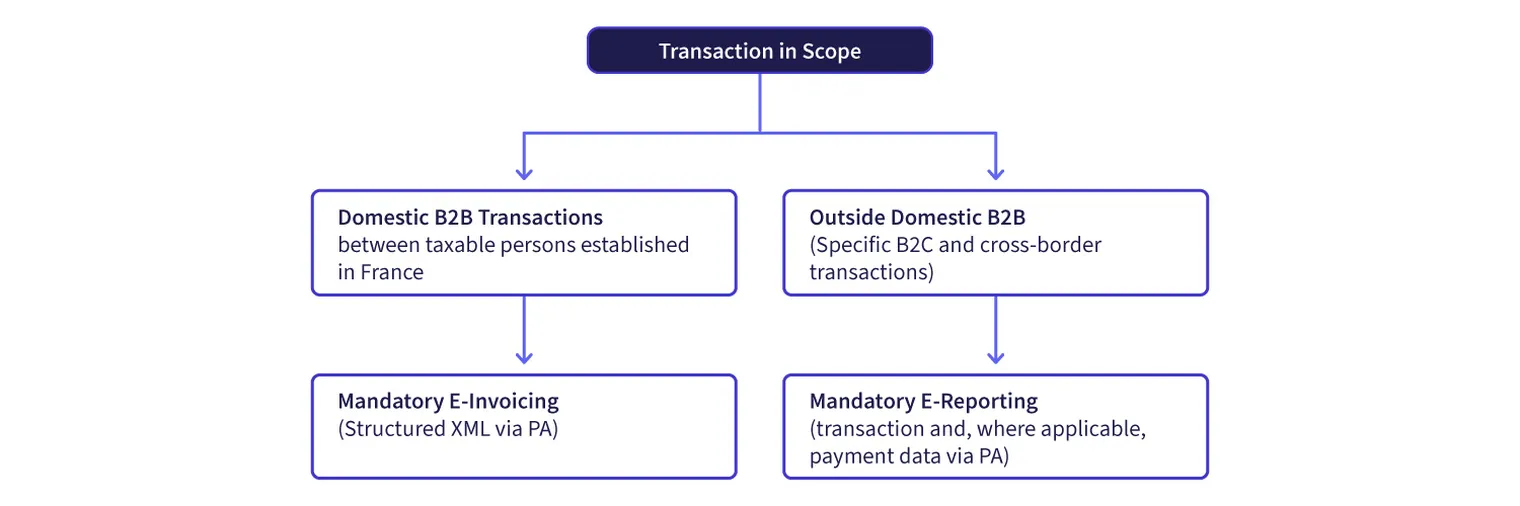
Transactions subject to mandatory e-invoicing
Electronic invoicing applies to domestic Business-to-Business (B2B) transactions where:
The transaction is a domestic supply of goods or services between two taxable persons established in France for VAT purposes.
The transaction is subject to French VAT invoicing rules under the Code général des impôts and is not excluded from the e-invoicing perimeter by a specific exemption.
Certain transactions that are exempt from VAT and exempt from the obligation to issue an invoice under the applicable provisions of Articles 261 to 261 E of the CGI fall outside mandatory e-invoicing. Examples may include certain healthcare, education, non-profit, financial and real-estate activities. The treatment depends on the specific transaction and applicable exemption; businesses should not assume that every VAT-exempt transaction is outside the framework.
Transactions subject to mandatory e-reporting
E-reporting applies to commercial transactions that fall outside domestic B2B e-invoicing, requiring data transmission to the tax administration:
Business-to-Consumer (B2C) sales of goods and services and other sales to non-taxable persons where the transaction is taxable in France.
Specified cross-border B2B transactions, including supplies to businesses established outside France and certain purchases or acquisitions from foreign suppliers, where the relevant French transaction or VAT data must be reported.
Certain taxable transactions in France carried out by non-established taxable persons with French VAT obligations or that otherwise fall within the French e-reporting rules.
E-reporting may also include payment-status data for certain service transactions, particularly where VAT is payable upon receipt (TVA sur les encaissements).
It’s worth noting that a transaction outside mandatory e-invoicing is not automatically exempt from digital reporting. Depending on the facts, it may fall within e-reporting or outside both obligations. The analysis should consider the parties’ establishment status, VAT liability, place of taxation, transaction type, and applicable exemptions. In case of doubt, businesses should consult a qualified tax advisor to analyse their specific operational scenarios and establish precise compliance requirements.
France's e-invoicing requirements
For transactions within the French mandate, e-invoicing replaces paper and unstructured PDF documents with structured electronic formats compatible with the applicable French and European requirements, including the EN 16931 standard.
Accepted electronic invoice formats
In-scope invoices exchanged through accredited partner platforms must be generated in a compliant structured or hybrid format supported by the French technical specifications. The three principal structured syntax formats used in France are:
Factur-X: A hybrid format combining a human-readable PDF/A-3 file with an embedded structured XML data file (based on the CII model).
Universal Business Language (UBL 2.1): A structured XML format widely used in international ERP ecosystems.
Cross Industry Invoice (CII): A structured XML standard developed by UN/CEFACT.
Unstructured PDF files, word processor files, and scanned paper images do not satisfy legal e-invoicing requirements.
To ensure technical interoperability with the PPF and accredited partner platforms, electronic invoices and lifecycle messages must comply with the data structures defined in the Z12-012 (invoice message formats and lifecycle statuses) and Z12-014 (B2B use cases) standards published by AFNOR.
Mandatory invoice data elements
In addition to standard VAT data generally required under Article 289 of the CGI, the reform introduces additional invoice data requirements. Depending on the transaction, French electronic invoices must include four additional mandatory fields:
Buyer’s SIREN number: The 9-digit unique national identifier for French legal entities (company registration number of the buyer).
Delivery address: The specific delivery address, where different from the buyer's billing address.
Transaction nature: An explicit categorisation indicating whether the supply relates to goods (livraison de biens), services (prestation de services), or both.
VAT payment option: A statement indicating whether the supplier has opted for VAT payment on debits (option pour le paiement de la taxe d'après les débits).
Lifecycle status tracking
Trading partners and their accredited platforms must manage invoice progress using a standard set of invoice-lifecycle statuses defined in the French technical specifications. These statuses record events such as submission, receipt, rejection, approval, suspension, payment and collection. The applicable reporting requirements depend on the status and transaction type.
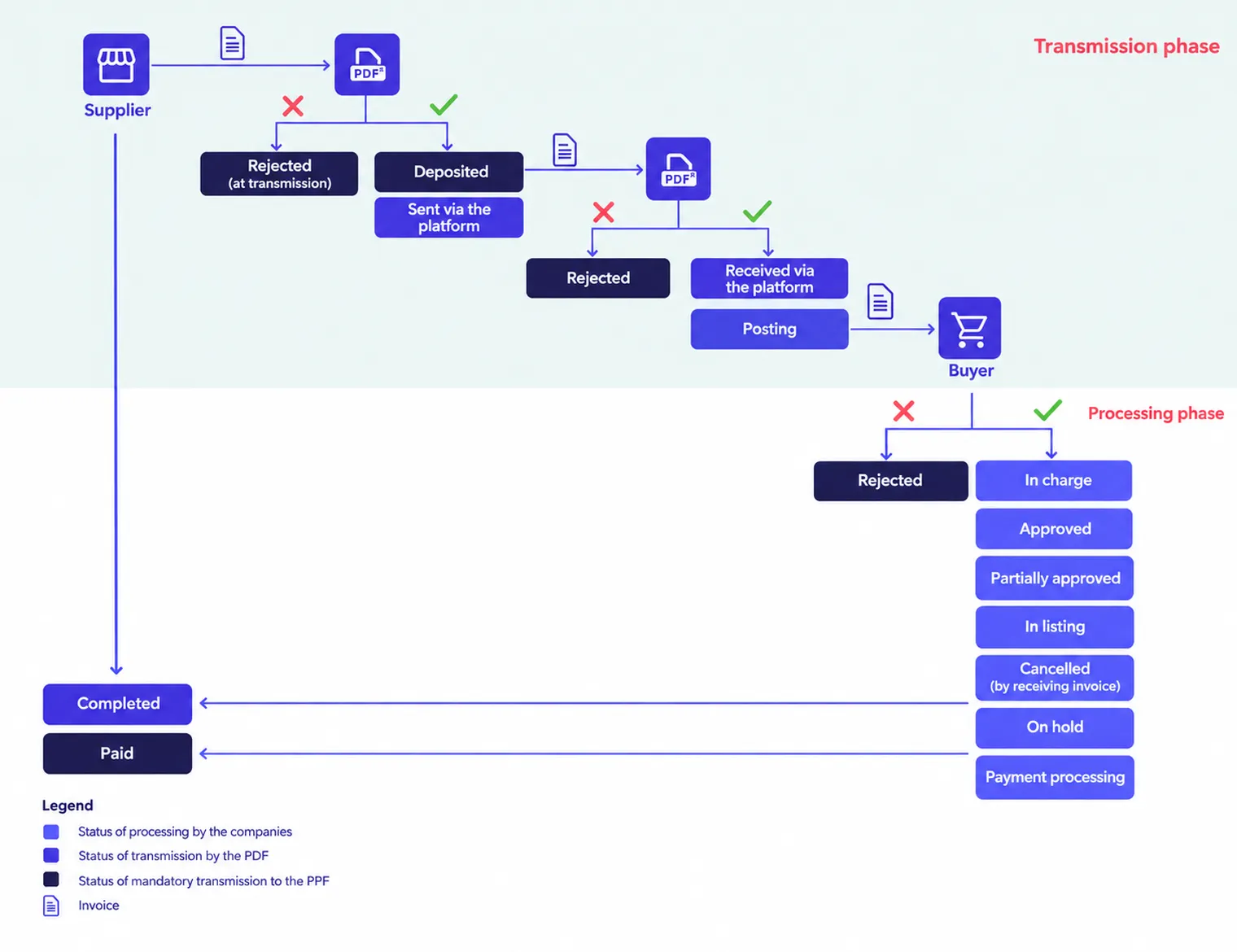
Four statuses are compulsory for tax monitoring:
Submitted (Déposée): Transmitted by the supplier to its accredited platform.
Rejected (Rejetée): Rejected at the platform level due to technical errors (e.g., syntax errors, invalid SIREN, missing mandatory tax fields) before reaching the buyer.
Refused (Refusée): Rejected by the buyer for commercial or business reasons (e.g., price disputes, unperformed services, or incorrect quantities).
Payment Received (Encaissée): Supplier collects payment, triggering VAT liability for services.
Note: It is vital to distinguish between a technical rejection and a commercial refusal.
As detailed above, the Rejetée status is a technical rejection - an automated technical block occurring at either the supplier’s platform (Rejetée à l'émission) or the buyer’s platform due to syntax errors, invalid SIREN numbers, or missing mandatory tax fields. In this scenario, the invoice never legally reaches the buyer.
The Refusée status, on the other hand, is a commercial or business dispute initiated by the buyer (such as price disagreements or incorrect quantities) on an invoice that was already technically valid and successfully delivered.
Ten additional optional statuses exist to manage internal enterprise processing and workflow tracking (e.g., Mise à disposition, Prise en charge, Approuvée, Suspendue, etc.).
Archiving obligations
Under Article L102 B of the Livre des procédures fiscales, invoices and other records subject to the tax administration’s audit rights must generally be retained for six years from the date of the last recorded transaction or the date the document was established. Where invoices are issued or received electronically, they must be retained in electronic form during that period. Businesses should also retain the records and documentation supporting their invoice authenticity, integrity and audit controls for the applicable six-year period. Certain special statutory registers may be subject to a ten-year retention period.
Under Article L102 C, electronically stored invoices must remain accessible to the tax administration, including through immediate online access, download and use of the relevant data, subject to the statutory storage-location rules.
Businesses should align with the practical standard FD Z42-029 to ensure compliant electronic retention, long-term readability, data integrity, and full evidential value for tax audit purposes.
France's e-reporting requirements
E-reporting ensures comprehensive transaction visibility by transmitting specified transaction and, where applicable, payment data for transactions not covered by domestic B2B e-invoicing, as detailed in the official transaction e-reporting guidance and payment e-reporting guidance published by the French tax administration on 30 September 2026.
Note: In accordance with the phased implementation timetable, these e-reporting obligations apply initially to large enterprises and mid-tier entities (ETIs) starting 1 September 2026, while small and micro-enterprises enter the e-reporting obligation phase on 1 September 2027.
Transaction e-reporting
For B2C and specified cross-border transactions, businesses must transmit prescribed transaction data to the DGFiP through an accredited platform. To reduce reporting complexity, for certain B2C transactions that do not give rise to an individual invoice (such as retail transactions supported by till receipts), line-item details are not necessarily required; aggregated daily summary entries (ticket de caisse totals) may be reported instead. Invoiced B2C transactions may require more detailed reporting.
Mandatory e-reporting fields include, but are not limited to:
Supplier identification (SIREN / French VAT number).
Reporting period and transaction or invoice issue date.
Transaction type (B2C, cross-border B2B supply/acquisition).
Taxable base, VAT rate applied, and total VAT amount due.
The number of daily transactions where aggregated reporting is permitted.
The invoice number, where the transaction gives rise to an invoice.
Payment e-reporting
For service supplies and other relevant transactions where VAT is due upon payment collection (TVA sur les encaissements), businesses must submit payment e-reporting data, unless an applicable exception applies. This data supports the DGFiP’s administration, monitoring and potential pre-filling or reconciliation of VAT reporting, particularly for output VAT on transactions where VAT becomes chargeable upon payment.
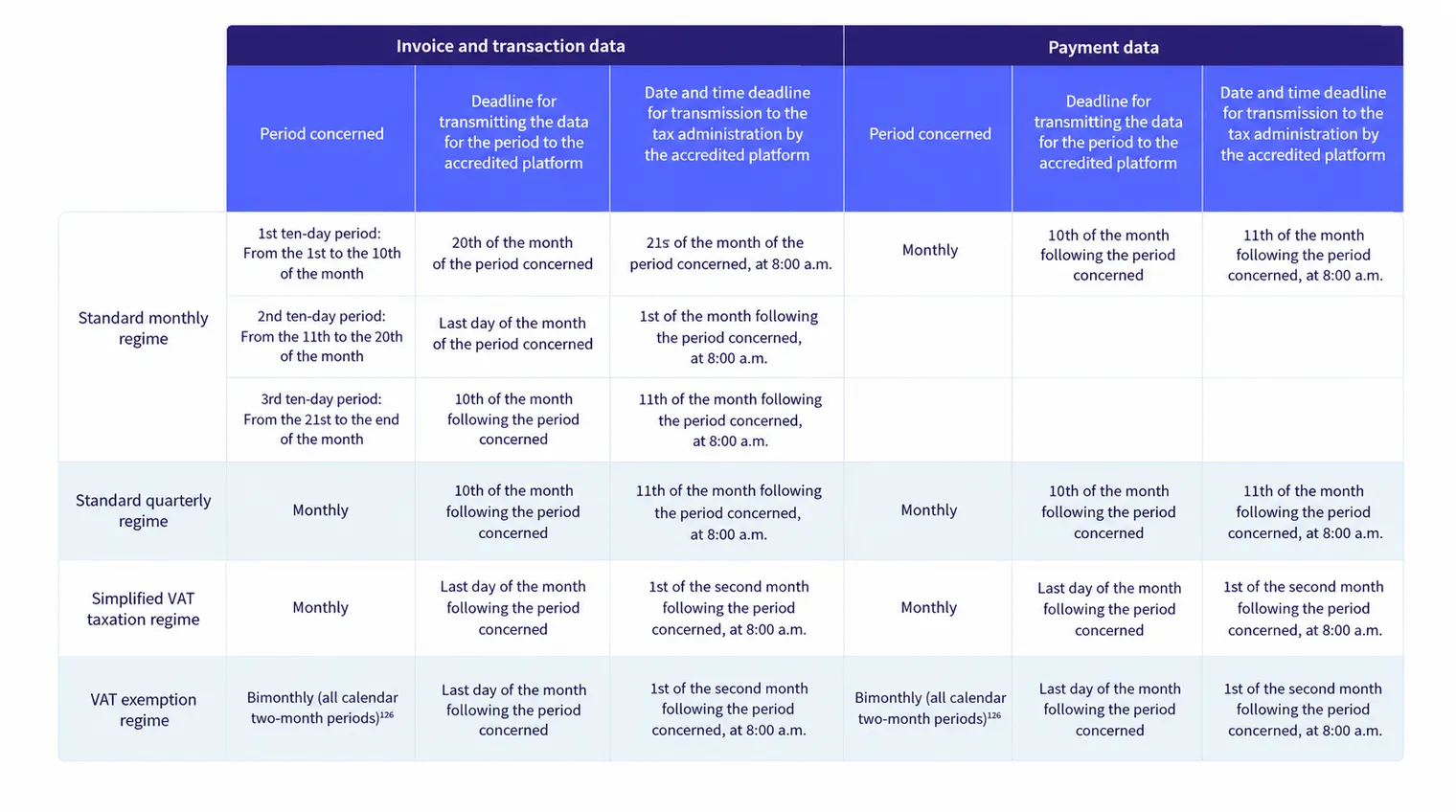
E-reporting transmission frequencies
Data transmission schedules depend principally on the taxpayer's applicable VAT accounting regime:
Standard monthly VAT regime (Régime réel normal mensuel): Submitted every 10 days (three times per month), generally within ten days after each period. Payment data is generally reported monthly.
Standard quarterly VAT regime (Régime réel normal trimestriel): Where applicable, transaction and payment data are generally reported monthly by the applicable deadline, generally the 10th of the following month.
Simplified VAT regime (Régime simplifié d'imposition - RSI): Transaction and payment data are generally submitted monthly, between the 25th and the end of the following month.
VAT exemption scheme for small businesses (Régime de franchise en base de TVA): Generally reported bi-monthly (every 2 calendar months) within the applicable deadline, i.e., by the last day of the month following the concerned period.
For non-established taxable persons, the frequency depends on the applicable French VAT regime as outlined above.
Technical architecture
France’s private-sector B2B e-invoicing system uses a hybrid exchange structure based on a 5-corner decentralised model. This model combines state-accredited private platforms (Plateformes Agréées, or PAs) with central government infrastructure (Portail Public de Facturation, or PPF).
Businesses connect through DGFiP-accredited PAs, which exchange invoices and lifecycle information with one another. The PPF provides the central directory (Annuaire) and data-concentration functions (Concentrateur de données) and supplies the tax administration with the required invoice, transaction, payment and status data. It is not the ordinary invoice-routing platform between private-sector trading partners.
B2G invoicing remains a separate regime operated through Chorus Pro.
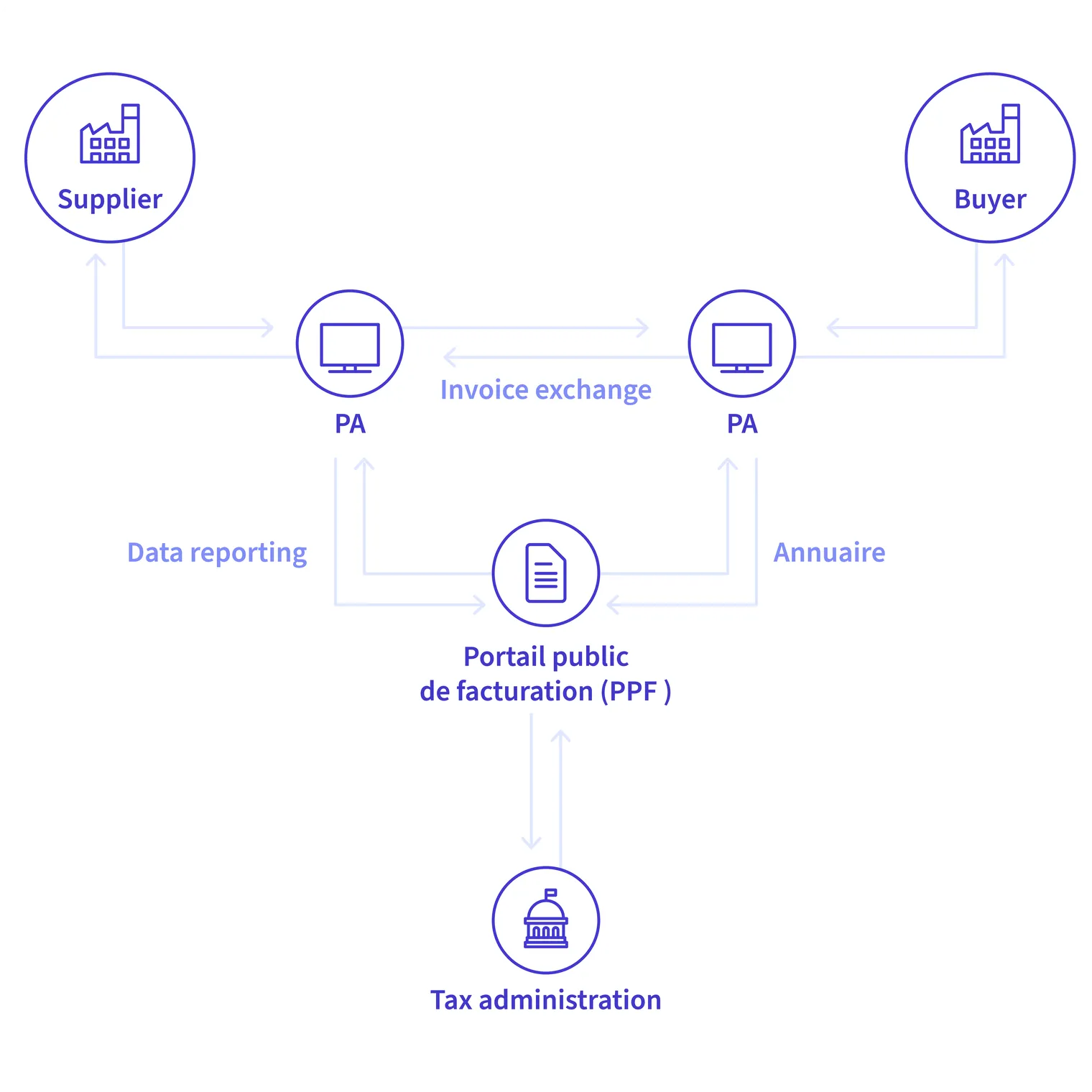
Supplier (Corner 1): Generates a structured invoice in a compliant structured or hybrid format (Factur-X, UBL, CII) within its ERP or accounting software.
Supplier's Accredited Platform (PA - Corner 2): Validates and, where necessary, converts the invoice into a compliant format, checks mandatory fields, queries the central directory (Annuaire) maintained by the PPF to locate the buyer's designated receiving platform, and transmits the invoice and relevant lifecycle messages to that platform.
Invoice exchange (PA to PA): The supplier's PA exchanges the structured invoice and relevant lifecycle information with the buyer's accredited platform (Corner 3) using secure protocols (such as AS4 or Peppol).
Buyer's Accredited Platform (PA - Corner 3): Receives, validates, and delivers the structured invoice into the buyer's ERP (Corner 4), and communicates lifecycle updates as required.
Data transmission to DGFiP (Corner 5): Both accredited platforms extract mandatory tax fields and lifecycle statuses, transmitting them to the central data concentrator at the PPF for DGFiP collection.
Businesses connect to the network via certified Plateformes Agréées of their choice.
Penalties for non-compliance
Support measures and 2026 penalties waiver period
Following the 1 September 2026 rollout, David Amiel, the Minister for Public Action and Public Accounts, announced that the initial phase will focus heavily on supporting businesses rather than immediate enforcement. Accordingly, no penalties will be applied during 2026.
To assist organisations, authorities have provided practical onboarding guides, dedicated telephone helplines, local tax office assistance, and resources available via impots.gouv.fr. Additionally, a monitoring committee meets regularly to assess implementation progress and prepare for the next rollout phase on 1 September 2027.
Active enforcement and non-compliance penalties after 2026
As the temporary penalty waiver expires, active enforcement begins: failure to comply with French e-invoicing and e-reporting rules attracts statutory financial penalties under the Code général des impôts. The following statutory penalties apply subject to the relevant conditions, annual caps, first-infringement rules, formal notices and cure periods. The penalties differ depending on whether the breach is committed by the taxpayer or by a Plateforme Agréée.
Violation type | Penalty rate | Statutory cap |
Omission or inaccuracy in an invoice or equivalent document | €15 per omission or inaccuracy | Total fines for each invoice capped at 25% of the amount stated, or that should have been stated |
Failure to issue a compliant e-invoice under Article 289 bis | €50 per invoice | Capped at €15,000 per calendar year |
Failure by taxpayer to transmit transaction or payment data under Article 290 | €500 per transmission | Capped at €15,000 per calendar year |
Failure by PA to transmit required invoice data under Article 289 E | €50 per invoice | Capped at €45,000 per calendar year, potential withdrawal of PA registration under specific circumstances in case of repeat infringement |
Failure by PA to transmit required transaction or payment data under Article 290 | €750 per transmission | Capped at €100,000 per calendar year, potential withdrawal of PA registration under specific circumstances in case of repeat infringement |
Failure to use a PA to receive electronic invoices | €500 after an initial three-month formal notice and cure period | If the breach continues, €1,000 after a further three-month notice period, followed by an additional €1,000 for each subsequent three-month period of continued non-compliance |
Beyond financial fines, non-compliance risks commercial disruption, delayed payment processing, and input VAT deduction disallowances during tax audits.
How businesses can prepare
France’s e-invoicing and e-reporting framework is now being implemented in phases. Because B2G e-invoicing via Chorus Pro has already been active for several years, businesses - especially those entering into new public-sector contracts - must ensure they can manage B2G, B2B e-invoicing, and e-reporting simultaneously. Organisations should maintain technical and operational readiness, reassess their obligations when their size, VAT status, establishment structure or transaction profile changes, and prepare for the next implementation phase.
Assess transaction scope: Review commercial flows regularly to categorise them into domestic B2B e-invoicing, B2C or cross-border e-reporting, B2G invoicing through Chorus Pro, or outside the current mandate.
Evaluate master data quality: Update customer and supplier master records to ensure required data - including 9-digit SIREN numbers, international VAT IDs, and accurate delivery addresses - are complete and current.
Select an Accredited Partner Platform (PA): Partner with a DGFiP-accredited or registered Plateforme Agréée capable of supporting Factur-X, UBL, and CII formats, handling API integration with your ERP, and automating e-reporting. Read our guide on Peppol Access Points and network models to understand connection options.
Update invoicing software: Ensure accounting and ERP systems can generate and process compliant structured or hybrid invoices, capture the applicable additional invoice data, receive incoming invoices and support the required e-reporting and payment-data workflows.
Establish lifecycle status workflows: Implement internal procedures within accounts payable and receivable teams to track and transmit the applicable mandatory lifecycle statuses (Déposée, Rejetée, Refusée and, where payment reporting applies, Encaissée). Platforms may also support additional statuses (such as Reçue, Approuvée and Paiement transmis).
Monitor regulatory updates: Follow official releases on the DGFiP e-invoicing portal to stay informed of updated technical specifications and directory testing guidelines. Reassess the business’s configuration when the next implementation phase begins, or its taxpayer status, size, establishment structure, or transaction flows change. Explore Banqup compliance management solutions to help streamline software integration.
Conclusion
France's B2B e-invoicing and e-reporting reform represents a major shift in digital tax administration. By replacing paper documents with structured electronic formats, mandatory lifecycle tracking, and automated e-reporting, the French Government is establishing a modern, transparent VAT system.
With the receiving obligation taking effect on 1 September 2026 for all businesses alongside mandatory issuance for large and mid-tier enterprises, organisations should evaluate their systems now. Selecting an accredited partner platform (Plateforme Agréée), auditing master data, and establishing compliant accounts payable and receivable workflows will ensure a smooth transition and ongoing tax compliance.
FAQ
No, not as the compliant invoice for an in-scope domestic B2B transaction. Unstructured PDF invoices sent via email do not satisfy French legal e-invoicing requirements for in-scope domestic B2B transactions. Invoices must be issued in structured electronic formats (Factur-X, UBL, CII) and transmitted through an accredited partner platform (Plateforme Agréée).