
This guide reflects the Icelandic statutory framework reviewed as at 12 October 2026. Public-sector supplier conditions, technical profile acceptance and certain administrative practices require separate confirmation. Public contracting authorities covered by Regulation No. 44/2019 must receive and process qualifying EN 16931-compliant structured invoices, subject to the exclusions in Article 2. Commercial B2B electronic invoicing remains voluntary and is subject to recipient consent under Regulation No. 505/2013. As an EFTA member state within the European Economic Area, direct and indirect taxation fall outside the scope of the EEA Agreement, meaning EU VAT directives do not apply to Iceland.
What is Iceland's current e-invoicing and digital tax strategy?
Covered public contracting authorities in Iceland must receive and process EN 16931-compliant structured electronic invoices for qualifying procurement transactions. Private B2B electronic invoicing remains voluntary. Digital tax administration is centred on periodic electronic VAT returns submitted to Skatturinn (Iceland Revenue and Customs), operating on a standard bimonthly schedule. EU VAT directives, including the enacted VAT in the Digital Age (ViDA) reforms under Council Directive (EU) 2025/516, do not apply to Iceland because indirect taxation falls outside the EEA Agreement, as confirmed by official EFTA Secretariat guidance.
Iceland's public sector supports structured XML invoicing through Peppol and other permitted message intermediaries. Fjársýslan operates invoicing services for most central government institutions and is identified as Iceland's Peppol Authority. Fjársýslan states that invoices for state purchases must be structured electronic invoices and that emailed PDF invoices are not accepted. Other public buyers' submission conditions should be assessed individually. In contrast, commercial B2B transactions operate on mutual agreement under Regulation No. 505/2013, which establishes that sending an electronic message in an unaccepted format is legally deemed non-delivery.
No general real-time invoice clearance or mandatory SAF-T submission regime was identified in the national legislation and VAT reporting guidance reviewed for this article. Tax compliance focuses on maintaining accurate electronic accounts under Accounting Act No. 145/1994 and submitting aggregate summary figures via official government portals.
How have e-invoicing and VAT rules evolved in Iceland?
Iceland established the legal equivalence of paper and electronic invoices in May 2013 through Regulation No. 505/2013, creating a statutory framework for electronic accounting and message transmission. This regulation introduced recipient consent rules for commercial trade, establishing that transmission methods must be accepted by the receiving party.
On 11 June 2015, the EEA Joint Committee adopted Decision No. 166/2015, incorporating Directive 2014/55/EU into the EEA Agreement's public procurement framework. Iceland transposed the directive through Regulation No. 44/2019, issued under Article 122 of the Public Procurement Act No. 120/2016. The regulation was published on 24 January 2019 and first took effect on 25 January 2019. The regulation mandated central government entities to receive EN 16931-compliant structured e-invoices by 18 April 2019, extending the mandate to sub-central public contracting authorities (including municipalities) by 18 April 2020.
As confirmed by official EFTA Secretariat guidance, direct and indirect taxation fall outside the policy scope of the EEA Agreement. Consequently, EU VAT Directive 2006/112/EC and subsequent EU ViDA reforms do not bind Iceland. All Icelandic tax rules, filing schedules, and digital reporting obligations are established independently through parliamentary enactments by Alþingi.
What are the key compliance dates for e-invoicing in Iceland?
Iceland's electronic invoicing framework transitioned into binding law between 2013 and 2020 through staged statutory milestones.
Date | Legal status | Milestone | Affected entities |
|---|---|---|---|
31 May 2013 | In force | Entry into force of Regulation No. 505/2013 establishing legal equivalence and recipient consent rules. | All accounting entities and private commercial businesses |
24–25 January 2019 | In force | Regulation No. 44/2019 was published on 24 January and first took effect on 25 January, ahead of staged reception deadlines. | Covered public contracting authorities |
18 April 2019 | In force | Compliance deadline for central government entities to receive EN 16931 e-invoices under Regulation No. 44/2019. | Central government institutions and state agencies |
18 April 2020 | In force | Compliance deadline for sub-central authorities (municipalities) to receive EN 16931 e-invoices. | Municipal administrations, public law bodies, local utilities |
12 October 2026 | Reference date | Covered B2G buyers must process compliant structured invoices; B2B remains voluntary and standard VAT returns remain bimonthly. | Relevant public buyers and taxable operators |
Which laws govern e-invoicing and VAT reporting in Iceland?
Electronic invoicing, bookkeeping, public procurement, and VAT compliance in Iceland are governed by specific primary statutes and implementing regulations.
Value Added Tax Act No. 50/1988 (Lög um virðisaukaskatt nr. 50/1988): Governs VAT registration exemptions (Article 4), rates (Article 14), records (Article 17), invoice requirements (Articles 20–21), periodic returns (Article 24), agricultural returns (Articles 30–33), reassessments and surcharges (Articles 26–28), foreign services (Article 35) and offences (Article 40).
Accounting Act No. 145/1994 (Lög um bókhald nr. 145/1994): Regulates commercial accounting standards, voucher requirements (Articles 7 and 8), record retention rules (Article 20), domestic storage residency, and statutory penalties (Articles 36–38).
Public Procurement Act No. 120/2016 (Lög um opinber innkaup nr. 120/2016): Article 122 provides the statutory legal basis for implementing public procurement electronic invoicing rules.
Regulation No. 505/2013: Governs electronic invoicing, accounting systems, recipient consent, deemed non-delivery for unaccepted formats, and electronic storage controls.
Regulation No. 44/2019: Transposes Directive 2014/55/EU; mandates reception of EN 16931 e-invoices across covered public contracting authorities.
Regulation No. 667/1995: Provides VAT filing rules, including the specialised six-month agricultural regime and other permitted settlement periods.
Regulation No. 50/1993: Governs cash registers, point-of-sale receipt slips, and revenue registration for VAT-registered businesses.
General Penal Code No. 19/1940 (Almenn hegningarlög nr. 19/1940): Article 262 prescribes criminal imprisonment of up to six years for major intentional or grossly negligent tax offences.
Which authorities oversee e-invoicing and VAT compliance in Iceland?
Skatturinn administers VAT compliance, Fjársýslan supports state invoicing, and Staðlaráð Íslands publishes technical standards. The Ministry of Finance and Economic Affairs oversees relevant policy and regulatory functions.
Institution | Responsibility |
|---|---|
Fjármála- og efnahagsráðuneytið (Ministry of Finance and Economic Affairs) | Develops tax and public-finance policy and issues regulations within its remit. |
Administers VAT registration, processes electronic returns, performs audits, and enforces penalty provisions. | |
Manages State Treasury accounting, oversees central government procurement invoicing, and serves as Iceland's Peppol Authority. | |
Publishes Icelandic technical specifications, including ÍST TS 236:2021. Regulation No. 44/2019 still names TS236:2017. |
Which transactions and entities are covered by e-invoicing rules in Iceland?
Iceland's electronic invoicing rules apply depending on whether the customer is a public contracting authority, a commercial enterprise, a retail consumer, or a foreign entity.
Transaction type | Issuance requirement | Reception requirement | Reporting requirement |
|---|---|---|---|
Domestic B2B | Voluntary (subject to mutual agreement) | Voluntary (recipient consent required under Regulation No. 505/2013) | Normally bimonthly VAT returns; approved annual filing is available to eligible previously registered businesses below ISK 4,000,000 |
Domestic B2G | Subject to buyer submission rules; Fjársýslan requires structured XML and rejects emailed PDFs | Mandatory by statute for covered public buyers under Regulation No. 44/2019 | Bimonthly standard VAT return for taxable entities |
Domestic B2C | Structured e-invoices not mandatory; retail sales require an approved invoice, cash-register receipt or permitted recording method | Voluntary (consumer choice) | Bimonthly standard VAT return |
Cross-border trade | Commercial invoicing (paper or electronic by mutual agreement) | Voluntary (subject to buyer agreement) | Import declarations where relevant; domestic VAT returns, registration or imported-service VAT treatment depend on the transaction |
Foreign suppliers | B2G buyer conditions apply; B2B e-invoicing is voluntary; VOES may apply to qualifying non-resident B2C supplies | Covered Icelandic public buyers must receive qualifying B2G e-invoices; private B2B reception remains voluntary | Bimonthly VOES return for qualifying B2C supplies; B2B imported-service VAT and registration rules vary |
Public sector B2G coverage and exceptions
Regulation No. 44/2019, Article 2 applies to covered public procurement contracts, including relevant public procurement, utilities, concessions and defence or security procurement regimes, subject to express exclusions. Under Article 2(2), e-invoice reception rules do not apply to contracts declared secret or classified, contracts requiring legally prescribed special security measures, or contracts where essential state security interests require exclusion. General defence procurement is not automatically exempt unless these specific criteria are met. The regulation establishes no general exemption for non-resident suppliers. Their invoice submission obligations depend on the covered public contract and the purchaser's applicable conditions.
Private commercial B2B scope
Commercial B2B e-invoicing remains voluntary. Businesses with taxable sales of ISK 2,000,000 or less in the relevant 12-month period generally qualify for the small-supplier VAT exemption under VAT Act No. 50/1988, Article 4(3), subject to statutory conditions. Skatturinn's 2026 notice confirms the threshold. This threshold exempts small traders from VAT collection but does not remove general statutory bookkeeping duties under Accounting Act No. 145/1994.
What are the technical and legal requirements for e-invoicing in Iceland?
Electronic invoices must meet applicable accounting, VAT and record-retention rules. Structured EN 16931 requirements apply to covered public procurement invoicing; private trading partners may agree on other compliant formats.
Which formats and national standards apply?
Regulation No. 44/2019, Article 4, mandates public contracting authorities to receive structured electronic invoices conforming to European standard EN 16931, as implemented through Icelandic technical specification TS236:2017. Staðlaráð Íslands lists ÍST TS 236:2021, effective from 15 November 2021, as a technical specification based on Peppol BIS Billing 3.0. Its status as a legal replacement for the TS236:2017 reference remains unconfirmed. Peppol BIS Billing 3.0 using UBL 2.1 XML is an established operational format for B2G exchanges, while compliant XML may also be transmitted through permitted message intermediaries. In B2B commerce, trading partners may agree on alternative structured XML formats or unstructured formats.
What mandatory information must an invoice contain?
A standard taxable sales invoice must contain the information prescribed by VAT Act No. 50/1988, Article 20 and Regulation No. 50/1993, Articles 3–5, subject to the applicable retail and invoice-type exceptions:
Invoice issue date; supply or delivery details where the applicable transaction rules or invoice profile require them.
Sequential invoice number from a continuous series.
Supplier's name, kennitala and VAT registration number; address details where required by the applicable invoice specification.
Buyer's name and kennitala on standard tax invoices, subject to retail exceptions; include address data when the applicable technical profile requires it.
Description, quantity, unit price and total price of goods or services supplied.
Taxable amounts by applicable VAT rate (24% or 11%), clearly stating whether VAT is included in the total price.
Calculated VAT amount in Icelandic krónur (ISK).
Appropriate exemption, self-billing or imported-service tax information where required by the transaction's legal treatment or applicable technical profile.
Under Regulation No. 50/1993, Articles 8 and 9, qualifying retailers must record sales through a permitted system. Cash-register customer receipts must show a breakdown of the transaction and its date. The ISK 6,000 threshold concerns when certain simplified retail invoices may omit buyer identification, not an unconditional rule requiring identification on every cash-register receipt above that amount. See VAT Act Article 20, Regulation No. 50/1993, Article 8 and Skatturinn's 2026 amount notice.
Are electronic signatures mandatory?
Qualified electronic signatures (QES) are not legally required on electronic invoices under Regulation No. 505/2013, Article 14. Authenticity of origin and integrity of content may be demonstrated through audit trails, secure electronic data interchange (EDI) logs, or internal accounting controls that establish a verifiable link between the invoice and the underlying supply.
What are the statutory record retention and storage rules?
Record retention and storage location rules are strictly enforced under Icelandic accounting law.
Document category | Retention period | Statutory starting point | Storage residency and format rules |
|---|---|---|---|
General accounting vouchers and e-invoices | 7 years | End of the relevant financial year | Stored in Iceland under Accounting Act No. 145/1994, Art. 20(1). Electronic or physical format ensuring readability and data integrity. |
Cash-register internal tapes (sjóðvélarstrimlar) | 3 years | End of the relevant financial year | Three-year retention is permitted where complete accounting records and signed annual financial statements exist, under Accounting Act Article 20. |
Annual financial statements (Ársreikningar) | 25 years | End of the relevant financial year | Retained securely for 25 years under Accounting Act No. 145/1994, Article 20. |
VAT declarations and tax ledgers | 7 years | End of the relevant financial year | VAT accounting documents are generally retained for seven years under VAT Act No. 50/1988, Article 17, with related bookkeeping duties under the Accounting Act. |
Under Accounting Act No. 145/1994, Article 20, accounting records must be retained physically or digitally in Iceland. Temporary storage abroad is permitted for qualifying entities for a maximum period of six months, subject to full regulatory accessibility. Under Regulation No. 505/2013, Articles 13–14, the delivered electronic invoice is the recipient's external original accounting record. A converted version is treated as an internal record. Preserve traceability and authenticity; do not assume conversion permits deletion of the delivered original.
What electronic VAT reporting obligations apply in Iceland?
VAT-registered businesses in Iceland normally fulfil their periodic filing obligations electronically through Skatturinn's service portal. The tax authority may authorise paper filing for one year at a time where valid grounds exist.
What are the VAT filing schedules and deadlines?
Filing frequencies and payment deadlines depend on taxpayer category and taxable turnover. In addition to the principal regimes below, Skatturinn may approve temporary settlement periods of one to two months for qualifying short-term taxable activities.
Reporting regime | Taxable entities | Filing and payment deadline | Reporting channel |
|---|---|---|---|
Standard bimonthly VAT return | Standard VAT-registered businesses | 5th day of the second month following the end of the tax period | |
Agricultural VAT return | Qualifying agricultural taxpayers | Normally six-monthly: January–June due 1 September; July–December due 1 March, subject to exceptions | |
Approved annual VAT return | Eligible previously registered businesses with prior-year taxable turnover below ISK 4,000,000 | 5 February after the year; application by 15 February of the filing year | |
Compulsory special monthly return | Certain taxpayers re-registered after specified compliance failures | 15 days after each month-end | |
Approved shorter monthly return | Eligible businesses with tax-refund positions, including qualifying exporters | One month and five days after month-end | |
VOES bimonthly return | Qualifying foreign suppliers registered under VOES | One month and five days after each two-month period |
Under Value Added Tax Act No. 50/1988, Article 24, standard bimonthly tax periods run as follows:
January–February: Due 5 April
March–April: Due 5 June
May–June: Due 5 August
July–August: Due 5 October
September–October: Due 5 December
November–December: Due 5 February (following year)
Qualifying agricultural taxpayers normally file six-monthly under Regulation No. 667/1995. However, VAT Act Article 32 requires standard filing periods where at least 60% of total business income comes from non-agricultural activities. Approved alternative periods may also apply.
Annual VAT filing requires approval, prior-year taxable turnover below ISK 4,000,000 and eligibility under Skatturinn's rules. Agricultural registrants, foreign representatives and certain special registrants are excluded. If taxable turnover reaches ISK 4,000,000 during the year, the taxpayer must switch to bimonthly filing from the relevant settlement period. Under Article 24, if a statutory filing deadline falls on a weekend or public holiday, the due date automatically defers to the next working day.
The standard VAT rate is 24% under Article 14(1), while the reduced rate of 11% under Article 14(2) applies to foodstuffs, hotel accommodation, books, heating, and electricity. The standard VAT return reports aggregate figures rather than transmitting each invoice for clearance. No general real-time clearance regime was identified in the official sources reviewed.
How are electronic invoices exchanged and processed in Iceland?
Peppol supports structured invoicing through its four-corner network model. For central government invoices, Fjársýslan also accepts structured XML through message intermediaries and offers a web-entry facility to suppliers without invoicing software.
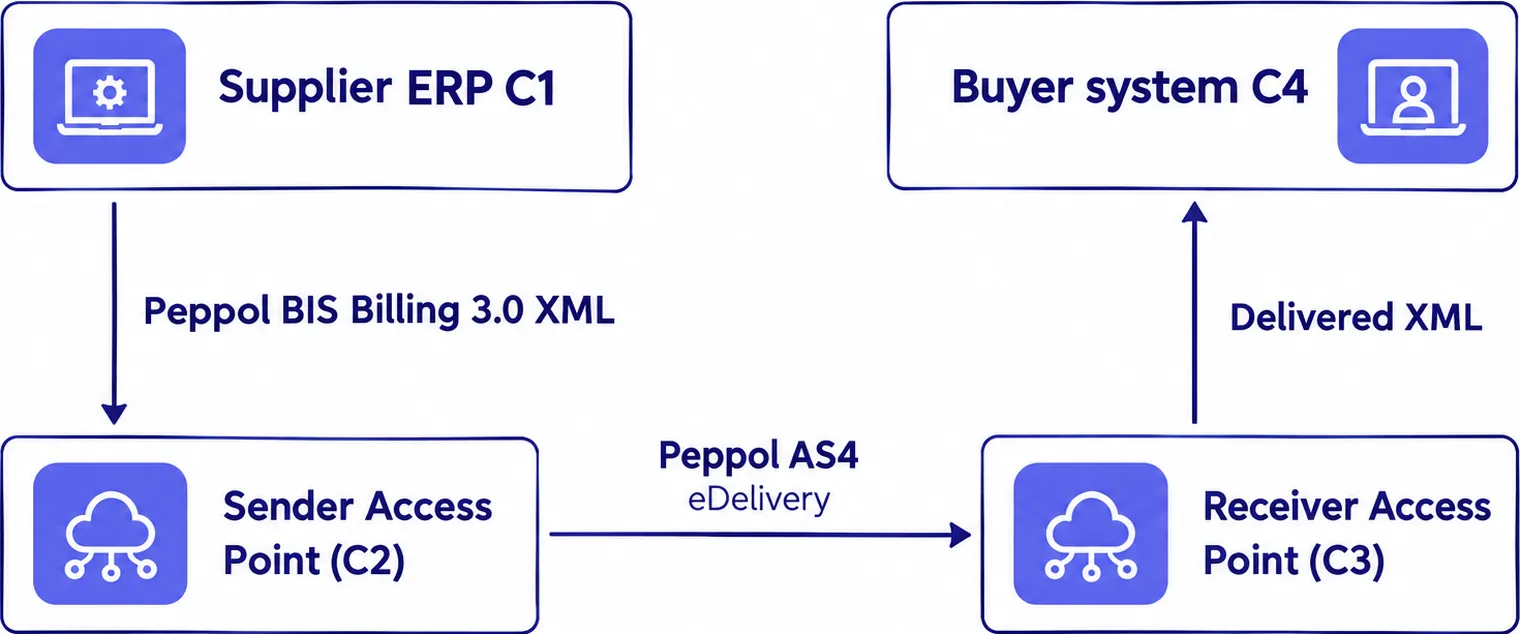
Where the Peppol route is used, the supplier (Corner 1) sends structured invoice data through its Access Point (Corner 2). The four-corner model illustrates Peppol exchange, not every permitted Icelandic invoice transmission channel. The sender's Access Point uses the Peppol Service Metadata Publisher (SMP) and Service Metadata Locator (SML) to identify the receiver's Access Point (Corner 3) and routes the document via the secure AS4 protocol. Corner 3 delivers the invoice to the receiving public authority or private enterprise (Corner 4).
Addressing and network identifiers
Participants on the Icelandic Peppol network are identified using official participant schemes.
National business identifier: Kennitala (10-digit national identification number assigned by Registers Iceland / Þjóðskrá Íslands).
Peppol electronic address scheme (EAS) code: 0196 (Icelandic kennitala / IS:KTNR), as published in the OpenPeppol EAS code list.
Peppol participant identifier: typically 0196:XXXXXXXXXX, where 0196 identifies the kennitala scheme, and XXXXXXXXXX is the ten-digit identifier. Confirm the recipient's registered participant address.
Peppol authority: Fjársýsla ríkisins (FJS) is listed by OpenPeppol as Iceland's national authority.
Suppliers without suitable accounting software can use Fjársýslan's invoice-entry facility for eligible state invoices.
What are the penalties for e-invoicing and VAT non-compliance in Iceland?
Non-compliance with VAT declaration deadlines, payment obligations, or invoice issuance standards in Iceland triggers administrative surcharges, statutory default interest, fixed fees, and criminal sanctions under Icelandic law.
Offence | Liable taxpayer category | Penalty or legal consequence | Statutory legal basis |
|---|---|---|---|
Late payment of VAT | VAT-registered taxable persons | Surcharge of 1% of unpaid tax per commenced day, capped at 10% maximum (reached in 10 days) | |
Unpaid VAT outstanding past one month | Delinquent taxpayers | Statutory default interest (Dráttarvextir) accruing from original due date | |
Late return following estimated assessment | VAT-registered taxable persons | ISK 5,000 charge per late return submitted after an estimated assessment, subject to possible relief | |
Inaccurate or under-declared VAT return | VAT-registered taxable persons | Administrative reassessment under Article 26 and applicable surcharges | |
Serious intentional or grossly negligent VAT offences | Responsible individuals | Statutory fines may reach ten times the tax; serious offences may attract imprisonment of up to six years | |
Serious accounting record offences | Responsible individuals | Fines; major intentional or grossly negligent offences may carry imprisonment of up to six years | |
Transmission in an unaccepted electronic format | Commercial invoice senders | Message deemed not delivered under Article 20; payment consequences depend on contract and civil law |
Penalty calculation and civil remedies
Under Value Added Tax Act No. 50/1988, Article 27, the late payment surcharge accrues at 1% per commenced day and reaches its statutory 10% maximum after ten commenced days. No flat 8% under-reporting surcharge exists in Icelandic legislation. If payment remains outstanding more than one month past the due date, default interest applies under Article 28 pursuant to Interest and Indexation Act No. 38/2001, Article 6.
Where a purchaser has formally specified an accepted structured invoice format and channel, a PDF submitted through an unaccepted method may be deemed not delivered under Regulation No. 505/2013. The effect on contractual payment periods requires assessment of the actual contract and applicable civil law. However, non-delivery does not automatically extinguish the underlying contractual debt under general civil law.
How can businesses prepare for e-invoicing and VAT compliance in Iceland?
Businesses operating in Iceland should implement structured digital workflows to ensure compliance across public procurement and commercial trade.
Assess transaction scope: Identify covered public purchasers under Regulation No. 44/2019, verify each buyer's submission rules and agree invoice formats with private B2B customers.
Confirm network addressing: Where Peppol is used, verify the organisation's registered participant identifier and the recipient's address. Icelandic kennitala uses scheme code 0196.
Configure invoicing software: Support the buyer's required EN 16931-compatible structured format and relevant Peppol profile. Validate any use of ÍST TS 236:2021 against current buyer specifications.
Set the correct VAT calendar: Use the standard bimonthly schedule unless an agricultural, approved annual, approved shorter monthly or compulsory special monthly regime applies. Confirm deadlines with Skatturinn.
Protect accounting records: Retain ordinary accounting records for seven years in accordance with Accounting Act Article 20, account for the six-month overseas storage exception and preserve the legally required electronic original.
What is the operational outlook for e-invoicing and digital tax compliance in Iceland?
Under Regulation No. 44/2019, covered public contracting authorities must receive and process EN 16931-compliant structured e-invoices. Peppol is an established transmission route, alongside other permitted structured exchange channels. Commercial B2B e-invoicing operates on voluntary adoption governed by recipient consent under Regulation No. 505/2013.
Digital tax administration relies on bimonthly electronic VAT returns submitted directly to Skatturinn, alongside specialised schedules for agricultural producers, approved annual filers, and monthly taxpayers. Organisations should combine relevant structured-invoice compatibility with buyer-specific transmission rules, accurate VAT filing calendars and compliant seven-year accounting-record retention. Software support alone does not establish full tax or procurement compliance.
FAQ
No. B2B electronic invoicing remains voluntary in Iceland. Private enterprises are not mandated by general statute to issue or receive structured e-invoices. Under Regulation No. 505/2013, Article 20, the transmission of electronic invoices requires recipient consent, which may be established by contract or published purchasing specifications.