
This article was updated on 13 October 2026 to reflect Latvia's phased e-invoicing and digital reporting regulations. Under Section 11(14) of the Accounting Law, structured electronic invoicing became mandatory for covered transactions with budgetary institutions on 1 January 2025, with public-sector invoice reporting to VID applying from 1 January 2026 (generally within five working days of dispatch). Mandatory domestic B2B e-invoicing and reporting will take effect on 1 January 2028, with voluntary B2B invoice reporting available since 1 January 2026. Suppliers to Latvian budgetary institutions must ensure compliance with delivery and reporting obligations, while businesses subject to domestic B2B rules should prepare their systems for the 2028 implementation date.
Is electronic invoicing mandatory in Latvia?
Latvia requires structured e-invoices for covered transactions with budgetary institutions. The general B2G requirement began on 1 January 2025, with qualifying pre-2025 agreements transitioning by 1 January 2026. Domestic B2B structured invoicing remains voluntary until the enacted mandate takes effect on 1 January 2028.
Since 1 January 2026, covered public-sector structured invoice data must be submitted to the State Revenue Service (Valsts ieņēmumu dienests, VID). B2B partners may already exchange structured invoices voluntarily, while voluntary submission of qualifying B2B invoice data to VID has been available since 1 January 2026.
Latvia permits several structured invoice delivery channels, including the official electronic address (eAdrese), service-provider networks and other agreed electronic channels. Covered invoices must comply with LVS EN 16931-1:2017 and the applicable technical specification. Submission of invoice data to VID follows separate rules under Cabinet Regulation No. 749.
Ordinary B2C sales are outside Latvia's general structured e-invoicing mandate. Retail transactions are generally subject to fiscal-device and receipt requirements, with specified exceptions and alternative documentation procedures.
How did electronic invoicing develop in Latvia?
Latvia first introduced structured e-invoice reception in public procurement. Under Directive 2014/55/EU and Section 83 of the Public Procurement Law, the reception requirements applied to relevant central government procurement procedures from 18 April 2019 and other contracting authorities from 18 April 2020, subject to the statutory transitional conditions.
The public procurement reception rules did not themselves create a general obligation for suppliers to issue structured invoices. Latvia's Accounting Law, adopted on 10 June 2021 and effective from 1 January 2022, was subsequently amended to introduce the structured e-invoice definition and mandatory issuance framework.
On 31 October 2024, parliament adopted the amendments to the Accounting Law, published on 12 November 2024 as official publication 2024/221.1. These established the phased, structured e-invoicing framework, including the 2025 budgetary-institution issuance requirement and public-sector invoice reporting from 2026.
The original legislation scheduled mandatory domestic B2B e-invoicing for 2026. The Saeima adopted further amendments on 5 June 2025, effective 12 June 2025, postponing the B2B mandate to 1 January 2028. Voluntary structured B2B exchange is permitted before that date, and voluntary reporting to VID is available from 1 January 2026 under Regulation No. 749.
The EU adopted the VAT in the Digital Age (ViDA) legislative package in March 2025. Council Directive (EU) 2025/516 establishes phased changes to cross-border VAT invoicing and digital reporting, including measures applicable from 1 July 2030. These EU obligations are distinct from Latvia's national B2B mandate beginning on 1 January 2028.
What is the compliance timeline for Latvian e-invoicing?
The following table outlines the verified milestones governing electronic invoicing and digital reporting in Latvia:
Date | Legal status | Milestone | Business impact |
|---|---|---|---|
18 April 2019 | In force | E-invoice reception begins for applicable central government procurement | Direct administration bodies must accept compliant invoices for procurement procedures covered by the transitional rules. |
18 April 2020 | In force | E-invoice reception extends to other contracting authorities | Relevant non-central contracting authorities become subject to the public procurement reception requirements. |
1 January 2022 | In force | New Accounting Law takes effect | Establishes the general accounting framework later amended to introduce mandatory structured invoicing. |
1 January 2024 | In force | VAT registration threshold rises to EUR 50,000 | Reduces registration burdens for small businesses and sole traders. |
31 October 2024 | Adopted | Accounting Law amendments adopted by the Saeima | Establishes the phased invoicing mandate; official publication 2024/221.1 followed on 12 November 2024. |
1 January 2025 | In force | General budgetary-institution e-invoicing mandate begins | Covered suppliers must issue structured invoices, with qualifying pre-2025 transactions transitioning by 1 January 2026. |
5 June 2025 | Adopted | Saeima amends Accounting Law Transitional Provisions 8 and 10 | Postpones B2B invoicing and reporting to 1 January 2028; amendment effective 12 June 2025. |
1 January 2026 | In force | Public-sector e-invoice reporting begins | Covered invoices must be submitted to VID once, generally within five working days after dispatch. |
1 January 2026 | In force | Voluntary B2B invoice submission to VID becomes available | Eligible businesses may submit structured invoice data through the channels specified in Regulation No. 749. |
1 January 2028 | Future enacted | Domestic B2B structured invoicing and VID reporting become mandatory | Covered Latvian-registered undertakings must exchange compliant invoices and report the required data, subject to statutory exceptions. |
Which laws govern e-invoicing and VAT reporting in Latvia?
Electronic invoicing, accounting records and digital tax declarations in Latvia are governed by four primary statutes and implementing Cabinet regulations:
Primary legislation
Accounting Law (Grāmatvedības likums): Governs accounting records, source documents and structured e-invoicing. Section 1 defines structured invoices, Section 11(14)–(16) establishes issuance obligations and exceptions, Section 28 sets retention periods, and Transitional Provisions 8–10 govern phased application and reporting.
Value Added Tax Law (Pievienotās vērtības nodokļa likums): Governs VAT rates, registration, invoices, returns and payments. Sections 41–50 set rates, Section 59 governs domestic registration, Sections 115 and 117–119 govern reporting and payment periods, Sections 125–126 specify invoice content, and Sections 131–133 address issue deadlines, electronic invoices and retention.
Law on Taxes and Duties (Par nodokļiem un nodevām): Regulates tax administration, fiscal devices and tax sanctions. Section 28.1 concerns fiscal devices, Section 29 governs late-payment interest, while Sections 140–142 contain relevant administrative offences involving fiscal devices and late declarations.
Public Procurement Law (Publisko iepirkumu likums): Requires contracting authorities to accept compliant structured electronic invoices under Section 83, subject to the applicable procurement rules.
Secondary regulations and guidelines
Cabinet Regulation No. 154 (2019): Specifies the structured invoice standard for public procurement.
Cabinet Regulation No. 749 (2025): Governs invoice exchange channels, VID submission routes, XML requirements and reporting deadlines.
Cabinet Regulation No. 40 (2013): Sets VAT declaration forms, annex specifications and completion instructions, including the EUR 150 individual disclosure threshold in PVN 1.
Cabinet Regulation No. 96 (2014): Establishes the procedures for using electronic fiscal devices and provides relevant exceptions and alternative receipt procedures.
Ministry of Finance guidance on structured electronic invoices: Explains implementation policy and phased requirements. The binding obligations are established by the Accounting Law and applicable Cabinet regulations.
Which authorities oversee e-invoicing and tax compliance in Latvia?
The administration, technical delivery and supervision of electronic invoicing and tax reporting in Latvia involve several public institutions:
Institution | Role | Primary responsibility |
|---|---|---|
Ministry of Finance (Finanšu ministrija) | Policy and legislative sponsor | Drafts accounting and taxation laws; coordinates the national e-invoicing strategy. |
State Revenue Service (Valsts ieņēmumu dienests, VID) | Tax administration and audit | Operates EDS, receives structured invoice data and administers VAT and fiscal-device compliance. |
State Digital Development Agency (Valsts digitālās attīstības aģentūra, VDAA) | State digital infrastructure authority | Responsible for the relevant state digital-service infrastructure, including the official electronic address system. |
Latvian Standard (Latvijas standarts - LVS) | National standardisation body | Publishes and maintains the LVS EN 16931-1:2017 electronic invoicing standard. |
OpenPeppol / Peppol Service Providers | Interoperability network | Facilitates decentralised cross-border and domestic invoice delivery using the Peppol BIS Billing 3.0 specification. |
Which transactions are covered by Latvia's e-invoicing rules?
The obligation to issue structured electronic invoices depends on whether the counterparty is a public sector budgetary body, a private commercial undertaking, or a final consumer:
Transaction type | Issuance requirement | Reception requirement | Reporting requirement | Effective date | Main exceptions |
|---|---|---|---|---|---|
Domestic B2G | Mandatory structured e-invoice issuance | Mandatory structured e-invoice reception | Mandatory transmission of invoice data to VID | Issuance: generally 1 January 2025, with a legacy-contract transition; VID reporting: 1 January 2026, generally within five working days. | Qualifying fiscal receipts; invoices generated by specified National Health Service or State Employment Agency systems; and prescribed documents of designated security and law-enforcement authorities. |
Domestic B2B | Voluntary; mandatory from 1 January 2028 | Voluntary; mandatory from 1 January 2028 | Periodic VAT returns, monthly or quarterly as applicable; structured invoice reporting to VID mandatory from 1 January 2028. | Voluntary exchange already permitted; voluntary VID reporting from 1 January 2026; mandate from 1 January 2028. | Transactions registered through certified cash registers with fiscal receipts. |
Domestic B2C | No general structured e-invoice mandate; receipts follow applicable fiscal and consumer rules. | No mandatory structured e-invoice reception; applicable consumer receipt rules remain. | Aggregated turnover reported in periodic VAT returns | In force | Specific fiscal-device exemptions and permitted alternative receipt procedures under Cabinet Regulation No. 96. |
Intra-EU cross-border | Standard VAT invoice; structured format optional | Standard VAT invoice acceptance | Periodic VAT return and applicable PVN 1 disclosures; monthly PVN 2 where qualifying intra-EU supplies or services occur. | In force; ViDA digital reporting pending EU schedule | Zero-rating and special transfer rules may affect VAT treatment but do not independently exempt transactions from applicable invoicing requirements. |
Third-country cross-border | Standard commercial invoice; structured format optional | Standard commercial invoice acceptance | Applicable periodic VAT reporting, including import VAT or reverse-charge transactions where required. | In force | Specific VAT and customs reliefs may apply; these do not automatically remove ordinary invoice-documentation obligations. |
Foreign suppliers | Depends on the supplier's Latvian establishment or branch status, applicable accounting obligations and public procurement rules. | Receipt obligations depend on the entity and transaction scope; VAT registration alone is not determinative. | Electronic filing via VID EDS if registered for VAT in Latvia | In force for established taxpayers | Reverse charge applies where the VAT Law prescribes it; other supplies may require Latvian VAT registration. |
Public sector scope
The structured invoicing framework covers qualifying B2G, G2G and G2B transactions involving Latvian public-sector institutions. The supplier-to-budgetary-institution obligation is not generally limited by procurement contract value. Qualifying agreements concluded before 1 January 2025 benefited from a transition ending on 1 January 2026.
Commercial B2B scope
Until 31 December 2027, covered domestic B2B partners may continue using mutually accepted invoice formats, including PDFs. Structured exchange is already voluntary, and qualifying voluntary submissions to VID have been permitted since 1 January 2026. From 1 January 2028, structured invoicing and reporting become mandatory for covered domestic B2B transactions, subject to statutory exceptions.
Retail and consumer transactions
Supplies to consumers not carrying out economic activity generally fall outside the structured e-invoicing mandate. Retail sales are subject to fiscal-device and receipt rules, including authorised exceptions and alternative documentation procedures under Cabinet Regulation No. 96.
What are the technical requirements for electronic invoices in Latvia?
Under Section 1, Paragraph 1, Clause 9 of the Accounting Law, a structured electronic invoice is defined as an invoice prepared, transmitted and received in a structured electronic format that complies with standard LVS EN 16931-1:2017, allowing for automated electronic processing.
Format or specification | Legal status | Applicable scope | Technical syntax |
|---|---|---|---|
LVS EN 16931-1:2017 | Mandatory national standard | B2G (mandatory), B2B (mandatory from 1 January 2028) | Semantic data model |
Peppol BIS Billing 3.0 | Required for the specified VID submission XML structure; used in compatible networks | Regulated VID submissions and supported invoice exchange | UBL 2.1 |
UN/CEFACT CII | Recognised EN 16931 syntax, subject to channel support | Compatible invoice exchanges where permitted | Applicable CII syntax version |
PDF / Paper | Accepted for non-mandated flows | Commercial B2B (until 1 January 2028) and B2C | Not applicable |
Mandatory invoice content
The required content of a Latvian VAT invoice is primarily governed by Sections 125 and 126 of the VAT Law. Accounting source-document particulars are addressed separately in Section 11 of the Accounting Law. Depending on the invoice type and transaction, the relevant information includes:
Date of issue and unique sequential invoice number.
Supplier legal name, registered address, and VAT registration number.
Customer identification details required for the applicable invoice type, including relevant name, address and registration or VAT number.
Date of supply of goods or completion of services (if different from invoice date).
Description, unit price (excluding VAT), quantity, discounts, and rebates.
Taxable base broken down by VAT rate or exemption.
Applicable VAT rate (standard 21%, reduced 12% or 5%) and total VAT amount payable in euros.
Mandatory statutory annotations where applicable:
Nodokļa apgrieztā maksāšana (reverse charge).
Pašrēķins (self-billing).
The prescribed margin-scheme annotation for the relevant transaction, such as travel services or second-hand goods, where the statutory special regime applies.
Reference to statutory VAT exemption provisions or intra-Community supply rules.
Issuance deadlines
Under Section 131 of the Value Added Tax Law, the principal tax-invoice issuance deadlines are:
Domestic transactions: A VAT invoice must generally be issued within 15 days of the transaction or receipt of an advance, subject to statutory exceptions under Section 131.
Intra-EU supplies of goods: Invoices must be issued no later than the 15th day of the month following the month in which the supply took place.
Qualifying cross-border services: For services covered by Section 131(2), invoices must be issued by the 15th day of the following month, including where the recipient accounts for VAT.
Electronic signatures and validation
A qualified electronic signature is not a universal requirement for electronic VAT invoices. Under Section 132(2) of the VAT Law, authenticity and integrity may be ensured through an accepted electronic signature, electronic data interchange or other suitable controls meeting the statutory requirements.
Archiving and format conversion
Under the Accounting Law and VAT Law:
Accounting source documents and VAT invoices: Ordinary source documents are generally retained for at least five years. VAT invoices are subject to a separate five-year period from their issue date under Section 133(4) of the VAT Law, unless longer retention applies.
Annual accounts, ledgers and inventory registers: Annual financial statements are retained until reorganisation or termination, subject to other applicable law. Ledgers and inventory registers generally require ten years.
Records supporting input VAT adjustments: Relevant invoices must be retained until the applicable input tax adjustment period ends where that period exceeds five years.
Electronic accounting records must remain accessible, readable and protected throughout the applicable retention period. Section 29 of the Accounting Law expressly regulates conversion of paper documents into electronic form. Businesses should retain original structured XML records unless they have established that an alternative archival format satisfies all applicable legal and evidential requirements. Electronic storage must also meet Accounting Law Section 27 and VAT Law Section 133.
What electronic VAT reporting is required in Latvia?
Latvian VAT registrants generally submit periodic returns and applicable annexes electronically through the State Revenue Service's Electronic Declaration System (Elektroniskās deklarēšanas sistēma, EDS). Certain taxpayers must also submit an annual VAT declaration, where the circumstances in Section 117(5) of the VAT Law apply.
Reporting mechanism | Covered taxpayers | Reported data | Frequency | Submission deadline | Official channel |
|---|---|---|---|---|---|
Monthly VAT return (PVN deklarācija + PVN 1) | Registered VAT payers meeting the monthly-period conditions in Section 115 of the VAT Law | VAT totals, input deductions and qualifying domestic transactions individually disclosed from EUR 150 excluding VAT. | Monthly | 20th day of the month following the period | |
Quarterly VAT return | VAT registrants who meet neither the monthly-period conditions in Section 115(1) nor the six-month post-registration rule in Section 115(2). | Aggregated tax and itemised transactions | Quarterly | 20th day of the month following the quarter | |
Recapitulative statement (PVN 2) | Registered VAT payers undertaking qualifying intra-EU supplies or cross-border services. | Intra-Community supplies of goods and cross-border services | Monthly | 20th day of the month following the period | |
Public sector e-invoice reporting | Contractors and budgetary institutions | Transaction-level structured invoice data | Continuous | Generally within five working days after invoice dispatch | eAdrese integration or VID EDS |
B2B structured e-invoice reporting | All registered commercial undertakings | Transaction-level structured invoice data | Continuous | Mandatory from 1 January 2028; voluntary submission available from 1 January 2026 | VID EDS automated endpoint |
VAT registration thresholds and rates
Under Section 59 of the Value Added Tax Law, Latvia's domestic VAT registration threshold is EUR 50,000, assessed under calendar-year turnover rules. Qualifying taxpayers may defer registration in specified circumstances where the threshold is exceeded by no more than EUR 5,000.
Latvia applies a standard rate of 21%, reduced rates of 12% and 5%, and a 0% rate for qualifying transactions under Sections 41–50 of the VAT Law. The principal standard and reduced-rate categories are:
Standard rate (21%): Applies to all standard supplies of goods and services.
Reduced rate (12%): Applies to qualifying medicines, medical products, passenger transport, household heating, fresh fruit, berries and vegetables. Specified bread, milk, poultry meat and eggs also qualify from 1 July 2026 to 30 June 2027.
Reduced rate (5%): Applies to qualifying books, press publications and other specified publications, subject to the statutory content and language conditions.
Itemised reporting in Annex PVN 1
Under Cabinet Regulation No. 40, qualifying domestic transactions with registered taxable counterparties must be reported individually in PVN 1 Part III where the relevant document value excluding VAT is EUR 150 or more. The prescribed details include counterparty identification, document references, transaction values and VAT information, subject to the regulation's aggregation rules.
Filing and payment schedule
Under Section 118(1) of the VAT Law, periodic VAT returns are generally due within 20 days after the taxation period. Under Section 119(1), the corresponding VAT payment is generally due within 23 days. Statutory non-working-day adjustments apply to the relevant filing deadlines.
How are electronic invoices exchanged across Latvian networks?
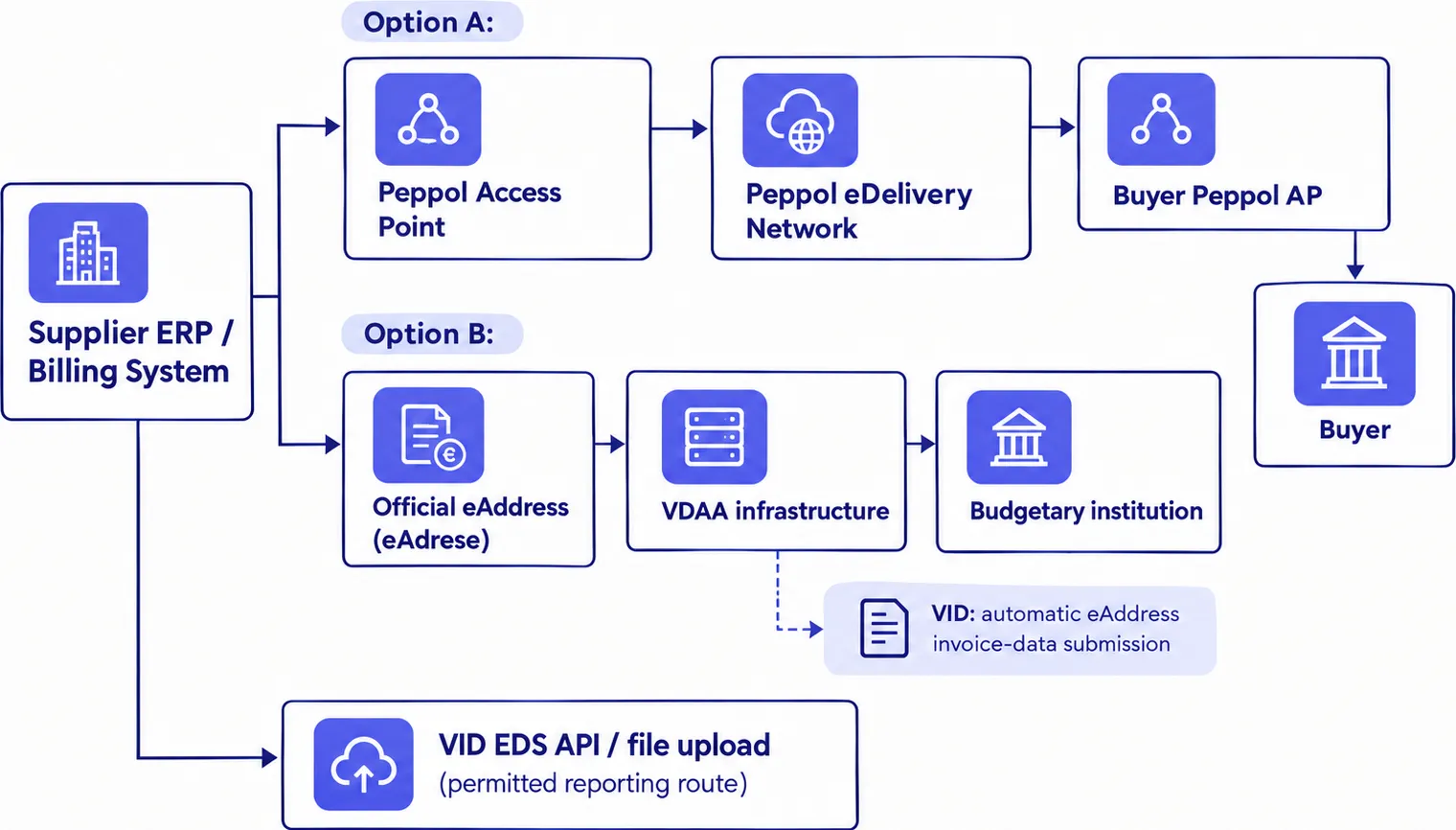
Latvia's technical architecture accommodates public administration workflows, commercial network interoperability and automated tax reporting:
Transmission channels
Official electronic address (eAdrese): Operated within Latvia's state digital infrastructure overseen by VDAA. The platform is an authorised structured invoice exchange channel. Under Regulation No. 749, paragraph 11, eligible eAdrese invoice messages are transmitted automatically to VID. VDAA guidance specifies the EINVOICE message type. Integrations must use the current software or apply the prescribed manual VID recipient-addressing procedure.
Peppol eDelivery network: Supports structured invoice exchange through accredited access points and the Peppol four-corner model. Participants must use compatible document specifications and registered addressing identifiers.
VID Electronic Declaration System (EDS): Supports VAT filing and structured invoice submission through the authorised EDS API or file-upload functionality. The required XML format and reporting channels are governed by Regulation No. 749.
Direct EDI channels: Trading partners may agree to use compatible bilateral electronic channels. Where statutory e-invoicing applies, invoices must meet the required structure and be submitted separately to VID through an authorised route.
Participant identifiers and routing schemes
When addressing invoices to Latvian entities across interoperable networks, organisations configure verified identifier schemes:
Scheme 0218 (Latvian unified registration number): Identifies an entity using its 11-digit registration number. The scheme is listed in the OpenPeppol code list. Businesses should confirm that the recipient's registered Peppol address uses this scheme before routing invoices.
Scheme 9939 (Latvian VAT number): Identifies an entity using its Latvian VAT number, normally formatted as LV followed by 11 digits. Availability and registration must be checked against the recipient's supported Peppol address.
Public-sector delivery through eAdrese uses the relevant official recipient account or configured sub-address. VDAA's technical guidelines identify EINVOICE as the electronic invoice message type. Businesses should confirm recipient addressing and integration compatibility before transmission.
What are the penalties for non-compliance in Latvia?
Breaches of accounting, invoice and tax reporting obligations may lead to different administrative sanctions. Interest applies separately to overdue tax liabilities under the conditions prescribed by law:
Offence | Liable party | Penalty or consequence | Legal provision |
|---|---|---|---|
Non-compliance with accounting document requirements | Legal entities and officers | Warning or offence-specific fine under Sections 41–44 of the Accounting Law; ordinary source-document breaches may attract up to 86 fine units | Accounting Law, Sections 41–45 |
Late submission of tax returns | Registered taxable persons | Warning or graduated fine according to the length of delay, generally from five to 140 fine units where Section 141 applies | Law on Taxes and Duties, Section 141 |
Overdue tax settlement | Registered taxable persons | Late-payment interest generally calculated at 0.05% per day on overdue tax, subject to statutory exceptions and relief provisions | Law on Taxes and Duties, Section 29(2) |
Failure to register for VAT | Businesses exceeding threshold | Potential assessment of unpaid VAT, interest and applicable sanctions, determined by the relevant facts and statutory penalty provisions | Law on Taxes and Duties, Section 32 |
Non-compliance with cash register rules | Retail businesses | Offence-specific administrative fines under Section 140 of the Law on Taxes and Duties; additional consequences depend on the applicable violation | Law on Taxes and Duties, Section 140 |
Civil remedies and invoice rejection
Budgetary institutions are entitled to require invoices that meet the applicable structured e-invoicing rules. Whether a particular non-compliant invoice may be rejected, and the consequences for payment, depend on the relevant statutory and contractual provisions.
In private B2B transactions, the Accounting Law does not expressly suspend payment deadlines merely because an invoice is issued in a non-compliant format. Any contractual right to reject an invoice or delay payment must be assessed under the agreement and applicable provisions of the Civil Law (Civillikums).
Input VAT deduction depends on meeting the substantive and documentary requirements of the VAT Law. Invoice-format defects do not necessarily determine the outcome alone, but the taxpayer must retain sufficient evidence to establish the statutory right to deduct.
How can businesses prepare for Latvia's e-invoicing mandate?
Businesses operating in Latvia should implement structured workflows to manage existing public sector rules and prepare for the 2028 B2B mandate:
Assess transaction scope: Identify invoices payable by Latvian budgetary institutions and apply the requirements of Section 11 of the Accounting Law, including statutory exceptions. Ensure covered invoices conform to LVS EN 16931-1:2017.
Establish delivery connectivity: Select an authorised electronic channel, such as eAdrese, an operator or another agreed method. Confirm the current recipient addressing requirements and applicable VID reporting arrangements before integrating.
Verify participant identifiers: Maintain accurate business and VAT registration data. Where Peppol is used, confirm whether the recipient is registered under scheme 0218, 9939 or another supported identifier.
Upgrade billing and ERP output: Generate EN 16931-compliant structured invoices and validate UBL 2.1/Peppol BIS Billing 3.0 output for the VID submission solution. Confirm separately whether any alternative syntax is supported by the delivery channel.
Test voluntary B2B exchange and reporting: Use the voluntary arrangements available before 1 January 2028, including eligible invoice-data submissions to VID permitted since 1 January 2026.
Implement compliant archiving: Preserve ordinary source documents for at least five years and apply any longer statutory period. VAT invoices must also meet the separate retention requirements of Section 133 of the VAT Law.
What are the key takeaways for compliance in Latvia?
Latvia requires structured invoices for covered transactions with budgetary institutions, with the general mandate applying from 1 January 2025 and qualifying legacy transactions transitioning by 1 January 2026. Public-sector invoice data reporting to VID began on 1 January 2026, generally subject to a five-working-day submission deadline.
Domestic B2B structured invoicing and VID reporting become mandatory for covered transactions on 1 January 2028. Eligible voluntary submissions have been available since 1 January 2026. Businesses should validate their structured invoice formats, confirm recipient identifiers and delivery channels, and apply the appropriate document retention periods.
FAQ
Yes. Businesses may generally exchange PDF invoices by agreement in domestic B2B transactions until 31 December 2027. Covered domestic B2B invoices must use a structured electronic format from 1 January 2028 under Section 11(14) and Transitional Provision 8 of the Accounting Law.