
This article was updated on 24 September 2026 to incorporate the ongoing implementation of Government Procurement Rule 44, the enforcement parameters for the upcoming 1 January 2027 large supplier mandate under Section 45 of the Financial Reporting Act 2013, the formal deprecation of legacy Peppol BIS 3.0 in favour of the unified PINT A-NZ Billing v1.1.2 specification, and the milestone announcement by the Ministry of Business, Innovation and Employment confirming over 110,000 registered New Zealand businesses on the Peppol network.
Introduction & digital tax strategy
New Zealand is executing a market-led, non-clearance digital trade strategy designed to enhance business productivity, reduce transaction costs, and eliminate payment friction across the economy. Rather than introducing an aggressive tax clearance model that interrupts commercial billing workflows, the New Zealand Government has anchored its national strategy on an open, decentralised network. By leveraging the international Peppol framework, the Crown aims to eliminate manual data entry, accelerate invoice settlement cycles, and safeguard commercial trading communities against payment redirection fraud and invoice phishing scams.
Central government procurement serves as the primary catalyst for national adoption. Under the Government Procurement Rules, the Crown uses its purchasing scale to drive standardisation across the supply chain. Qualifying government agencies are mandated to process structured e-invoices directly through their primary accounts payable and accounts receivable software. Starting 1 January 2027, this requirement expands to mandate that large commercial vendors tender and contract using structured e-invoices via Peppol. According to research from the New Zealand Institute of Economic Research (NZIER), the economy-wide transition to automated e-invoicing represents an estimated NZD 800 million in annual productivity dividends.
This phased transition creates a critical mass of digitally enabled enterprises, encouraging organic business-to-business (B2B) uptake without imposing immediate statutory reporting burdens on small and medium-sized businesses.
Historical evolution & global context
The architecture of New Zealand's digital trade framework was established on 22 February 2019, when the Prime Ministers of New Zealand and Australia confirmed a joint commitment to establish a single, seamless digital economic market across the Tasman Sea. This bilateral strategy was formalised under the Trans-Tasman Electronic Invoicing Arrangement (TTEIA), which established the Australia and New Zealand Electronic Invoicing Board (ANZEIB) to ensure permanent regulatory and technical alignment.
2018-2019: Bilateral foundation
TTEIA signed between New Zealand and Australia
Joint adoption of OpenPeppol interoperability framework
MBIE established as the New Zealand Peppol Authority
2022-2024: Public sector capability & global standardisation
Central government agencies mandated to establish e-invoice reception capability
Replacement of rigid tax invoice rules with flexible Taxable Supply Information (TSI)
Development and publication of the shared PINT A-NZ specification
2025-2027: Enterprise mandates & full PINT migration
PINT A-NZ becomes mandatory; legacy Peppol BIS 3.0 completely phased out
Procurement Rule 44 enforces agency e-invoicing capability and 5-day prompt payment (Rule 36)
1 January 2027: Mandated agencies require all large commercial suppliers to send e-invoices
To prevent the cross-border market fragmentation common to proprietary invoice portals, both jurisdictions selected the international OpenPeppol interoperability framework. In October 2019, the Ministry of Business, Innovation and Employment (Hīkina Whakatutuki - MBIE) formally assumed the role of the New Zealand Peppol Authority. MBIE took on statutory responsibility for chartering accredited Peppol service providers, establishing local cryptographic transport rules, and registering domestic enterprises using the New Zealand Business Number (NZBN).
On the tax policy front, New Zealand modernised its Value Added Tax framework through the Taxation (Annual Rates for 2021–22, GST, and Remedial Matters) Act 2022. Effective 1 April 2023, Inland Revenue (Te Tari Taake - IRD) abolished the historic requirement to maintain rigid, physical documents titled "Tax Invoice". Instead, the tax administration introduced the flexible Taxable Supply Information (TSI) concept under the Goods and Services Tax Act 1985. This legislative change confirmed that structured electronic records generated, exchanged, and archived via software systems are fully compliant for GST validation and input tax credit claims.
On a global scale, New Zealand’s framework contrasts sharply with Latin American clearance systems or European continuous transaction controls, such as the Y-model in France or central clearance platforms in Italy and Poland. While jurisdictions worldwide prepare for the European Union's VAT in the Digital Age (ViDA) initiative by deploying real-time digital reporting requirements to tax portals, New Zealand separates commercial billing from tax collection. Inland Revenue does not sit between trading entities, does not intercept invoice transmissions, and does not require pre-clearance tokens. Instead, New Zealand relies on a four-corner open exchange network, ensuring that commercial data remains private between trading partners and their accredited access points.
Complete compliance timeline
The following table tracks the complete statutory and technical implementation milestones for electronic invoicing across New Zealand:
Date | Milestone category | Statutory & operational milestone |
22 February 2019 | Strategic alignment | Prime Ministers of Australia and New Zealand execute the Trans-Tasman Electronic Invoicing Arrangement (TTEIA) and establish the Australia New Zealand Electronic Invoicing Board (ANZEIB). |
1 October 2019 | Administrative oversight | The Ministry of Business, Innovation and Employment (Hīkina Whakatutuki - MBIE) formally launches operations as the New Zealand Peppol Authority. |
31 March 2022 | Public procurement (B2G) | Policy directive requires all central government agencies to achieve capability to receive structured electronic invoices via the Peppol network. |
1 April 2023 | Tax legislative reform | Inland Revenue enforces modernised Taxable Supply Information (TSI) rules under the Goods and Services Tax Act 1985, replacing traditional tax invoice requirements. |
15 April 2024 | International cooperation | MBIE and Singapore's Infocomm Media Development Authority (IMDA) sign a formal Memorandum of Arrangement to coordinate cross-border e-invoicing interoperability. |
15 November 2024 | Technical standard | PINT A-NZ Billing becomes mandatory across the regional network; service providers commence phasing out legacy Peppol BIS 3.0 extensions. |
1 December 2025 | Procurement policy | The fifth edition of the Government Procurement Rules enters into force, introducing mandatory prompt payment terms and paving the way for supplier e-invoicing duties. |
1 January 2026 | Public procurement (B2G) | Government Procurement Rule 44 takes full effect: mandated agencies handling more than 2,000 domestic invoices annually must send and receive e-invoices. Rule 36 enforces prompt payment within five business days. |
31 March 2026 | Technical transition | The legacy A-NZ regional extension of Peppol BIS Billing 3.0 is decommissioned and removed from the Peppol network, leaving PINT A-NZ Billing as the sole supported standard. |
8 July 2026 | Commercial adoption | MBIE announces that registered New Zealand businesses on the Peppol network have surpassed 110,000 participants, with annual transaction exchange volumes doubling year-on-year. |
1 January 2027 | Public procurement (B2G) | Government agencies subject to Rule 44 must contractually mandate large suppliers (turnover exceeding NZD 33 million) to submit all domestic trade invoices electronically via Peppol. |
Legal framework
New Zealand's e-invoicing mandate operates at the intersection of public procurement law, corporate financial reporting thresholds, and national tax record-keeping statutes.
Government Procurement Rules: Rule 44 (eInvoicing capability)
The operational mandate is established under Government Procurement Rule 44. Rather than enacting a tax decree, Cabinet embedded digital invoicing within the public procurement rules governing state services:
Agency capability (Rule 44.1): Mandated government agencies that receive more than 2,000 domestic trade invoices per financial year must maintain active software capability to receive structured e-invoices via their primary accounts payable solutions. Agencies that send more than 2,000 domestic trade invoices annually must likewise be capable of sending e-invoices via accounts receivable.
Large supplier requirement (Rule 44.2): Starting 1 January 2027, mandated agencies subject to the receiving threshold must require their large suppliers to submit invoices as electronic invoices via the Peppol network when contracting with the Crown.
Financial Reporting Act 2013: Section 45 (Large entity threshold)
The legal classification of a "large supplier" subject to the 2027 B2G mandate is defined by Section 45 of the Financial Reporting Act 2013. An entity (including its consolidated subsidiaries) qualifies as large in respect of an accounting period if it satisfies either of the following tests across each of the two preceding accounting periods:
Revenue test: The total revenue of the entity and its subsidiaries exceeds NZD 33 million.
Asset test: The total value of the assets of the entity and its subsidiaries exceeds NZD 66 million.
Government Procurement Rules: Rule 36 (Prompt payment times)
To incentivize commercial suppliers to adopt digital workflows, Government Procurement Rule 36 legally links e-invoicing to accelerated cash flow. Government agencies must pay 95% of domestic trade e-invoices within five business days of entering the document into their accounts payable register. Non-electronic domestic invoices carry a longer 10-business-day standard. Agencies are required to submit quarterly payment performance audits to MBIE for public reporting.
Tax Administration Act 1994: Section 22 (Record-keeping)
Under Section 22 of the Tax Administration Act 1994, all registered businesses must maintain operational and financial records for a minimum statutory period of seven years after the end of the tax year to which they relate. Records must be kept in either English or te reo Māori and must be readily retrievable upon request by the Commissioner of Inland Revenue.
Authorities
The administration of New Zealand's digital compliance ecosystem is shared between commerce, procurement, and taxation authorities:
Ministry of Business, Innovation and Employment (Hīkina Whakatutuki - MBIE)
MBIE serves as the lead policy ministry and operational anchor for electronic invoicing in New Zealand. Within MBIE:
The New Zealand Peppol Authority: MBIE regulates the domestic Peppol environment. It negotiates bilateral operating agreements, accredits and audits commercial access point providers, enforces technical conformance with the PINT A-NZ specification, and manages the national participant directory.
New Zealand Government Procurement (NZGP): The procurement division within MBIE monitors and enforces agency compliance with Rules 36 and 44, publishing quarterly performance scorecards that benchmark agency prompt payment times.
Inland Revenue Department (Te Tari Taake - IRD)
Inland Revenue is New Zealand's statutory tax administration. IRD administers the Goods and Services Tax Act 1985 and the Tax Administration Act 1994. In contrast to revenue authorities in Continuous Transaction Control (CTC) jurisdictions, Inland Revenue does not operate a central clearance platform and does not receive copies of commercial e-invoices. IRD limits its role to setting record-keeping rules and verifying Taxable Supply Information (TSI) during post-audit reviews.
Australia and New Zealand Electronic Invoicing Board (ANZEIB)
ANZEIB is the joint ministerial governance body established under the TTEIA. Composed of executive leadership from MBIE, the Australian Taxation Office (ATO), and respective national Treasuries, ANZEIB oversees regional interoperability, coordinates changes to the PINT A-NZ technical standard, and maintains alignment across the Australasian economic zone.
New Zealand Business Number Registry (Te Kāhui Kaupapa Tuakiri Pakihi)
Administered by MBIE, the NZBN registry assigns every recognized business entity in New Zealand a unique 13-digit identifier. The NZBN functions as the core participant identifier within the Peppol network, allowing enterprise accounting solutions to locate, authenticate, and route invoices accurately.
Scope of the mandate
The scope of New Zealand's e-invoicing obligations varies by transaction type and commercial trading tier.
Business-to-Government (B2G) & Government-to-Government (G2G)
Compliance is compulsory across qualifying public sector entities. Central government departments, departmental agencies, and specified Crown entities, including New Zealand Police, Health New Zealand, and the New Zealand Transport Agency (Waka Kotahi), that meet the 2,000 annual invoice threshold must actively send and receive e-invoices.
From 1 January 2027, these agencies are legally required to mandate that large suppliers submit e-invoices. MBIE has clarified that this requirement is implemented progressively through new contracts, renewals, and procurement tender exercises, rather than by retroactively terminating existing contracts on 1 January 2027.
Large supplier criteria & domestic trade definition
The supplier obligation applies exclusively to domestic trade invoices denominated in New Zealand dollars ($NZD) for supplies delivered within New Zealand by an entity carrying on business locally. International vendors shipping goods into New Zealand or billing from overseas entities are excluded from the Rule 44.2 requirements.
Statutory exemptions from Procurement Rules 44 and 36
Certain financial settlements are structurally exempt from the e-invoicing capability and prompt payment mandates:
Non-invoice disbursements: Reimbursement of employee expenses, lease and rental payments, corporate credit card statements, bank financing fees, and insurance premiums.
Contract progress milestones: Milestone payments on ongoing construction or civil engineering projects that do not require independent invoices (such as progress draws on complex roading contracts).
Disputed or deficient billings: Invoices subject to bona fide dispute regarding delivery, goods deemed incomplete or unsatisfactory, or invoices submitted with incorrect accounting metadata.
Business-to-Business (B2B)
Electronic invoicing between private enterprises remains strictly voluntary. The Crown promotes market adoption through software enablement, educational forums, and faster commercial settlements under supply chain agreements. While Australia continues to examine a statutory Business E-invoicing Right (BER), New Zealand maintains a market-led model. B2B uptake is driven by major private enterprises requiring trading partners to automate order-to-cash workflows via Peppol.
Business-to-Consumer (B2C)
Consumer retail transactions are entirely excluded from the e-invoicing framework. Retailers issue standard till receipts, electronic point-of-sale printouts, or digital PDFs. Because individual consumers do not possess a registered New Zealand Business Number (NZBN), they cannot be addressed as endpoints within the Peppol network.
E-invoicing requirements
To achieve regulatory compliance in New Zealand, electronic billing systems must adhere to strict technical standards established by the New Zealand Peppol Authority.
Technical format: PINT A-NZ Billing
New Zealand operates under the PINT A-NZ Billing specification (current baseline: v1.1.2). PINT (Peppol International) is an international standard administered by OpenPeppol. It adapts the European semantic data model (EN 16931) to accommodate the tax structures, currency formatting, and business identifiers of non-European nations.
PINT AU-NZ message structure:
Syntax: Universal Business Language (UBL 2.1 XML)
Semantic Base: EN 16931 compliant Core Invoice Usage Specification (CIUS)
Customisation Identifier: urn:peppol:pint:billing-1@a-nz-1
Mandatory identifiers
Scheme: 0088 (GLN / EAN Location)
Participant ID: 13-digit NZBN
Buyer & Supplier verified identities
Mandatory tax elements
Explicit GST line-item breakdowns
Zero-rated & exempt categorisations
Total payable in New Zealand Dollars
Under PINT A-NZ, invoices must be constructed in Universal Business Language (UBL 2.1) XML. The legacy Australian and New Zealand extensions to Peppol BIS Billing 3.0 were deprecated in May 2025 and permanently decommissioned on 31 March 2026. All access points operating in New Zealand now process PINT A-NZ payloads exclusively.
Peppol participant addressing & NZBN schemes
In New Zealand, the routing address for any entity connected to the Peppol network is its 13-digit New Zealand Business Number (NZBN). In network message transmission headers, the NZBN is routed using the internationally recognised 0088 scheme (the ISO/IEC 6523 identifier for Global Location Numbers). Software applications query the Peppol Service Metadata Publisher (SMP) to resolve the recipient’s dynamic digital address before sending documents.
Mandatory data elements: Taxable Supply Information (TSI)
Under the modernised rules of the Goods and Services Tax Act 1985, every e-invoice must transmit comprehensive Taxable Supply Information. For taxable supplies exceeding NZD 1,000, compliant PINT A-NZ XML messages must contain:
The legal name and registered NZBN of the supplier.
The legal name and registered NZBN (or delivery details) of the recipient.
The date of invoice issuance.
A clear, detailed description of the underlying goods or services supplied.
The individual item quantity and unit pricing.
The total amount charged, itemising the Goods and Services Tax charged (standard 15%, 0% for zero-rated exports, or exempt).
Currency specification (settled in New Zealand Dollars for domestic trade).
Archival & storage regulations
In accordance with Section 22 of the Tax Administration Act 1994, businesses must retain electronic invoices for a minimum of seven years. The statutory rules mandate that:
Data integrity & authenticity: Electronic files must be stored in their original structured XML format, ensuring that computational data models, timestamps, and line-item structures remain unaltered.
Language compliance: Archives must be instantly viewable and exportable in either English or te reo Māori.
Offshore storage approvals: Where a business utilizes cloud storage infrastructure hosted outside New Zealand, Section 22 requires the business to hold formal approval from the Commissioner of Inland Revenue, or ensure that the overseas cloud provider meets Inland Revenue's offshore information storage standards.
E-reporting requirements & GST administration
A defining characteristic of New Zealand's digital compliance regime is that there is no statutory e-reporting requirement to the tax administration.
Unlike the continuous reporting systems introduced across Europe, the Middle East, and Latin America, New Zealand has decoupled business invoicing from fiscal reporting:
Commercial exchange vs fiscal control in New Zealand <=== Structured PINT A-NZ XML ===> | |
Supplier ERP | Buyer accounts payable |
Exchanged via Accredited Peppol APs No invoice data is copied, reported or cleared to inland revenue (IRD) at the time of sale | Taxable entity- Standard periodic GST return (GST101A) Inland revenue / IRD: filed monthly, two-monthly, or six-monthly Supported by stored Taxable Supply Information (TSI) |
Absence of Continuous Transaction Controls (CTC)
Inland Revenue (Te Tari Taake) does not maintain a real-time clearance platform, does not generate electronic validation tokens, and does not require periodic electronic accounting file exports such as SAF-T (Standard Audit File for Tax). The Peppol network operates as a strictly commercial messaging network between trading entities. Inland Revenue receives zero visibility into the invoices exchanged between private businesses or between commercial suppliers and government buyers.
GST administration & Taxable Supply Information (TSI)
The administration of Goods and Services Tax (GST) continues through standard periodic tax declarations:
Taxpayers compile their routine GST returns (Form GST101A) based on general ledger totals, submitting filings on a monthly, two-monthly, or six-monthly basis via IRD's online myIR portal.
Taxpayers do not upload itemised sales ledgers or invoice metadata to IRD when lodging returns.
If an enterprise is selected for a routine tax audit, compliance verification is conducted retrospectively. The taxpayer satisfies audit inquiries by extracting structured PINT A-NZ XML records, human-readable visual renders, or commercial purchase documentation stored within its archives.
Technical architecture
New Zealand exchanges structured electronic invoices using the international Peppol four-corner network. This architecture decentralises operations, eliminating central government processing hubs and enabling businesses to communicate via certified service providers.
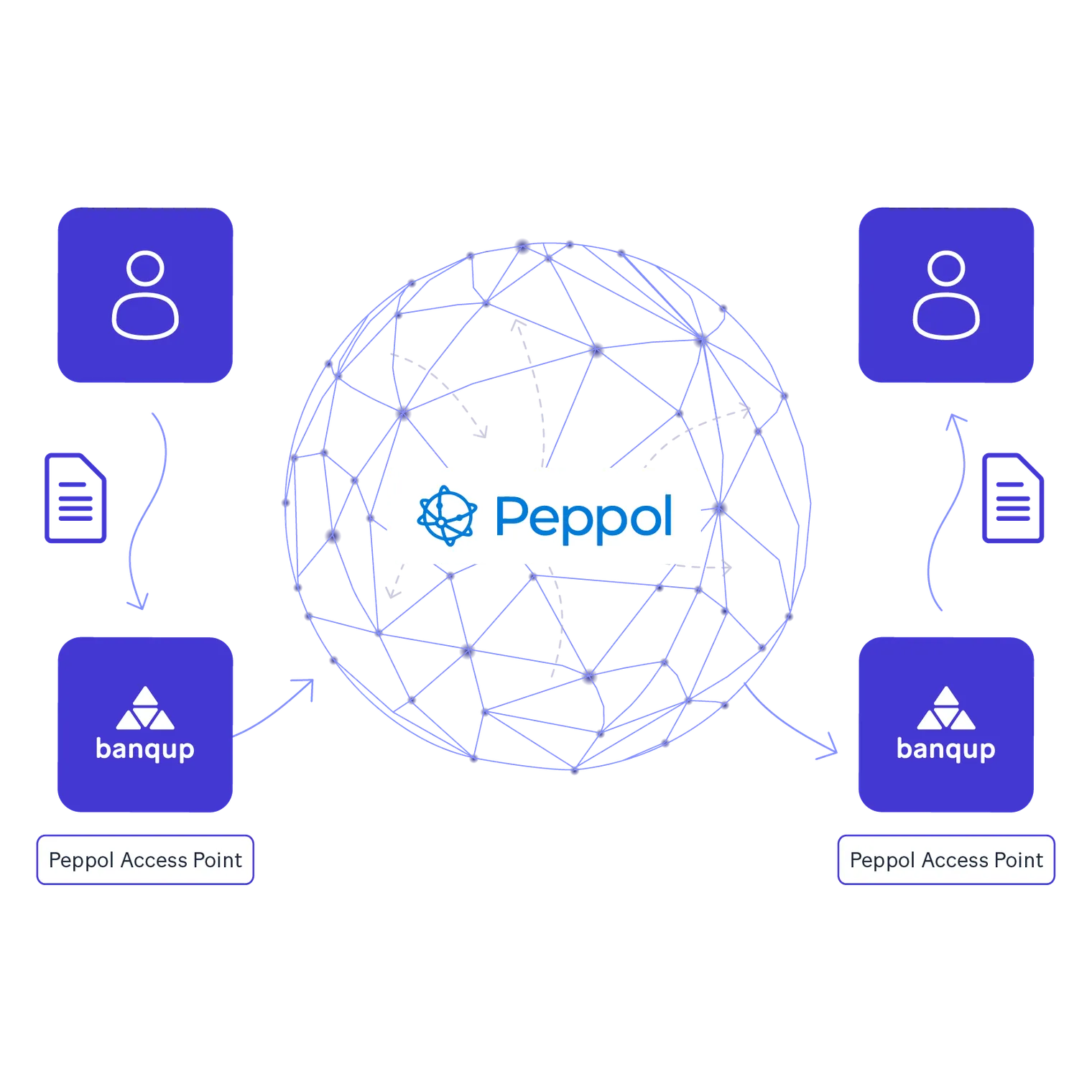
The operational stages of the Peppol 4-corner model
Corner 1 (Supplier): The supplier enters transaction details into its ERP or accounting platform. The software prepares invoice data and passes it to its certified Peppol access point.
Corner 2 (Sending Access Point): The sending service provider validates the payload against PINT A-NZ Schematron rules, converts the data into compliant UBL 2.1 XML, and signs the document with a digital certificate. The access point queries the Peppol Service Metadata Locator (SML) and Service Metadata Publisher (SMP) to identify the receiving address registered to the buyer's NZBN.
Corner 3 (Receiving Access Point): The buyer’s certified service provider receives the encrypted message over the AS4 protocol, validates the digital signature, unpacks the PINT A-NZ payload, and routes it directly to the customer's enterprise environment.
Corner 4 (Buyer): The buyer's accounts payable system receives the structured invoice, matches it automatically against the internal purchase order and goods receipt note, and schedules payment in accordance with agreed commercial terms.
Certified access points
Enterprises do not build direct connections between each other. Instead, each business contracts with an accredited access point provider. MBIE establishes rigorous operational security requirements, requiring providers to prove high-level data encryption, business continuity mechanisms, and system integrity before granting operating accreditation in New Zealand.
Penalties & procurement non-compliance
Because New Zealand’s e-invoicing framework is driven by public procurement regulations rather than compulsory tax decrees, non-compliance carries commercial and administrative consequences rather than direct tax fines.
Procurement non-compliance & commercial disqualification
For large suppliers serving the public sector, the 1 January 2027 mandate introduces significant commercial risk:
Tender disqualification: Government agencies governed by Rule 44 cannot execute or renew procurement contracts with large suppliers that lack Peppol e-invoicing capability. A vendor unable to deliver PINT A-NZ e-invoices faces exclusion from lucrative Crown supply arrangements.
Cash flow impact: While valid Peppol e-invoices benefit from mandatory five-day payment settlement under Rule 36, non-compliant paper or PDF invoices are relegated to standard 10-business-day processing, or delayed further by manual exception handling.
Public agency accountability: Government agencies that fail to meet their 95% prompt payment targets are subject to mandatory monthly reporting to MBIE, with findings published on central government websites.
Tax audit penalties & record-keeping sanctions
Although Inland Revenue does not penalise a business simply for using paper or PDF invoices in the private B2B sector, traditional tax penalties apply if record-keeping standards are breached:
GST deduction disallowance: If an entity claims input tax credits on financial transactions lacking valid Taxable Supply Information, Inland Revenue will disallow the tax deduction and issue reassessment notices.
Shortfall & shortfall interest: Incorrect or unsupported GST claims attract statutory late payment interest and shortfall penalties ranging from 20% (for lack of reasonable care) to 100% (for evasion or deliberate non-compliance) under the Tax Administration Act 1994.
Record-keeping offences: Failing to retain financial records in compliant, retrievable electronic formats for the mandatory seven-year period carries statutory fines of up to NZD 12,000 for a first offence and up to NZD 24,000 for subsequent offences.
How businesses can prepare
Preparing for New Zealand’s evolving e-invoicing ecosystem requires practical action across software readiness, master data validation, and supply chain alignment.
1. Confirm your large supplier classification
Commercial enterprises transacting with central government agencies should audit their financial accounts across the two preceding accounting periods. If consolidated revenue exceeds NZD 33 million, or gross assets exceed NZD 66 million, your organisation qualifies as a large supplier. Finance leaders must engage procurement partners to incorporate Peppol transmission milestones into upcoming public contract negotiations.
2. Verify and cleanse master data (NZBN)
E-invoicing requires precise participant addressing. Accounting and master data teams should conduct an immediate audit of enterprise databases:
Verify that your organisation's 13-digit NZBN is active on the official New Zealand Business Number Registry.
Cleanse customer and vendor master files to confirm every domestic trading partner is mapped to its verified NZBN.
Update internal billing engines to ensure the NZBN is mapped into the EndpointID and PartyTaxScheme fields under the ISO 0088 scheme.
3. Upgrade accounting software & connect to an accredited access point
Enterprises must evaluate whether their core ERP (such as SAP, Oracle, Microsoft Dynamics 365, Xero, or MYOB) includes native Peppol connectivity or requires an accredited third-party service provider. Confirm that your technology partner:
Holds official accreditation from the New Zealand Peppol Authority (MBIE).
Fully supports the active PINT A-NZ Billing (v1.1.2) specification and automated Schematron business rules.
Manages secure connection over the AS4 communications network.
4. Digitalise accounts payable to capitalise on Rule 36
Moving to structured e-invoicing allows accounts payable teams to replace manual approval steps with automated validation. By pairing e-invoicing with automated three-way purchase order matching, suppliers can secure settlement within the five-day prompt payment window enforced across Crown agencies under Rule 36.
Conclusion
New Zealand has pioneered a modern, collaborative approach to digital tax compliance. By building upon the Trans-Tasman Electronic Invoicing Arrangement (TTEIA) and selecting the open Peppol four-corner network, the country has established a single digital market with Australia while safeguarding commercial data privacy. Rather than imposing intrusive, real-time tax clearance mechanisms, New Zealand leverages the scale of public sector procurement to drive digital transformation.
With Government Procurement Rule 44 actively requiring qualifying public sector agencies to send and receive e-invoices, and the 1 January 2027 large supplier deadline approaching, enterprise compliance priorities are shifting rapidly. For commercial vendors supplying the Crown, implementing structured e-invoicing is no longer merely an IT efficiency project, it is an essential commercial requirement for retaining government contracts.
Organisations that act now to upgrade their billing software, validate counterparty business numbers, and connect with an accredited Peppol access point will mitigate procurement risks, guarantee compliance, and capitalise on the substantial operational advantages of straight-through digital invoicing.
FAQ
No. Business-to-business e-invoicing remains voluntary across the commercial market. However, large private enterprises are increasingly requiring their trade vendors to connect via Peppol to automate supply chain interactions and lower transaction costs.