
This article was updated on 21 September 2026 to reflect the official expansion of the electronic invoicing compliance timeline under Revenue Regulations No. 26-2025 issued by the Bureau of Internal Revenue (BIR). It incorporates the mandatory 31 December 2026 compliance deadline for selected taxpayers, the administrative integration between the Electronic Invoicing/Receipting System (EIS) and the Ease of Paying Taxes (EOPT) Act (Republic Act No. 11976), the incentives enacted under the CREATE MORE Act (Republic Act No. 12066), and the latest technical transmission specifications for JSON sales reporting.
Introduction & digital tax strategy
The Republic of the Philippines is executing a comprehensive modernisation of its commercial tax infrastructure, shifting from historic manual billing booklets and physically stamped receipts toward automated digital validation. Administered by the Bureau of Internal Revenue (BIR), the national digital transformation strategy centres on the Electronic Invoicing/Receipting System (EIS), an electronic platform designed to store and process continuous sales data from taxpayers across the archipelago.
The digital tax strategy addresses structural economic factors specific to the Philippines: curbing widespread value-added tax (VAT) evasion, streamlining business compliance across dispersed commercial hubs, and creating digital audit trails for a rapidly growing digital economy. The reform is anchored in continuous transaction visibility, ensuring that transactional data moves from private enterprise billing systems to tax authorities without creating friction in domestic commerce.
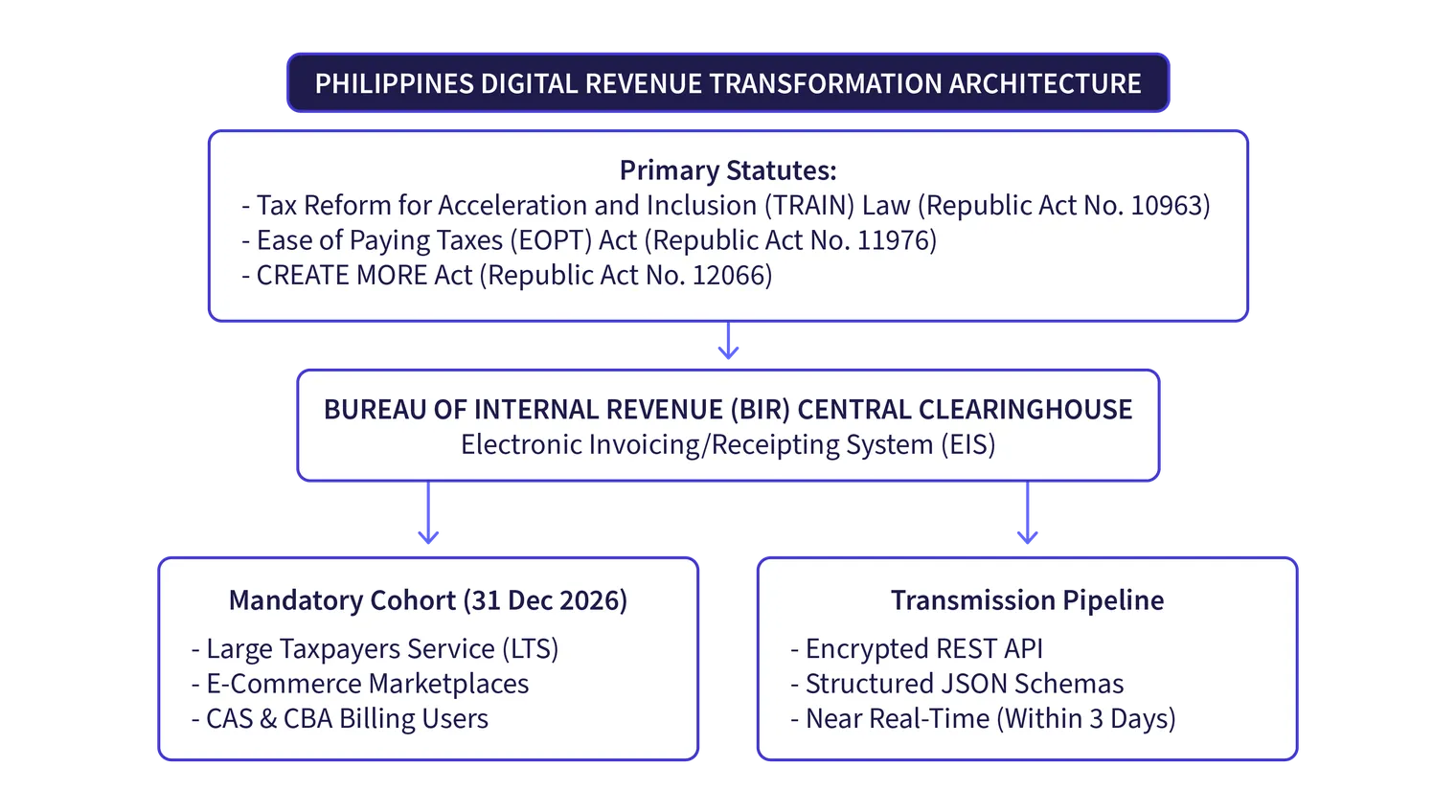
A critical milestone in this strategy is the formal expansion of the mandatory compliance timeline. Under Revenue Memorandum Circular No. 98-2026, which sets the policies and guidelines for electronic invoicing, the BIR established that selected covered taxpayers have until 31 December 2026 to achieve complete technical readiness and compliance. From 1 January 2027, the mandatory issuance of structured electronic invoices becomes fully enforceable for this priority cohort. Crucially, the obligation to issue electronic invoices is separate from continuous electronic sales reporting, which will only become mandatory once the BIR issues corresponding implementing guidelines.
This phased approach balances regulatory enforcement with system readiness, enabling corporate taxpayers, software developers, and tax advisors to reconfigure Enterprise Resource Planning (ERP) databases, secure statutory transmission permits, and retire redundant legacy processes.
Historical evolution and global context
The path toward digital tax compliance in the Philippines began legislatively in December 2017 with the enactment of Republic Act No. 10963, known as the Tax Reform for Acceleration and Inclusion (TRAIN) Law. Section 237 of the National Internal Revenue Code (NIRC) was amended to mandate that, within five years from the law's effectivity, certain taxpayer categories must issue electronic receipts or sales invoices and report those transactions digitally to the BIR.
The BIR launched its foundational pilot on 1 July 2022, partnering with the top 100 large taxpayers to test the initial deployment of the web-based and Application Programming Interface (API) facilities of the EIS platform. Operating in collaboration with the Korea International Cooperation Agency (KOICA), the platform was tailored to reflect international Continuous Transaction Control (CTC) mechanics while adapting to domestic commercial workflows.
The legal landscape shifted significantly in January 2024 with the passage of the Ease of Paying Taxes (EOPT) Act (Republic Act No. 11976). For decades, Philippine tax doctrine maintained a strict division between commercial sales of goods (documented via Sales Invoices) and sales of services or leases of property (documented via Official Receipts). The EOPT Act dismantled this dual regime by establishing the Invoice as the sole principal document for commercial transactions across both goods and services. This eliminated decades of administrative complexity and cleared the regulatory runway for a single, harmonised digital invoice data schema.
Late in 2024, the Philippine legislature enacted Republic Act No. 12066, commonly known as the CREATE MORE Act. This statute reinforced statutory electronic invoicing requirements while granting direct financial incentives, including enhanced corporate income tax deductions for expenses incurred in deploying BIR-registered invoicing systems. To coordinate these statutory updates, the BIR published Revenue Regulations No. 11-2025 and Revenue Regulations No. 26-2025, culminating in the issuance of Revenue Memorandum Circular (RMC) No. 98-2026 in September 2026. This Circular established the operational policies and guidelines for e-invoicing under Section 237 ahead of the 31 December 2026 deadline, while clarifying that electronic sales reporting under Section 237-A remains subject to separate implementing rules.
In a global context, the Philippine EIS model represents a hybrid post-issuance reporting Continuous Transaction Control (CTC) framework. Unlike the pre-issuance clearance systems seen in Latin America or the European Union's centralised models, the Philippines permits businesses to generate and deliver the invoice to the customer first, provided the structured data payload is transmitted to the tax authority's central hub within a statutory window of three calendar days. For multinational enterprises operating across Europe and Asia, this framework aligns closer to distributed near real-time reporting models than to the decentralised Peppol 4-corner or 5-corner networks expanding through European jurisdictions under the ViDA initiative.
Complete compliance timeline
The transition toward electronic invoicing and sales reporting in the Philippines spans a phased regulatory timetable. The following table details the key statutory milestones from inception to nationwide enforcement:
Date | Legal authority | Regulatory milestone |
19 December 2017 | Republic Act No. 10963 | Enactment of the TRAIN Law, introducing statutory mandates under Sections 237 and 237-A of the Tax Code for e-invoicing within five years. |
30 June 2022 | RR No. 8-2022 & RR No. 9-2022 | Publication of operational rules for the Electronic Invoicing/Receipting System (EIS) and establishing admissibility standards for electronic sales documents. |
1 July 2022 | BIR Pilot Programme | Launch of the EIS pilot project involving the country's top 100 large taxpayers across diverse industrial sectors. |
5 January 2024 | Republic Act No. 11976 | Passage of the Ease of Paying Taxes (EOPT) Act, establishing the Invoice as the sole principal sales document and creating four taxpayer categories. |
18 June 2024 | RR No. 11-2024 | Promulgation of transitional invoicing regulations under EOPT, allowing the conversion of unused Official Receipts into Invoices until 31 December 2024. |
7 November 2024 | Republic Act No. 12066 | Passage of the CREATE MORE Act, reinforcing e-invoicing mandates and establishing enhanced corporate tax deductions for electronic system implementations. |
27 February 2025 | RR No. 11-2025 | Issuance of comprehensive implementing rules governing structured e-invoice issuance and electronic sales reporting for initial taxpayer cohorts. |
5 September 2025 | RR No. 26-2025 | Official amendment extending the mandatory compliance deadline for covered taxpayers to 31 December 2026. |
22 September 2026 | Revenue Memorandum Circular No. 98-2026 | Issuance of operational policies and guidelines for e-invoicing under Section 237 of the Tax Code. Introduces the Permit to Issue (PTI) Electronic Invoice, bars productivity software (e.g., Excel/Word), and separates e-invoicing from e-reporting. |
31 December 2026 | RR No. 26-2025 & RMC No. 98-2026 | Final statutory deadline for covered taxpayers (LTS, Large Taxpayers under EOPT, Small/Medium/Large e-commerce merchants, and CAS/CBA users) to obtain a Permit to Issue (PTI) Electronic Invoice and achieve e-invoicing capability. |
1 January 2027 | Statutory Enforcement | Mandatory issuance of structured electronic invoices becomes fully enforceable for covered taxpayers. Continuous sales data reporting to the EIS under Section 237-A will take effect once corresponding guidelines are published. |
Subsequent phases (TBD) | Future BIR Issuances | Progressive expansion of mandatory e-invoicing to medium and small enterprises based on BIR administrative capacity and technical system scaling. |
Legal framework
The electronic invoicing and reporting regime in the Philippines is governed by statutory acts passed by the Philippine Congress, complemented by implementing Revenue Regulations issued by the Department of Finance and the BIR.
Statutory hierarchy and legal bases
Primary Tax Statutes
National Internal Revenue Code (NIRC) of 1997, as amended
Section 237: Issuance of Receipts or Sales or Commercial Invoices
Section 237-A: Electronic Sales Reporting System
Republic Act No. 10963 (TRAIN Law)
Republic Act No. 11976 (Ease of Paying Taxes Act)
Republic Act No. 12066 (CREATE MORE Act)
Executive Revenue Regulations
Revenue Regulations No. 8-2022 (EIS Operational Guidelines)
Revenue Regulations No. 9-2022 (Admissibility of Electronic Documents)
Revenue Regulations No. 11-2024 (EOPT Invoicing Transitory Rules)
Revenue Regulations No. 11-2025 (Initial Rollout Framework)
Revenue Regulations No. 26-2025 (Rollout Extension to 31 December 2026) |
Primary legislation
Republic Act No. 10963 (TRAIN Law): Enacted in December 2017, this legislation amended Section 237 and inserted Section 237-A into the NIRC. It established the baseline legal requirement that taxpayers engaged in export and e-commerce, and those categorised under the Large Taxpayers Service, must issue electronic invoices and transmit continuous sales data to the BIR.
Republic Act No. 11976 (Ease of Paying Taxes Act): Signed into law in January 2024, the EOPT Act modernised tax administration by repealing the mandatory use of Official Receipts for services, making the Invoice the uniform evidentiary document for all sales. It also established four distinct taxpayer classifications based on gross sales: Micro (less than PHP 3 million), Small (PHP 3 million to less than PHP 20 million), Medium (PHP 20 million to less than PHP 1 billion), and Large (PHP 1 billion and above).
Republic Act No. 12066 (CREATE MORE Act): Enacted to maximise corporate investments, this statute provides incentives for businesses modernising their digital systems, introducing an additional corporate tax deduction of 50% on expenses incurred for acquiring and implementing BIR-registered electronic sales reporting software.
Revenue regulations and administrative orders
Revenue Regulations No. 8-2022: Sets out the foundational operational policies for the EIS platform. It details the requirements for taxpayers to develop a Sales Data Transmission System, apply for EIS Certification (EIS CERT), secure a Permit to Transmit (PTT), and transmit encrypted JSON files to the tax authority.
Revenue Regulations No. 9-2022: Establishes the admissibility of electronic sales documents during tax audits. Crucially, it stipulates that only purchase data verified through the EIS shall be permitted for claiming input VAT deductions and corporate income tax business expense deductions.
Revenue Regulations No. 11-2024: Outlines transitional mechanics under the EOPT Act, defining how taxpayers must reconfigure Cash Register Machines (CRM), Point-of-Sale (POS) devices, and Computerised Accounting Systems (CAS) to issue compliant Invoices.
Revenue Regulations No. 26-2025: Amends RR No. 11-2025 by formally establishing that the compliance period for covered taxpayers to implement electronic invoicing and electronic sales reporting is extended to 31 December 2026.
Revenue Memorandum Circular No. 98-2026: Establishes operational guidelines for e-invoicing under Section 237 of the Tax Code. It introduces the mandatory Permit to Issue (PTI) Electronic Invoice, explicitly prohibits manual productivity software (e.g., Excel, Word) as e-invoicing engines, and formally separates the e-invoicing obligation from electronic sales reporting under Section 237-A.
Authorities
The regulation, implementation, and oversight of the electronic invoicing and sales reporting ecosystem in the Philippines fall under the authority of specific executive bodies:
Department of Finance (DOF)
The Department of Finance is the executive agency responsible for the sound management of the nation's financial resources. The Secretary of Finance approves and promulgates all Revenue Regulations upon the recommendation of the Commissioner of Internal Revenue, ensuring that digital tax mandates remain consistent with national economic priorities.
Bureau of Internal Revenue (BIR)
The Bureau of Internal Revenue, an attached agency of the DOF, is the primary tax administration body. The BIR oversees the nationwide rollout of digital tax tools, evaluates software applications, conducts system compliance audits, and operates the core infrastructure supporting the national reform.
Large Taxpayers Service (LTS)
The LTS is an administrative division within the BIR dedicated to monitoring corporations that meet statutory large-taxpayer thresholds. Because the first wave of the digital mandate centres on the large corporate sector, the LTS directly manages taxpayer onboarding, EIS Certification issuance, and compliance verification across this key demographic.
Public Advisory: Accreditation status of third-party software vendors
A vital distinction enforced by the BIR is that the tax authority does not accredit third-party commercial e-invoicing software vendors or service providers. In official public advisories, the BIR has clarified that software providers cannot claim to be "BIR-accredited e-invoicing vendors."
Instead, compliance obligations rest strictly upon the taxpayer. Taxpayers must configure their billing modules to become EIS-ready and directly apply to the BIR for their own system certification (EIS CERT) and Permit to Transmit (PTT), regardless of whether the software was developed in-house or licensed from an external technology vendor.
Scope of the mandate
The Philippine digital tax mandate applies according to taxpayer classification, business activity, and accounting infrastructure. Rather than imposing an immediate, universal obligation across every commercial operator, the BIR has established a focused, priority scope for its initial enforcement.
Who must comply by 31 December 2026?
Under Section 237 of the Tax Code, as amended by the TRAIN Law and the EOPT Act, and governed by RR No. 11-2025, RR No. 26-2025, and Revenue Memorandum Circular (RMC) No. 98-2026, the following categories of covered taxpayers must achieve full e-invoicing capability and secure a Permit to Issue (PTI) Electronic Invoice on or before 31 December 2026:
Large taxpayers: Enterprises formally classified under the BIR Large Taxpayers Service (LTS), as well as businesses meeting the EOPT large taxpayer classification threshold of gross annual sales equal to or exceeding PHP 1,000,000,000.
E-commerce merchants and digital service providers: Small, Medium, and Large taxpayers engaged in e-commerce or internet transactions.
Taxpayers operating Computerized Accounting Systems (CAS): Any business utilizing a CAS or Computerized Books of Accounts (CBA) with an electronic invoicing component.
Exporters and designated taxpayers: Exporters of goods and services, as well as any additional taxpayer categories subsequently designated by the Commissioner of Internal Revenue.
Excluded and deferred taxpayers
Micro taxpayers: Under the classification established by the EOPT Act, businesses with gross annual sales below PHP 3,000,000 are exempt from the mandatory e-invoicing and electronic sales reporting requirements for the initial rollout. Micro taxpayers may continue utilizing manual invoices or basic electronic cash registers, though they retain the statutory right to adopt the EIS facility voluntarily.
Small and medium taxpayers: Enterprises falling within the Small (PHP 3 million to less than PHP 20 million) and Medium (PHP 20 million to less than PHP 1 billion) tiers that do not use a CAS and are not engaged in e-commerce or exports are currently deferred. They will be integrated into the mandate in future implementation phases following separate administrative circulars.
Voluntary adopters: Any taxpayer not mandatorily covered by the 31 December 2026 requirement may voluntarily adopt electronic invoicing, provided they first apply for and secure a Permit to Issue (PTI) Electronic Invoice from their respective Revenue District Office (RDO) or Large Taxpayers Office (LTO).
Commercial transaction mapping
The mandate spans all transaction flows executed by covered entities:
Business-to-Business (B2B): Domestic supplies of goods and services must be documented using structured, sequential electronic Invoices.
Business-to-Government (B2G): Supplies delivered to public sector entities, government departments, and state-owned corporations must be processed via compliant Invoices, which serve as the basis for public expenditure disbursement.
Business-to-Consumer (B2C): Retail point-of-sale transactions and consumer e-commerce checkouts must generate electronic invoices or digital receipts, capturing customer details where required by tax regulations.
Cross-border transactions: Export supplies are subject to structured e-invoicing to provide the BIR with real-time visibility into claims for zero-rated VAT and tax refund verification under Section 112 of the Tax Code.
Electronic invoicing requirements
Under the Philippine digital tax regime, an electronic invoice is strictly defined and cannot be created using manual productivity tools. Under Revenue Memorandum Circular (RMC) No. 98-2026, invoices manually prepared using applications such as Microsoft Word, Microsoft Excel, Google Docs, or Google Sheets—even if saved as PDFs or transmitted electronically—are explicitly prohibited and do not qualify as valid electronic invoices. Furthermore, if a Computerised Accounting System (CAS) or Point-of-Sale (POS) system generates an invoice but lacks the capability to electronically issue and transmit it to the buyer or extract sales data for reporting, the document is classified as a "system-generated non-electronic invoice". Compliant electronic invoices must be generated in a structured format by a system authorized under a BIR Permit to Issue (PTI) Electronic Invoice.
Mandatory invoice data payload
Core transaction metadata:
Serialised invoice number (continuous, system-controlled sequence)
Date and time of transaction
Commercial parties:
Seller legal name, registered business address, and 9-digit TIN (+ Branch)
Buyer legal name, address, and TIN (mandatory for B2B/B2G transactions)
Financial breakdown:
Detailed description of goods or services provided
Unit cost, quantity, and total gross consideration
Clear breakdown: VATable sales, VAT-exempt sales, zero-rated sales
12% value-added tax amount (clearly broken out)
Creditable withholding tax (CWT) rates applied, where applicable
Verification patterns:
Cryptographic verification signature or hash
Dynamic QR code linking to online validation tools
Invoice content and structural integrity
To satisfy statutory invoicing requirements under Section 113 of the Tax Code and the EOPT Act, electronic invoices issued by covered taxpayers must show:
A sequential, system-generated invoice number.
The seller's full registered name, business style (if applicable), registered business address, and Taxpayer Identification Number (TIN), including the specific 3- to 5-digit branch code.
The buyer's legal name, address, and TIN (mandatory for B2B and B2G supplies; required for B2C supplies exceeding statutory value thresholds).
A clear breakdown between VATable sales, VAT-exempt sales, and zero-rated sales. The 12% VAT amount must be displayed as a distinct, separate line item.
The date of transaction issuance.
Applicable withholding tax indicators where the customer acts as a designated withholding agent.
Permit to issue (PTI) electronic invoice
To generate and issue valid electronic invoices under Section 237 of the Tax Code, covered taxpayers must secure a specific Permit to Issue (PTI) Electronic Invoice from their respective Revenue District Office (RDO) or Large Taxpayers Office (LTO). RMC No. 98-2026 clarifies that holding a Permit to Use (PTU) or Acknowledgement Certificate for a Computerised Accounting System (CAS) does not automatically grant authorization to issue electronic invoices. Taxpayers must file a separate PTI application, and upon issuance, complete EIS Certification within six months to avoid permit revocation.
Invoice adjustments and corrections
Under RMC No. 98-2026, issued electronic invoices cannot be directly deleted, altered, or overwritten in the billing system once generated. Any post-issuance adjustments must follow formal accounting protocols: if an adjustment reduces the invoiced amount, the taxpayer must issue a BIR-authorized electronic Credit Note or Credit Memo. If an adjustment increases the transaction amount, a separate, new electronic invoice must be generated.
Transition away from Official Receipts under the EOPT Act
A fundamental compliance transformation introduced by the EOPT Act and detailed under RR No. 11-2024 is that the Official Receipt is no longer recognised as the primary evidentiary document for the sale of services.
Taxpayers that historically maintained dual systems (Invoices for goods and Official Receipts for services) must now issue Invoices across all business lines. The term Official Receipt is relegated to a purely supplementary document used internally to acknowledge the physical collection of cash or payment receipt, but it possesses no legal validity for claiming input VAT deductions or corporate expense deductions.
Storage and statutory archiving
Pursuant to Sections 235 and 237 of the Tax Code, electronic invoices and their corresponding validation files must be retained for a statutory period of 10 years. Taxpayers must ensure that the electronic records maintain source authenticity, content integrity, and continuous accessibility, allowing BIR revenue officers to audit and reconstruct transaction histories on demand.
Contingency and system downtime protocols
RMC No. 98-2026 mandates that taxpayers maintain BIR-authorized manual backup invoices to ensure business continuity during technical disruptions, system downtime, power outages, or cybersecurity incidents. When electronic invoicing capabilities are restored, all manually issued invoices must be systematically replaced by corresponding electronic invoices that explicitly cross-reference the original manual invoice serial numbers.
Electronic reporting requirements
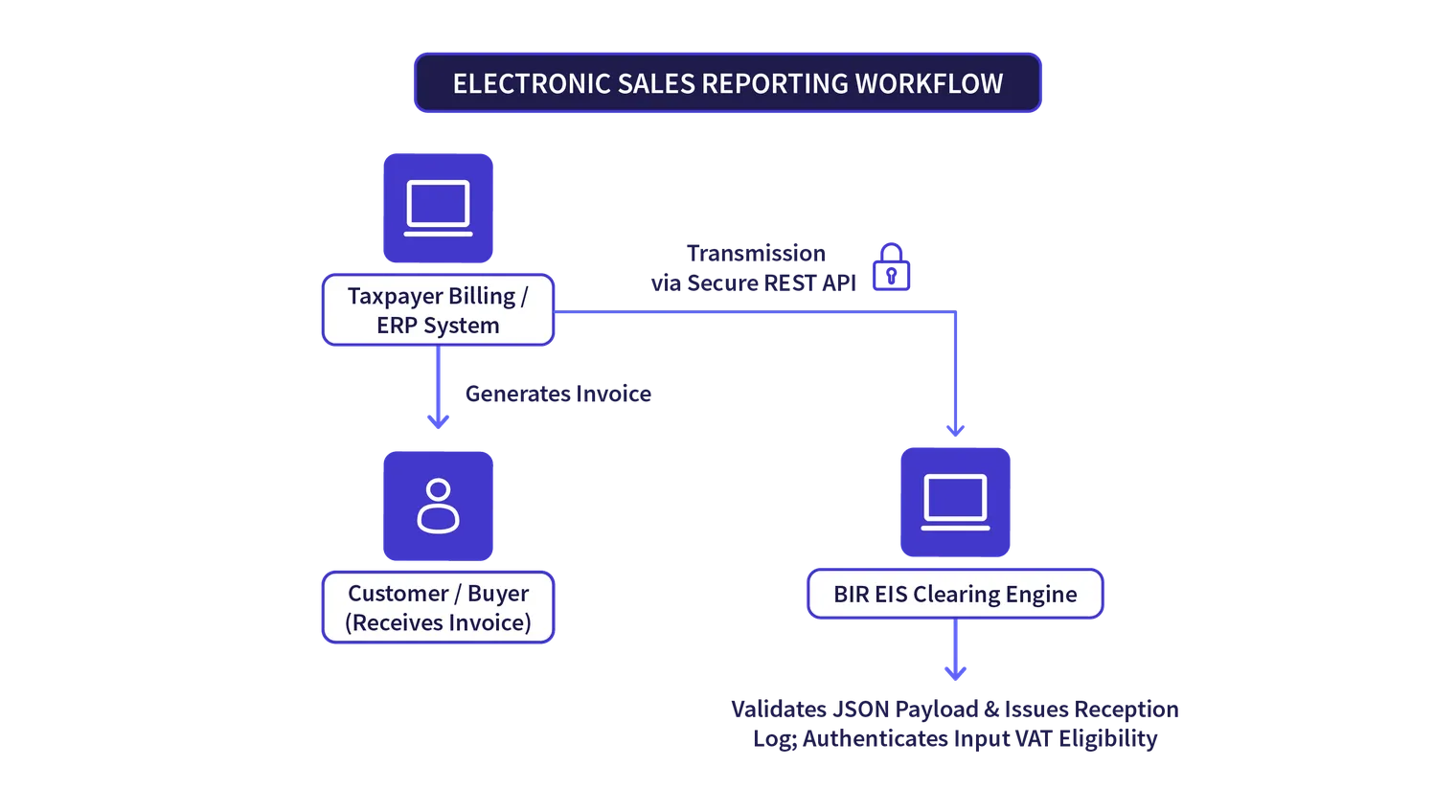
While electronic invoicing governs how a commercial document is generated and delivered to the buyer, electronic reporting governs the systematic transmission of transactional sales data to the tax authority's central repository. Under Revenue Memorandum Circular No. 98-2026, the BIR explicitly clarified that the statutory obligation to issue electronic invoices (Section 237) is separate from electronic sales reporting (Section 237-A). Continuous electronic sales reporting will only become mandatory once the BIR issues its separate implementing guidelines and procedures.
Data payload and syntax standards
In accordance with Section 3 of RR No. 8-2022, the Philippine EIS operates on structured, machine-readable data payloads. Sales data transmitted to the central government platform must conform strictly to the JavaScript Object Notation (JSON) file format. Unstructured files, images, or standard text files will be rejected automatically by the BIR transmission gateway.
The JSON payload captures critical invoice metadata, including:
Header information: System ID, transmission timestamp, and taxpayer identification parameters.
Line-item specifics: Product or service categorisation, item quantity, unit price, discounts, and item-level tax classification.
Aggregated metrics: Total net consideration, zero-rated balances, exempt totals, total VAT charged, and total invoice value.
Statutory transmission window (The 3-day rule)
Unlike strict clearance systems that block an invoice from being delivered to the buyer until the state assigns an authorisation token, the Philippine framework establishes a post-issuance continuous transaction control mechanism.
Under RR No. 8-2022, covered taxpayers must transmit their sales data to the BIR EIS in real time or within three calendar days from the date of invoice issuance. This provides operational resilience for commercial enterprises, allowing billing engines to operate smoothly even during temporary network interruptions, provided the sales data is synchronised within the three-day statutory envelope.
Sales Data Transmission System and licensing
To initiate electronic sales reporting, taxpayers must develop or configure a dedicated Sales Data Transmission System capable of communicating with the BIR API. The system onboarding follows a strict two-tier compliance track:
EIS Certification (EIS CERT): The taxpayer submits their sales transmission application and underlying software modules to the BIR for automated technical validation, ensuring the system correctly generates JSON payloads matching BIR Schemas.
Permit to Transmit (PTT): Following successful test transmissions and certification, the BIR issues an official Permit to Transmit, granting the taxpayer production API credentials to begin live sales data feeds into the national database.
Technical architecture
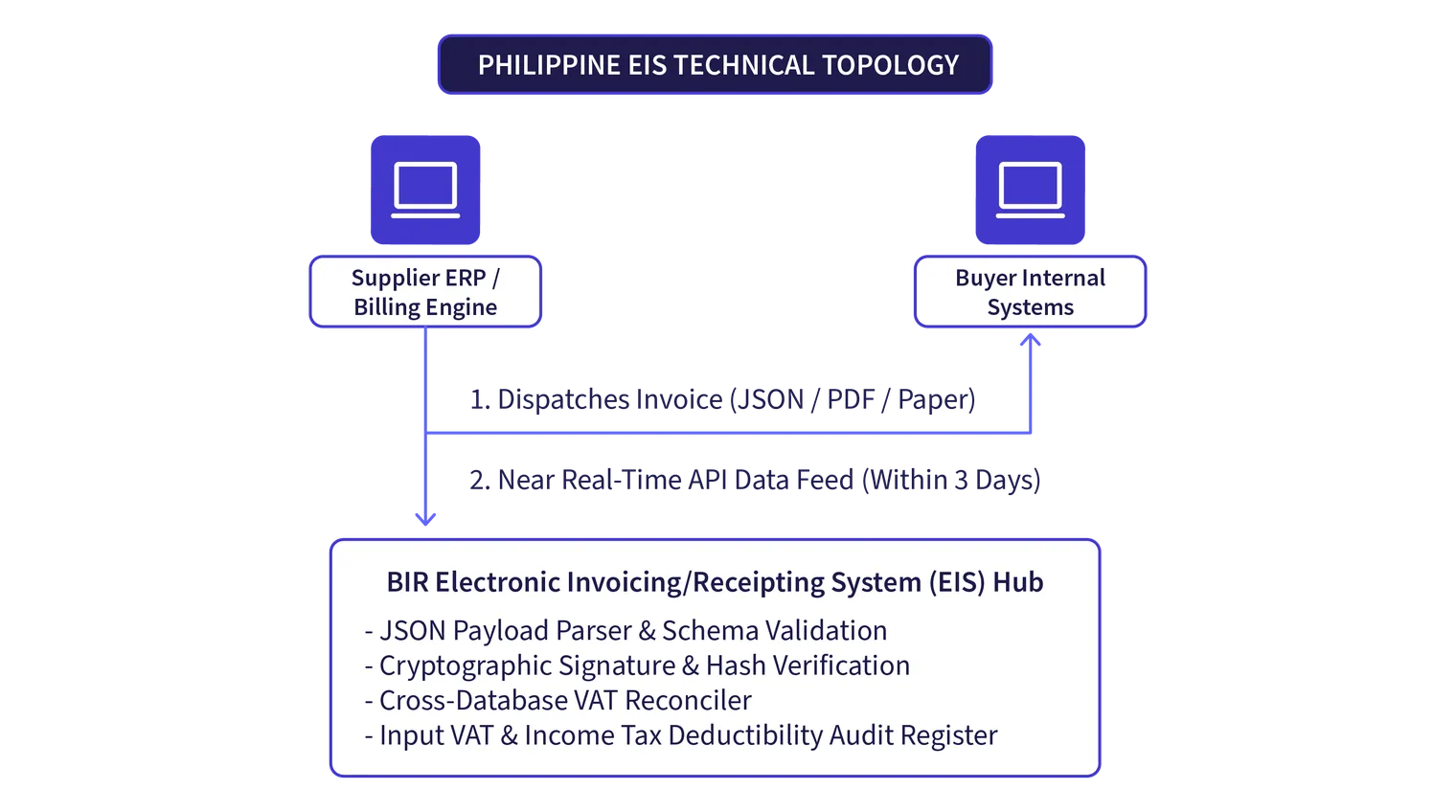
The technical architecture of the Philippine e-invoicing and e-reporting framework is structured around a centralised, government-operated clearance and registry platform.
Component breakdown
Supplier billing engine (Corner 1): Enterprise ERP systems (such as SAP, Oracle, Microsoft Dynamics) or proprietary billing applications generate structured commercial invoices and simultaneously create encrypted JSON reporting payloads.
Buyer endpoint (Corner 2): The customer receives the commercial invoice directly from the supplier via electronic channels (such as structured data interchange, customer portals, or electronic mail) or a physical printout.
BIR EIS gateway (Corner 3 - Regulatory Clearinghouse): The government platform receives encrypted JSON data over secure HTTPS/REST API protocols. It verifies the syntax, validates the supplier's TIN, registers the invoice totals, and records the transaction within the national tax audit registry.
Admissibility of electronic sales documents
A critical legal and architectural feature codified under RR No. 9-2022 is the formal admissibility of electronic documents during tax investigations:
Taxpayers authorised to transmit data to the EIS via web facilities or system APIs are exempt from presenting physical, printed copies of sales invoices during tax audits.
Crucially, purchasers may only claim input VAT deductions under Section 110 of the Tax Code, and income tax expense deductions under Section 34, if the corresponding invoice data has been successfully reported and validated in the BIR EIS.
Purchases claimed on tax returns that cannot be reconciled against supplier data in the EIS are legally classified as unverified and may trigger immediate administrative tax investigations.
Penalties and non-compliance risks
The Philippine Tax Code and associated Revenue Regulations establish severe monetary penalties, civil liabilities, and operational sanctions for taxpayers that fail to comply with electronic invoicing and sales reporting rules.
Non-compliance sanction profile
Disallowance of input VAT and corporate expense deductions
The most severe commercial consequence of non-compliance falls upon corporate buyers. Under RR No. 9-2022, if a supplier fails to transmit sales data to the EIS within statutory deadlines, the corporate customer is prohibited from claiming the associated input VAT (12%) and deducting the purchase price as a legitimate business expense for corporate income tax purposes (25%). This mechanism transforms administrative non-compliance by a vendor into an immediate financial loss for the buyer.
Monetary fines under the tax code
Failure to issue compliant electronic invoices: Under Section 264 of the NIRC, failing to issue commercial invoices, or issuing invoices lacking mandatory statutory information, incurs fines ranging from PHP 1,000 to PHP 50,000, alongside imprisonment of two to four years for responsible corporate officers.
Failure to transmit electronic sales data: Operating an unregistered invoicing system or failing to transmit JSON data into the EIS attracts general administrative fines under Section 275 of the Tax Code, escalating based on transaction volume and past compliance behaviour.
Tax fraud and intentional evasion: In cases of deliberate under-reporting or the deployment of uncertified, tampered software modules, the BIR applies a 50% civil fraud surcharge on the deficiency tax, alongside criminal charges for tax evasion under Section 254.
Administrative sanctions: Oplan Kandado
Under Section 115 of the Tax Code, the BIR possesses the executive authority to execute commercial closures through its Oplan Kandado programme. Establishments that fail to register their invoicing systems, under-report sales by 30% or more, or refuse to comply with statutory transmission orders face immediate physical and commercial suspension for a minimum of five days, continuing until all compliance deficiencies are resolved.
How businesses can prepare
With the compliance deadline under RR No. 26-2025 formally confirmed for 31 December 2026, enterprise taxpayers, accounting advisors, and software integrators must execute a structured readiness plan well ahead of the statutory cutoff.
Six-step system readiness roadmap
1. Execute an operational scope audit
Organisations must review their legal corporate structure and annual gross turnover against the EOPT Act classifications. If an enterprise generates gross sales of PHP 1,000,000,000 or more, falls under the Large Taxpayers Service, sells goods or services online, or operates a Computerised Accounting System, it must prepare for mandatory compliance by 31 December 2026.
2. Standardise invoicing templates to uniform Invoices
In line with RR No. 11-2024, businesses must verify that all billing systems have completely retired the word Official Receipt as a primary sales title. Invoicing software must be reconfigured to generate serialised Invoices (such as Sales Invoice, Billing Invoice, or Service Invoice) for all revenue streams, ensuring that 12% VAT, zero-rated balances, and exempt components are clearly broken down.
3. Cleanse customer and supplier master data
Transmission errors into the EIS occur primarily when business master records contain invalid or missing tax parameters. Finance teams must audit their enterprise databases to guarantee that:
Supplier and customer legal names correspond exactly with BIR registration certificates.
The 9-digit Taxpayer Identification Number (TIN) is accompanied by the correct 3- to 5-digit branch code (e.g., 000 for Head Office).
Correct operational business styles and physical registered addresses are populated across all billing records.
4. Build and test JSON data pipelines
IT teams and software providers must build data transformation layers that convert internal billing records into structured JSON payloads compliant with BIR EIS developer specifications. Software modules must be tested to ensure they can transmit data to the BIR API automatically within the statutory three-day transmission window.
5. Obtain EIS Certification and Permit to Transmit (PTT)
Taxpayers must first secure a Permit to Issue (PTI) Electronic Invoice from their Revenue District Office (RDO) or Large Taxpayers Office (LTO) before generating compliant e-invoices. Under RMC No. 98-2026, a PTI Electronic Invoice is distinct from a Computerised Accounting System (CAS) Permit to Use (PTU) or Acknowledgement Certificate. Within six months of receiving the PTI Electronic Invoice, taxpayers must obtain EIS Certification to validate that their system can extract and transmit sales data according to BIR technical standards.
6. Avail of CREATE MORE corporate tax incentives
Finance directors should carefully track all capital expenditures, development outlays, and software licensing fees associated with deploying EIS-compliant invoicing systems. Under Republic Act No. 12066 (CREATE MORE Act), corporations can claim an additional corporate income tax deduction of 50% on these implementation costs, reducing corporate income tax liabilities while modernising systems.
Conclusion
The Republic of the Philippines is taking decisive strides toward a fully digital tax landscape. Anchored by the TRAIN Law, the landmark Ease of Paying Taxes (EOPT) Act, and the investment incentives codified under the CREATE MORE Act, the country's electronic invoicing framework is transforming corporate billing from an administrative burden into an integrated digital workflow.
The issuance of Revenue Regulations No. 26-2025, extending the compliance deadline for covered taxpayers to 31 December 2026, provides a vital strategic window. Enterprises within the Large Taxpayers Service, e-commerce operators, and businesses utilising Computerised Accounting Systems must use this time to eliminate legacy manual documents, standardise billing around the uniform Invoice, and implement robust JSON data transmission pipelines.
Because input VAT deductibility and corporate expense claims are legally tied to verified EIS data, compliance is not merely an IT challenge, it is an essential commercial priority. Organisations that proactively cleanse their master data, align their ERP frameworks with BIR REST APIs, and complete the EIS Certification process will minimise audit exposure, protect valuable tax deductions, and position their enterprises to thrive in the growing digital economy.
FAQ
No. Under RMC No. 98-2026, invoices manually created using office productivity applications—such as Microsoft Word, Microsoft Excel, Google Docs, or Google Sheets—and saved as PDFs or sent via email are explicitly excluded from being valid electronic invoices. A compliant electronic invoice must be generated by a registered or approved invoicing system in a structured format, transmitted electronically to the buyer, and capable of automated data extraction for BIR reporting.