
This article was last updated on 14 September 2026 to incorporate the Dutch government's official policy decision announced on 11 September 2026 regarding domestic B2B e-invoicing and the transposition of the EU VAT in the Digital Age (ViDA) package. It reflects the Ministry of Finance's policy outline letter (Contourenbrief) establishing mandatory domestic B2B e-invoicing for 1 July 2030 and domestic digital reporting for 1 July 2031, operational guidelines issued by the Netherlands Peppol Authority (Nederlandse Peppolautoriteit - NPa), Logius Digipoort integration requirements, and technical standards governing the Dutch Core Invoice Usage Specification (NLCIUS).
Introduction & digital tax strategy
The Kingdom of the Netherlands is entering the next phase of its digital tax modernisation agenda. Having achieved widespread digitalisation across Business-to-Government (B2G) transactions, the Dutch government formally confirmed its policy decision on 11 September 2026 to mandate structured electronic invoicing for domestic B2B commerce effective 1 July 2030, followed by domestic digital reporting on 1 July 2031. Exempting small businesses under the KOR scheme (turnover ≤ €20,000), this strategy addresses two primary national priorities: closing the Dutch VAT gap by securing transaction visibility and eliminating administrative waste across enterprise supply chains. A draft bill will undergo public consultation in autumn 2026 before being submitted to Parliament before summer 2027.
Unlike member states that opted for clearance regimes requiring pre-clearance by government servers, Dutch fiscal policy consistently champions market enablement and international interoperability. The central tenet of the Dutch strategy relies on an open, decentralised network. Through the governance of the Netherlands Peppol Authority (Nederlandse Peppolautoriteit - NPa), administered under Logius, the Netherlands uses the Peppol network as its universal transactional backbone.
Commercial entities operating in the Netherlands must navigate this shift with care. The informal practice of exchanging unstructured PDF documents via email is reaching the end of its legal utility. As outlined in the Netherlands Peppol-based ViDA rollout roadmap, Dutch businesses must upgrade from manual data entry to machine-readable data structures that integrate directly into modern enterprise software.
Historical evolution & EU/global context
The origin of electronic invoicing in the Netherlands dates back to the implementation of the European Directive 2014/55/EU, commonly known as the EU Directive on E-Invoicing in Public Procurement, or European E-Invoicing Directive. The Dutch government took an early leadership role by establishing mandatory e-invoicing for new procurement contracts for central government suppliers on 1 January 2017. This initial mandate was executed through central procurement terms (Inkoopvoorwaarden Rijksoverheid), obliging direct contractors to submit structured electronic invoices for newly contracted public works, goods, and services.
Two years later, on 18 April 2019, the Dutch Parliament enacted the transposition of Directive 2014/55/EU into national law via amendments to the Public Procurement Act (Aanbestedingswet 2012). This statutory milestone made it legally mandatory for all Dutch public sector bodies, including decentralised authorities such as municipalities (gemeenten), provinces (provincies), and regional water authorities (waterschappen), to be technically capable of receiving and processing structured e-invoices.
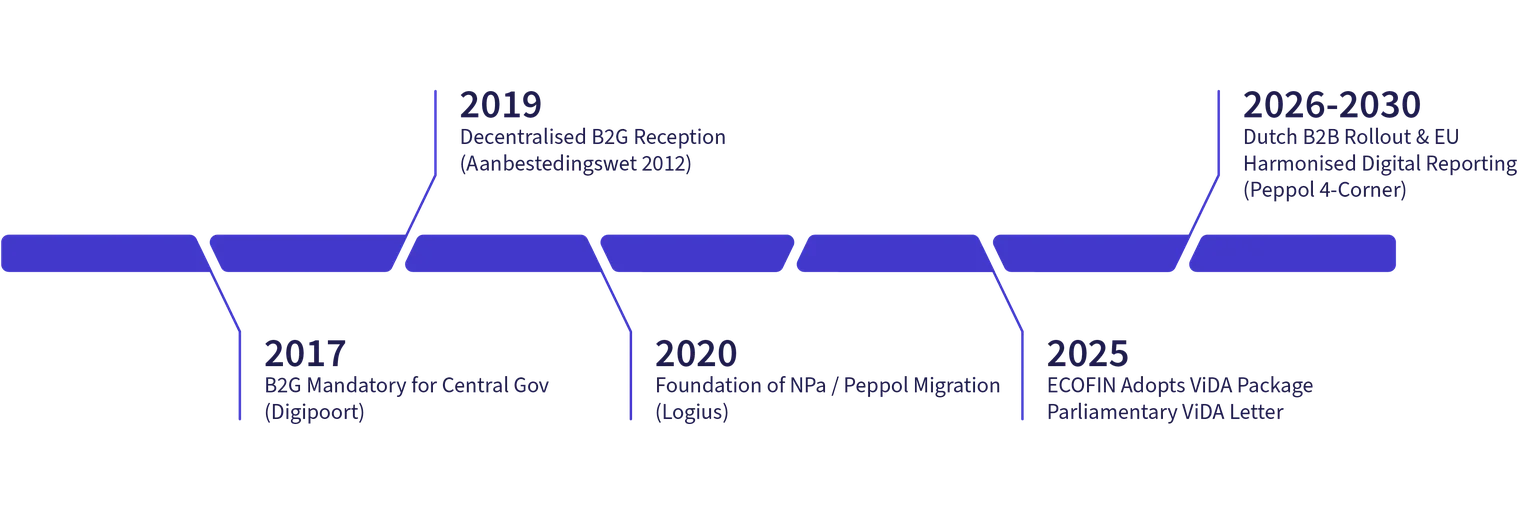
In October 2020, the Ministry of the Interior and Kingdom Relations (Ministerie van Binnenlandse Zaken en Koninkrijksrelaties) formally established the Netherlands Peppol Authority (Nederlandse Peppolautoriteit - NPa). The NPa assumed regulatory oversight from the former Simplerinvoicing consortium at the end of 2020, positioning the Dutch public and private sectors squarely on the international Peppol framework.
At the European Union level, the ECOFIN Council reached political agreement on the VAT in the Digital Age (ViDA) legislative package. ViDA eliminates the prior requirement under Article 232 of the EU VAT Directive that made electronic invoicing conditional upon buyer acceptance. Crucially, it allows member states to introduce domestic B2B e-invoicing mandates without seeking individual derogations from the European Commission.
In response, the Dutch State Secretary for Tax Affairs and Tax Administration submitted formal policy documents to the House of Representatives (Tweede Kamer), including the pivotal Kamerbrief on the implementation of the ViDA Directive. Backed by comprehensive market studies, the Dutch government endorsed the implementation of a full domestic B2B e-invoicing mandate using Peppol, aligning domestic transaction workflows directly with the EU 2030 Digital Reporting Requirements (DRRs).
Building upon earlier parliamentary communications (Kamerbrieven), State Secretary Eelco Eerenberg submitted an official policy outline letter (Contourenbrief) on 11 September 2026 formally setting the Dutch domestic timeline. The Netherlands will mandate domestic B2B e-invoicing on 1 July 2030 in parallel with the EU ViDA cross-border mandate, followed by domestic digital transactional reporting to the Belastingdienst on 1 July 2031. To protect micro-enterprises, businesses participating in the small-business scheme (kleineondernemersregeling - KOR) with an annual turnover up to €20,000 are explicitly exempt.
Complete compliance timeline
The Dutch path to full digital tax compliance operates across distinct phases, transitioning from public procurement to universal domestic and cross-border commercial transactions. Following the government's policy announcement on 11 September 2026, public internet consultation will open in autumn 2026, with legislative submission targeted before summer 2027 ahead of statutory enforcement dates:
Date | Milestone | Legal & operational scope |
1 January 2017 | Central government B2G mandate | Mandatory issuance of structured e-invoices for suppliers executing new central government procurement contracts. |
18 April 2019 | Decentralised B2G reception mandate | Transposition of Directive 2014/55/EU via the Aanbestedingswet 2012. All contracting authorities must be able to receive e-invoices. |
20 October 2020 | Establishment of the NPa | Official launch of the Nederlandse Peppolautoriteit under Logius to supervise Peppol service providers and enforce compliance. |
26 June 2025 | Government ViDA policy adoption | Publication of the Dutch Parliamentary Letter (Kamerbrief) confirming the strategic adoption of Peppol for EU and domestic B2B compliance. |
2026 - 2027 | B2B technical consultation & preparation | Stakeholder consultations and legislative drafting to amend the Dutch VAT Act, updating the statutory definition of an invoice. |
1 July 2030 | Domestic B2B e-invoicing & ViDA EU DRR enforcement | Mandatory structured e-invoicing for domestic B2B transactions, alongside real-time digital reporting for all intra-Community cross-border B2B transactions across the EU. |
1 July 2031 | Domestic B2B digital reporting | Mandatory transactional digital reporting for domestic B2B transactions to the Belastingdienst (one year following the e-invoicing mandate). |
Legal framework
The regulatory foundation governing electronic invoicing and digital reporting in the Netherlands is established across several key statutes and ministerial decrees:
1. Dutch VAT Act 1968 (Wet op de omzetbelasting 1968)
The Wet op de omzetbelasting 1968 represents the primary statutory basis for commercial invoicing rules in the Netherlands.
Article 34c: Governs administrative obligations and statutory record-keeping rules for VAT-registered entrepreneurs.
Article 35a: Defines mandatory invoice content, invoice issuance timeframes, and formatting rules. Currently, electronic invoices are permitted subject to acceptance by the counterparty. In line with the EU ViDA package, this provision is being amended to remove the buyer acceptance barrier, establishing structured electronic invoicing as the default legal standard.
2. Dutch Public Procurement Act 2012 (Aanbestedingswet 2012)
The Aanbestedingswet 2012 establishes mandatory electronic invoicing across public procurement.
Article 4.3: Mandates that contracting authorities (aanbestedende diensten) and special-sector entities must accept and process electronic invoices that comply with the European standard EN 16931 and the Dutch national extension standard (NLCIUS).
3. Ministerial decrees and parliamentary letters (Kamerbrieven)
Parliamentary Letter on ViDA Implementation (26 June 2025): The official policy paper submitted by the Ministry of Finance to the Tweede Kamer, laying out the Dutch roadmap for transposing the ViDA package and detailing options for the domestic B2B mandate.
General Tax Act (Algemene wet inzake rijksbelastingen - AWR): Sections 52 and 68 establish the statutory duty for companies to maintain a compliant, accessible, and auditable accounting ledger for at least seven years (extended to ten years for transactions concerning real estate).
Policy Outline Letter on ViDA Implementation (Contourenbrief, 11 September 2026): Submitted to the House of Representatives (Tweede Kamer) by State Secretary Eelco Eerenberg, this policy paper confirms the definitive roadmap: mandatory domestic B2B e-invoicing starting 1 July 2030 and domestic digital reporting starting 1 July 2031 (with a KOR exemption for turnover ≤ €20,000). It schedules an internet consultation for autumn 2026 and parliamentary submission before summer 2027.
4. European legal baselines
EU Directive 2014/55/EU: Establishes the legal framework for electronic invoicing in public procurement and mandates the creation of the European semantic standard (EN 16931).
ViDA Directive (EU Council Agreement): Amends Directive 2006/112/EC regarding digital reporting and e-invoicing rules across European member states.
Authorities
Digital tax compliance and electronic invoicing workflows in the Netherlands are supervised by three key public bodies, each fulfilling distinct administrative and technical roles:
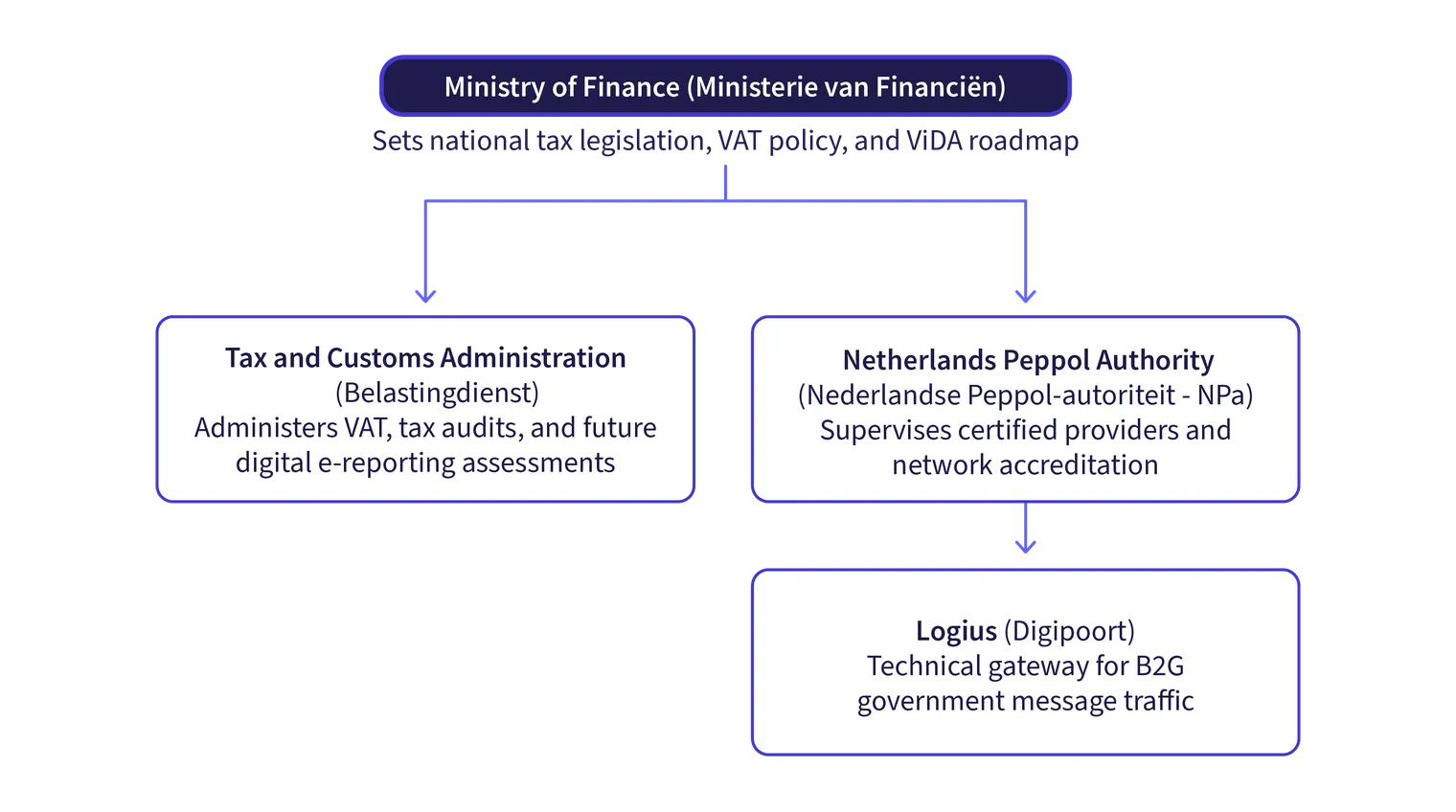
Ministry of Finance (Ministerie van Financiën)
The Ministry of Finance develops national fiscal policy, drafts amendments to the Dutch VAT Act 1968, and oversees negotiations at the European Council level. It coordinates the transition from voluntary market standards to statutory mandates.
Tax and Customs Administration (Belastingdienst)
The Belastingdienst is the statutory revenue service responsible for administering turnover taxes (VAT), conducting corporate audits, enforcing record-keeping mandates, and inspecting digital records. The Belastingdienst will receive and process transaction data under the future digital reporting requirements (DRRs).
Netherlands Peppol Authority (Nederlandse Peppolautoriteit - NPa)
Operating under Logius, the digital government agency of the Ministry of the Interior and Kingdom Relations, the NPa is the official regulatory custodian of Peppol in the Netherlands. The NPa does not inspect invoice contents or intercept tax data. Instead, it:
Licenses and supervises accredited Peppol Service Providers operating within the Dutch jurisdiction.
Ensures strict compliance with OpenPeppol security, encryption, and operational agreements.
Manages the Dutch national addressing conventions, facilitating accurate company routing via the Dutch Chamber of Commerce number (KvK-nummer) and VAT identification number.
Logius (Digipoort)
Logius is the technical operational arm of the Dutch state. It maintains Digipoort, the central electronic postal facility that serves as the primary technical communications hub for government agencies. Suppliers to the central government may route invoices into Digipoort either through the Peppol network or via direct API connections.
Scope of the mandate
The Dutch electronic invoicing landscape applies distinct operational criteria across transactional categories:
Transaction type | Current compliance status | Technical transmission standard |
Business-to-Government (B2G) | Mandatory | Peppol 4-corner network, Digipoort, or the central Government Suppliers Portal (Leveranciersportaal). |
Domestic B2B | Currently voluntary/mandatory from 1 July 2030 (reporting from 1 July 2031) | Peppol 4-corner network / EN 16931 structured formats. (KOR businesses with a turnover ≤ €20,000 are exempted) |
Cross-Border Intra-EU B2B | Mandatory from 1 July 2030 | European Digital Reporting Requirements (DRRs) via EN 16931 structured formats. |
Business-to-Consumer (B2C) | Excluded | Standard retail receipts and consumer invoicing remain outside the structured e-invoicing mandate. |
Public sector procurement (B2G)
Every Dutch contracting authority is legally bound by the Aanbestedingswet 2012 to accept compliant electronic invoices. For central government ministries (Rijksoverheid), suppliers are strictly required by procurement conditions to issue structured e-invoices. Submitting paper or plain PDF documents on central contracts results in administrative rejection.
Domestic private-sector trade (B2B)
Under existing provisions of the Dutch VAT Act 1968, a buyer must agree to receive an electronic invoice. However, this buyer-acceptance barrier is being removed under the national ViDA transposition legislation. Mandatory structured e-invoicing for domestic B2B transactions will come into force on 1 July 2030, with domestic digital reporting following on 1 July 2031. Small businesses participating in the KOR scheme with an annual turnover up to €20,000 are exempt. Dutch commercial entities are encouraged to migrate early to capture operational efficiencies and avoid dual-workflow disruptions.
Cross-border commercial operations
Under the ViDA agreement adopted by ECOFIN, cross-border transactions between taxable persons established in different EU member states will become subject to mandatory structured e-invoicing and real-time digital reporting by 1 July 2030. Unstructured PDFs will no longer qualify as legal tax invoices for these supplies.
E-invoicing requirements
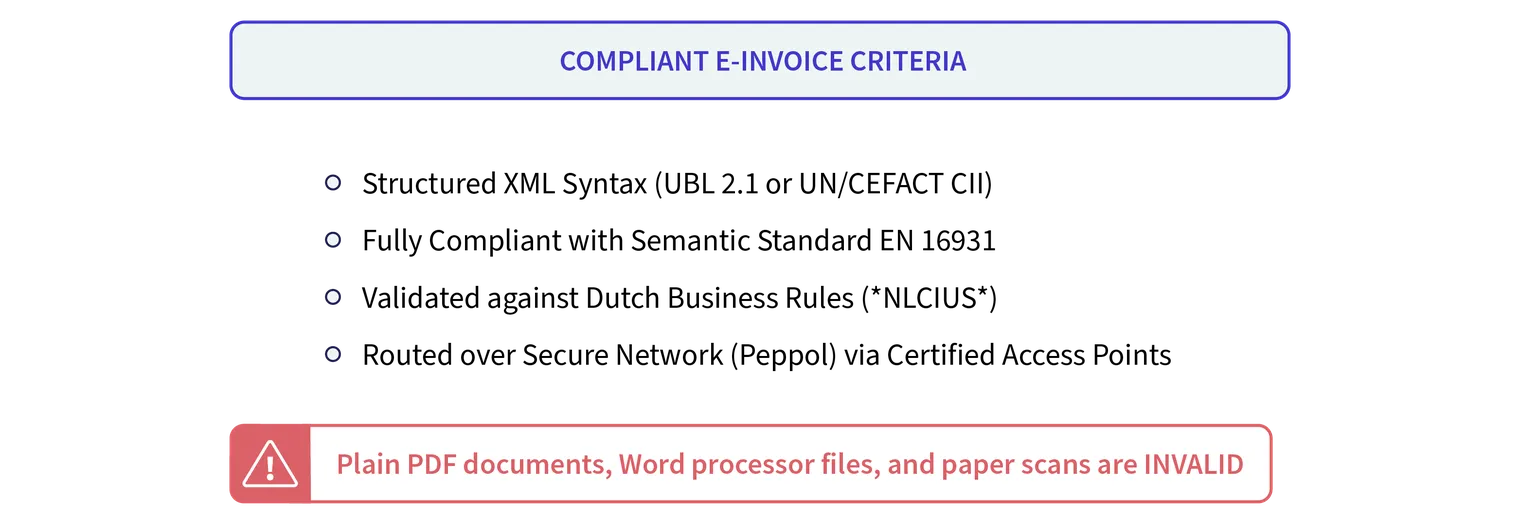
To meet the legal threshold of an electronic invoice in the Netherlands, a document must be created, transmitted, and received in a structured electronic format that allows for automated, electronic data processing. A PDF file sent by email does not satisfy this legal definition.
Approved technical formats
Compliance in the Netherlands is governed by the European standard EN 16931 and its Dutch national application profile, NLCIUS (Nederlandse CIUS):
Peppol BIS Billing 3.0: The primary standard syntax utilised across the Dutch business community and the Peppol network. It maps EN 16931 semantics directly to Universal Business Language (UBL 2.1).
NLCIUS: The official Dutch Core Invoice Usage Specification. NLCIUS operates on top of EN 16931, applying specific Dutch business rules such as mandatory validation of Dutch Chamber of Commerce numbers (KvK-nummers), specific VAT categories, and domestic bank account structures (IBAN/BIC).
Universal Business Language (UBL): Invoices formatted as standard UBL XML are native to Dutch accounting software.
Cross Industry Invoice (CII): Supported under the European norm, though UBL remains the dominant format in the Dutch market.
Mandatory data content
Electronic invoices issued by Dutch taxable persons must contain all statutory fields required under Article 35a of the Wet op de omzetbelasting 1968, the Dutch VAT Act:
Complete legal identity, registered commercial address, and VAT numbers of both supplier and buyer.
The supplier's Dutch Chamber of Commerce registration number (KvK-nummer).
A unique, sequential invoice identifier generated from an unbroken series.
Exact issue date and delivery date (or advance payment date).
Detailed line-item breakdown: product or service description, volume, net unit pricing, applicable discounts, and standard classification codes.
Tax breakdown per rate: taxable base amount, applicable VAT percentage (21%, 9%, or 0%), VAT exemptions, or reverse-charge (btw verlegd) notices.
The total payable amount expressed in euros, including domestic payment instructions (IBAN).
Electronic archiving and data integrity
In accordance with Section 52 of the Algemene wet inzake rijksbelastingen (AWR), the General Tax Act, Dutch businesses must preserve electronic invoices in their original digital format for at least seven years. For electronic invoices relating to immovable property (real estate), the statutory retention period is extended to ten years.
Businesses must ensure the authenticity of the origin, the integrity of the content, and the continuous readability of stored invoices throughout the retention timeframe. Maintaining an archived paper printout of an XML invoice fails statutory audit standards, the original structured data payload and validation audit logs must be retrievable upon request by the Belastingdienst.
E-reporting requirements
While structured electronic invoicing governs the document exchange between supplier and buyer, electronic reporting (e-reporting) relates to the automated digital submission of transaction-level VAT data to the tax administration.
Current reporting mechanics
The Netherlands currently relies on traditional, periodic VAT filings:
Periodic VAT return (Btw-aangifte): Submitted monthly, quarterly, or annually by taxable persons.
Intra-Community Declaration (Opgaaf intracommunautaire prestaties - ICP): Periodic submission reporting supplies of goods and services delivered to VAT-registered buyers in other EU member states.
The ViDA digital reporting transformation
The Dutch government's ViDA roadmap establishes a structural transition away from retroactive, summary declarations toward transactional digital reporting:
Abolition of the ICP Return: The periodic Opgaaf ICP will be phased out and replaced by real-time digital transaction reporting.
Transmission window: Under the ViDA framework, structured e-invoices for cross-border intra-Community transactions must be issued within ten calendar days of the chargeable event, and the transaction data must be reported digitally to the tax administration at the time the invoice is issued (i.e. within that 10‑day window).
Domestic transaction controls: While domestic B2B e-invoicing becomes mandatory on 1 July 2030, transactional digital reporting to the Belastingdienst will follow one year later, on 1 July 2031. The Dutch administration plans to leverage decentralised exchange infrastructure (such as Peppol) to extract transaction data efficiently without imposing duplicative reporting platforms on commercial enterprises.
Technical architecture
The Dutch digital invoicing ecosystem uses a decentralised network architecture. Rather than routing all commercial traffic through a state-controlled gateway, the Dutch government relies on the international Peppol 4-corner network, reserving central infrastructure exclusively for public-sector reception.
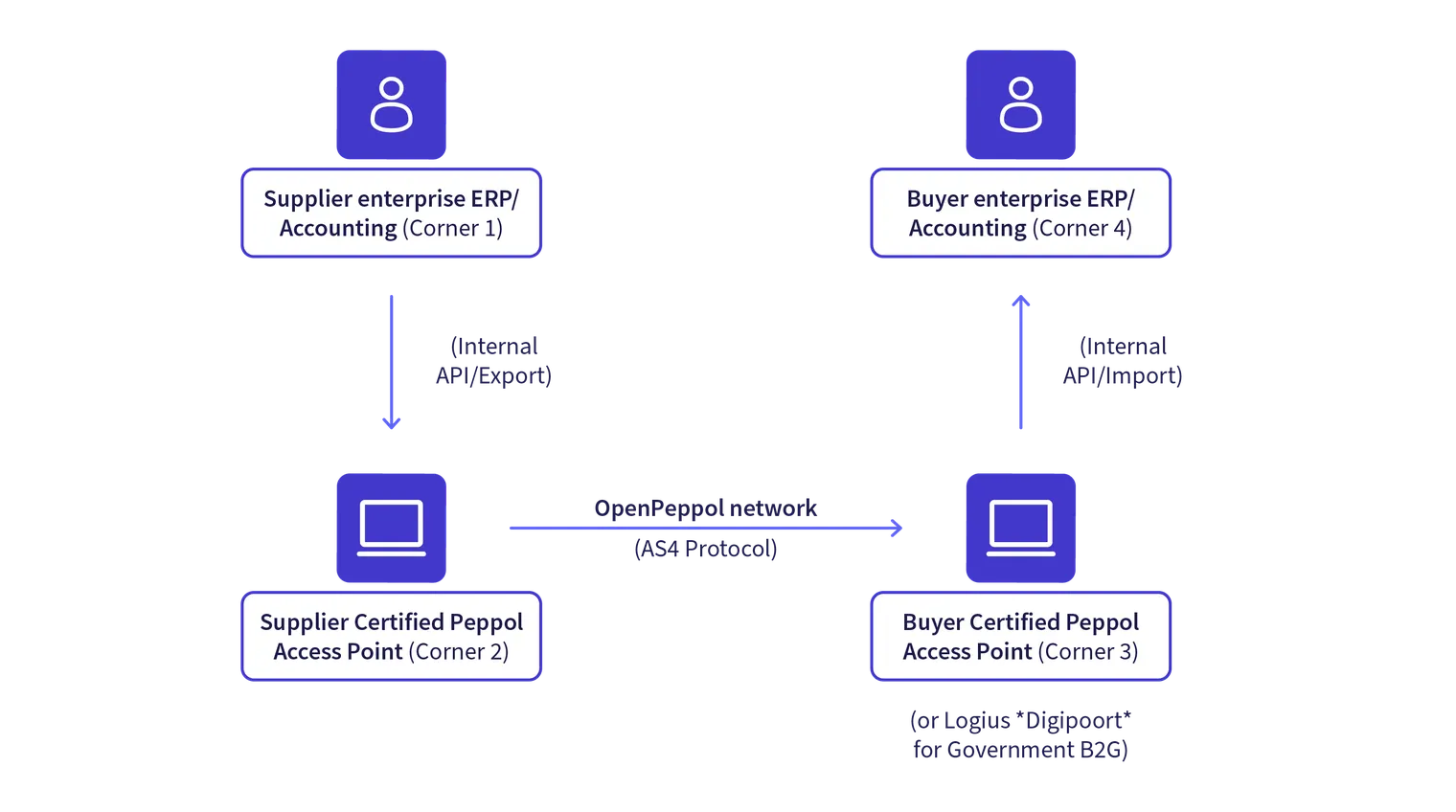
The Peppol 4-corner model explained
In this decentralised structure, trading partners do not need custom point-to-point connections. Document delivery operates through certified intermediaries, commonly known as Access Points:
Corner 1 (Supplier): Generates an invoice payload compliant with NLCIUS or Peppol BIS Billing 3.0 via its internal ERP or billing application.
Corner 2 (Supplier's Access Point): The certified Peppol service provider validates the invoice against national business rules and signs it using secure transport encryption.
Corner 3 (Buyer's Access Point): The receiving certified provider accepts the message via the Peppol AS4 transport protocol, performs cryptographic checks, and delivers the payload to the buyer.
Corner 4 (Buyer): Automatically digests the structured XML data directly into accounts payable ledgers.
For central government procurement, Corner 3 is represented by Logius Digipoort. The state portal receives the incoming Peppol document and directs it to the appropriate ministry or public agency.
Unique addressing via the Peppol network
A cornerstone of Dutch e-invoicing efficiency is unambiguous directory routing. Within the Peppol Service Metadata Publisher (SMP) and Service Metadata Locator (SML), Dutch enterprises and public bodies are registered using standard identifiers:
Chamber of Commerce Number (KvK-nummer): Using the ISO 6523 scheme code 0106 (e.g. 0106:12345678).
Dutch VAT Identification Number (Btw-identificatienummer): Using the scheme code 9944 (e.g. 9944:NL123456789B01).
Government Identification Code (Organisatie-identificatienummer - OIN): Used by public-sector entities under scheme code 0190.
This addressing architecture guarantees that an invoice dispatched from any certified access point in Europe arrives instantly at the recipient's designated accounting software.
Penalties
Failure to comply with statutory invoicing and record-keeping mandates in the Netherlands exposes businesses to severe administrative and financial sanctions under national tax legislation:
Statutory tax penalties under the AWR
Under the General Tax Act (Algemene wet inzake rijksbelastingen - AWR), non-compliance with statutory invoicing obligations triggers formal enforcement:
Administrative fines: Failure to issue invoices, persistent delays in issuing invoices past statutory deadlines, or emitting invoices with substantial omissions can attract administrative penalties of up to €5,514 per violation under Section 68 of the AWR.
Intentional default and tax fraud: Where the tax authorities establish intent (opzet) or gross negligence (grove schuld) in omitting invoices or falsifying transaction data, administrative fines can reach 100% of the unpaid tax amount, alongside potential criminal prosecution under Section 69 of the AWR.
Disallowance of input VAT deduction
The most significant commercial risk involves the invalidation of input VAT claims. Under Article 15 of the Wet op de omzetbelasting 1968, the statutory right to deduct input tax (vooraftrek) requires the possession of an invoice that satisfies all legal requirements.
If a Dutch business claims input VAT using non-compliant, unstructured documents where structured e-invoicing is statutorily mandated, the Belastingdienst may disallow the deduction. This triggers retrospective tax assessments, default interest (belastingrente), and additional penalty surcharges.
Commercial and public procurement exclusion
For suppliers dealing with the Dutch public sector, non-compliant invoices are rejected at the Digipoort gateway. Incomplete or manual submissions fail automated invoice registration, resulting in payment freezes, breached contractual conditions, and potential disqualification from future public tenders.
How businesses can prepare
The shift from voluntary e-invoicing to structured digital compliance requires strategic operational preparation. Organisations operating in the Netherlands should implement the following implementation plan ahead of the planned 2030 B2B mandate and subsequent domestic reporting requirement:
1. Audit procurement and sales invoice workflows
Begin by evaluating all current order-to-cash (AR) and procure-to-pay (AP) processes.
Map all outgoing and incoming document flows to quantify transaction volume.
Identify systems still generating or receiving paper invoices or basic email PDFs.
Determine whether existing trade involves cross-border EU counterparties subject to accelerated ViDA timelines.
2. Confirm ERP and accounting software capability
Evaluate your software landscape to ensure complete compatibility with European e-invoicing standards.
Confirm that your financial applications can natively generate and ingest structured XML payloads in UBL 2.1 syntax complying with EN 16931 and the Dutch NLCIUS specification.
Ensure your software automatically checks for mandatory data fields, including valid KvK-nummers, accurate tax rate codes, and IBAN formats.
3. Establish certified Peppol network connectivity
Direct connectivity to the Peppol network is essential for compliant document exchange in the Netherlands.
Partner with an accredited Peppol service provider to secure Access Point integration.
Register your organisation in the Peppol directory using your Dutch KvK-nummer (0106) or VAT number (9944) to allow trading partners to route invoices to you automatically.
To understand how certified service providers facilitate secure document routing, read our guide on Peppol Access Points.
4. Cleanse master data records
The success of automated e-invoicing depends on high-quality master data.
Validate all customer and supplier records across your CRM and ERP databases.
Ensure legal company names, addresses, Dutch KvK numbers, and VAT identification numbers match official Chamber of Commerce registrations.
Implement verification checks to prevent transmission failures caused by missing or inaccurate identifiers.
5. Secure an auditable electronic archive
Ensure digital archiving procedures conform to Dutch tax rules.
Deploy an archiving solution capable of preserving original XML payloads for the mandatory seven-year period (or ten years for property-related transactions) from the end of the calendar year in which the invoice was issued.
Confirm that archive indexes maintain continuous readability, audit trails, and instant accessibility for tax auditors.
6. Train finance and procurement teams
Equip internal teams with the operational knowledge required to handle structured e-invoices and comply with evolving tax reporting protocols:
Ensure AP/AR staff understand the difference between structured e-invoices (UBL/NLCIUS) and PDF/email invoices.
Clarify internal policies on supplier onboarding, Peppol IDs, and exception handling for non-compliant invoices.
Conclusion
The digitalisation of tax and financial transactions in the Netherlands has arrived at a pivotal turning point. Having established a reliable, standardised B2G e-invoicing ecosystem centred on Peppol, Logius Digipoort, and NLCIUS, the Dutch government is translating this technical success into the private sector. The forthcoming rollout of domestic B2B e-invoicing, combined with the binding requirements of the European Union's VAT in the Digital Age (ViDA) package, marks an irreversible transition toward fully automated commercial document exchange.
For organisations operating in the Dutch market, waiting for formal statutory enforcement deadlines introduces unnecessary operational risk. Modernising accounting workflows, cleansing master data, and establishing integration with a certified Peppol Access Point not only guarantees ongoing regulatory compliance but delivers immediate commercial returns by reducing invoice cycle times, eliminating manual processing errors, and accelerating cash flow. Businesses that take deliberate action today will lead an efficient, connected, and compliant digital future.
FAQ
No. Under Dutch and European standards, an electronic invoice must be issued and received in a structured electronic format (such as XML compliant with EN 16931) that enables automated computer processing. Until the B2B mandate takes effect, a PDF file can still be a valid VAT invoice if authenticity, integrity, and legibility are ensured, but is legally treated as an unstructured electronic image and does not satisfy the requirements of a structured e-invoice.