
This article was updated on 28 September 2026 to incorporate the official disclosure regarding Banqup Group's selection by the Federal Tax Authority (FTA) to develop, implement, and operate the national Peppol Corner 5 Access Point. It also reflects updated legislative enactments, including the Ministry of Finance extension under Ministerial Decision No. 244 of 2025 requiring Phase 1 taxpayers to appoint an Accredited Service Provider by 30 October 2026 ahead of the 1 January 2027 go-live, statutory amendments to the Value Added Tax and Tax Procedures Laws, technical specifications for PINT AE under the Peppol 5-corner model, and penalty frameworks under Cabinet Decision No. 106 of 2025.
Introduction & digital tax strategy
The United Arab Emirates (UAE) is undertaking a decisive structural transition across its corporate taxation and financial reporting landscape. Under the federal e-invoicing programme, led by the Ministry of Finance (MoF) in close collaboration with the Federal Tax Authority (FTA), the nation is moving from post-audit accounting checks to Continuous Transaction Controls (CTCs). This initiative has three strategic purposes: eliminating systemic Value Added Tax (VAT) revenue leakage, curtailing the shadow economy, and digitising B2B commercial interactions in line with the UAE digital economy strategy.
As confirmed on the official UAE government portal, electronic invoicing in the UAE is not simply a conversion of paper into digital PDF attachments sent via email. Instead, an electronic invoice is legally defined as structured, machine-readable commercial data produced in an agreed syntax, validated by an accredited intermediary, and simultaneously reported to the tax administration.
Rather than developing a closed, state-run clearance clearinghouse that could create supply-chain friction, the UAE government selected a decentralised continuous transaction control and exchange model. Built upon the international Peppol framework, this structure allows commercial software systems to exchange commercial documents directly through certified access points while routing required fiscal audit data to tax authorities in near real-time. For a comprehensive look at how this shift fits into national digital tax policy, read our guide on the UAE e-invoicing initiative.
Historical evolution & global context
The path toward electronic billing in the UAE reflects a structured progression that began with the introduction of federal VAT at 5% on 1 January 2018 under Federal Decree-Law No. 8 of 2017. While the original VAT framework permitted tax invoices to be issued electronically, acceptance depended entirely on buyer consent and private record-keeping. The lack of standardised data schemas led to fragmented accounting practices, manual audits, and administrative overhead.
To establish modern Continuous Transaction Controls, the UAE analysed peer models across the Gulf Cooperation Council (GCC) and the wider international arena. In the Kingdom of Saudi Arabia, the Zakat, Tax and Customs Authority (ZATCA) implemented a centralised clearance model (FATOORA), requiring direct clearance of standard B2B tax invoices through a central government engine.
Conversely, the UAE chose the Decentralised Continuous Transaction Control and Exchange (DCTCE) framework, mirroring the approach used in Singapore and European pioneers such as Belgium and Slovakia. By adopting the Peppol International (PINT) semantic model, the UAE ensures that domestic billing aligns with international procurement standards. The UAE became the first nation in the world to deploy a fully operational sovereign Peppol Corner 5 Access Point under a DCTCE architecture. Following project initiation on 27 October 2025, the central implementation phase was completed in May 2026, establishing the technical receiving layer for the FTA. To understand how the UAE architecture compares to alternative global systems, explore our guide on navigating global compliance models.
Complete compliance timeline
The UAE e-invoicing programme follows a phased schedule enacted by ministerial decisions, allowing enterprises and software providers to deploy compliant infrastructure before statutory deadlines take effect.
Date | Affected group or taxpayer category | Mandatory compliance milestone |
October 2024 | All taxable persons | Promulgation of Federal Decree-Laws No. 16 and 17 of 2024, embedding the Electronic Invoicing System into federal tax legislation. |
September 2025 | All corporate taxpayers | Issuance of Ministerial Decision No. 243 of 2025 and Ministerial Decision No. 244 of 2025, establishing the scope, definitions, and wave thresholds. |
27 October 2025 | Federal Tax Authority & Technology Consortium | Project initiation for the development and deployment of the FTA national Peppol Corner 5 Access Point. |
May 2026 | Federal Tax Authority | Completion of the Peppol Corner 5 Access Point implementation, establishing the central tax receiving engine. |
May 2026 | Phase 1 taxpayers | Ministry of Finance issues a targeted decree amendment extending the ASP contractual appointment deadline from 31 July 2026 to 31 October 2026. |
1 July 2026 | Voluntary participants | Launch of the official voluntary adoption phase and pilot programme, allowing certified ASPs and taxpayers to test production transmission without penalty exposure. |
28 September 2026 | International Markets | Official public disclosure regarding the completion and operation of the FTA Peppol Corner 5 Access Point. |
31 October 2026 | Phase 1 taxpayers (revenue ≥ AED 50 million) | Mandatory statutory deadline for Phase 1 entities to formally appoint and onboard a Ministry of Finance Accredited Service Provider (ASP). |
1 January 2027 | Phase 1 taxpayers (revenue ≥ AED 50 million) | Mandatory go-live for Phase 1. Full statutory obligation to issue, exchange, and report structured B2B and B2G e-invoices via accredited platforms. |
31 March 2027 | Phase 2 taxpayers (revenue < AED 50 million) and government bodies | Statutory deadline for all remaining taxable persons and public sector entities to formally appoint an ASP. |
1 July 2027 | Phase 2 taxpayers (revenue < AED 50 million) | Mandatory go-live for Phase 2. Nationwide enforcement for all registered private enterprises regardless of annual turnover. |
1 October 2027 | Federal and local government entities | Mandatory enforcement across public sector procurement and government billing. |
1 January 2029 | Tax groups (intra-group transactions) | Expiry of the 24-month transitional grace period; mandatory e-invoicing enforced for internal supplies within registered VAT groups. |
Legal framework
The legal foundation for the UAE electronic invoicing regime rests upon primary federal decree-laws supplemented by implementing ministerial resolutions.
Federal Decree-Law No. 16 of 2024: Amends key articles of Federal Decree-Law No. 8 of 2017 on Value Added Tax. It formally introduces the legal definitions of an "Electronic Invoice" and "Electronic Credit Note", mandating their use for taxable supplies and explicitly conditioning input tax recovery on holding a verified electronic invoice.
Federal Decree-Law No. 17 of 2024: Amends Federal Decree-Law No. 28 of 2022 on Tax Procedures. It codifies the "Electronic Invoicing System" into federal administrative procedure, retitles Chapter 2 to include electronic record-keeping, and empowers the Ministry of Finance and the Federal Tax Authority to regulate system security and operational compliance.
Ministerial Decision No. 64 of 2025: Promulgated by the Ministry of Finance, this resolution governs the accreditation of service providers. It establishes technical criteria for ASPs, including mandatory OpenPeppol Access Point certification, ISO/IEC 27001 compliance, local data security safeguards, and continuous interoperability testing.
Ministerial Decision No. 243 of 2025: Establishes the operational framework and legal scope of the Electronic Invoicing System. It defines core transmission requirements, valid business data dictionaries, the 14-day statutory invoice issuance window, and local archiving mandates.
Ministerial Decision No. 244 of 2025: Defines the phased implementation schedule and revenue thresholds for Phase 1, Phase 2, and government entities.
Ministry of Finance Amendment to Decision No. 244 (May 2026): Enacted following market-readiness consultations, this targeted instrument officially extended the deadline for Phase 1 taxpayers (gross revenue of AED 50 million and above) to appoint an Accredited Service Provider (ASP) to 31 October 2026, while keeping the go-live enforcement date set at 1 January 2027.
Cabinet Decision No. 106 of 2025: Amends administrative tax penalty schedules, establishing specific financial sanctions for failing to issue structured e-invoices, non-compliance with transmission windows, or operating outside certified service channels.
Federal Tax Authority Public Clarification VATP046: Issued in September 2026, this clarification highlights recent VAT law amendments supporting the introduction of electronic invoicing in the UAE. It formally introduces key statutory definitions such as "Electronic Invoicing System", "Electronic Invoice", and "Electronic Credit Note", confirms that electronic documents must satisfy applicable VAT requirements to qualify as valid tax invoices or credit notes, and links e-invoicing compliance directly to input VAT recovery and administrative penalties.
Federal Tax Authority Investor Disclosure (September 2026): Formal release confirming the contractual deployment of the central Peppol Corner 5 Access Point engine by Banqup Group on behalf of the FTA.
Authorities & key system actors
Administrative and technical execution of the UAE e-invoicing framework is shared between federal ministries, tax authorities, and international standards organisations:
Ministry of Finance (MoF)
The Ministry of Finance serves as the legislative architect and system owner of the UAE Electronic Invoicing System. The Ministry sets national fiscal policy, issues executive ministerial decisions, defines turnover thresholds, and oversees the licensing and accreditation of service providers through the Pre-Approved e-Invoicing Service Providers register.
Federal Tax Authority (FTA) & Banqup Group Corner 5
The Federal Tax Authority manages daily operational tax compliance, audits, and VAT return reconciliation. Within the 5-corner DCTCE model, the FTA operates the central receiving platform known as Corner 5.
To build this central infrastructure, Banqup Group was contracted as the technology provider within an international consortium to develop, implement, and operate the Peppol Corner 5 Access Point for the FTA. Following the completion of the design and deployment phase in May 2026, the FTA's Corner 5 platform ingests real-time Tax Data Document (TDD) feeds from accredited market Access Points over the Peppol eDelivery network, providing the tax administration with real-time audit visibility.
OpenPeppol & Peppol Authority
The UAE has embedded OpenPeppol standards into its federal framework. Operating as an authorised Peppol domain, the designated UAE Peppol Authority regulates national specifications (PINT AE), coordinates the metadata directory, and ensures that certified Access Points adhere to international security and messaging conventions. Learn more about how these networks operate in our complete guide to Peppol and e-invoicing.
Scope of the mandate
The UAE e-invoicing mandate applies broadly across the corporate and commercial tax base, with specific rules governing transaction types, company size, and territorial jurisdictions.
Transaction scope in the UAE | ||
Transaction category | Mandatory channel | Operational status |
Domestic B2B | Peppol Network (ASP) | Mandatory (Phased 2027) |
Domestic B2G | Peppol Network (ASP) | Mandatory (October 2027) |
Cross-border exports | Peppol / Fallback | CTC Reporting Mandatory |
Business-to-Consumer (B2C) | Point of Sale / POS | Exempt until future decree |
Intra-group (VAT Groups) | Internal Systems | Deferred until 1 January 2029 |
Who must comply?
Under Ministerial Decisions No. 243 and 244 of 2025, compliance is mandatory for all taxable persons conducting commercial activities in the UAE:
Phase 1 entities (revenue ≥ AED 50 million): Taxable persons whose total annual gross turnover equalled or exceeded AED 50 million in their most recently closed financial year. In-scope entities must contract an accredited ASP by 31 October 2026 and exchange structured e-invoices by 1 January 2027. Revenue is evaluated at the single legal entity level rather than consolidated corporate group figures.
Phase 2 entities (revenue < AED 50 million): All remaining VAT-registered businesses operating across the mainland and free zones, regardless of size. These taxpayers must contract an ASP by 31 March 2027 and achieve full compliance by 1 July 2027.
Government bodies: Federal, local, and municipal public authorities issuing or receiving commercial bills must deploy compliant integrations by 1 October 2027.
Free zones and designated zones
The mandate applies across all commercial jurisdictions within the UAE. Businesses operating in financial free zones (such as DIFC and ADGM) as well as commercial free zones and Designated Zones must comply with e-invoicing rules if they are registered for UAE VAT. Where a transaction occurs between entities in Designated Zones, structured electronic invoicing remains mandatory even if the supply qualifies for zero-rating or tax relief.
Excluded and deferred transactions
Business-to-Consumer (B2C): Retail point-of-sale transactions are excluded from the initial rollout waves. B2C operations continue under standard fiscal receipt rules until an explicit retail reporting model is introduced.
Intra-group transactions: Supplies between members of the same registered VAT group are granted a 24-month transitional grace period. Transmission through the Electronic Invoicing System is deferred for these internal transactions until 1 January 2029, though external supplies to third parties remain subject to standard wave deadlines.
Sovereign government activities: Supplies performed by public authorities acting in their sovereign capacity remain outside the commercial e-invoicing scope.
UAE e-invoicing requirements
Under the statutory standards defined in Ministerial Decision No. 243 of 2025, an invoice qualifies as an authentic tax invoice only when it meets strict structural and technical requirements:
Structured data format (PINT AE)
Unstructured documents, including PDFs, scanned images, Word documents, or paper forms, are legally invalid for in-scope transactions.
The UAE requires structured invoices generated in XML format adhering to the PINT AE (Peppol International for the United Arab Emirates) specification, built on the UBL 2.1 data syntax. This standard incorporates specific UAE legal requirements, including bilingual Arabic and English descriptions, supplier and buyer Tax Registration Numbers (TRNs), commercial register details, line-item tax categorisations, and currency exchange conversions to UAE Dirhams (AED).
The 14-day statutory issuance window
In accordance with Article 67 of the VAT Law, amended by Federal Decree-Law No. 16 of 2024 and confirmed under Ministerial Decision No. 243 of 2025, electronic tax invoices and credit notes must be issued and transmitted through the accredited network within a maximum of 14 calendar days from the date of the supply. Invoices submitted past this window fail validation and trigger statutory administrative penalties.
Mandatory validation checks
Before an electronic invoice reaches the buyer, it must undergo automated semantic and syntax validation by the supplier's ASP. The system validates:
Active registration and verification of the supplier's and buyer's 15-digit TRNs.
Arithmetic accuracy of line-item amounts, discounts, VAT rates (standard 5%, 0%, or exempt), and net totals.
Presence of a globally unique invoice identifier (UUID) and unbroken cryptographic reference hashes.
Accurate conversion of foreign currencies to AED using Central Bank of the UAE exchange rates.
Archiving and data sovereignty
Businesses must archive structured e-invoices, credit notes, and associated processing logs in their original XML format for a minimum statutory period of 5 years (or 15 years for records concerning capital real estate assets).
Under UAE tax procedures and data sovereignty mandates, electronic accounting records must be stored within the physical or cloud territory of the UAE. While cloud hosting solutions are permitted, the infrastructure must comply with national cybersecurity standards, maintain continuous availability, and ensure that records are immediately accessible for tax audit inspections.
UAE e-reporting requirements
While e-invoicing governs the exchange of commercial documents between trading partners, e-reporting provides continuous transaction visibility to the tax administration.
Under the UAE framework, e-invoicing and e-reporting occur simultaneously within the same technical transaction. Taxpayers are not required to generate a secondary periodic tax report or upload separate monthly listings. Instead, when the supplier's ASP validates and routes a commercial invoice, the system extracts the Tax Data Document (TDD) payload.
The ASP transmits this standardised compliance dataset directly to the Federal Tax Authority's Corner 5 receiving platform. Because transaction reporting is handled automatically at the access point level, invoice validation and tax reporting occur within minutes of issuance. This Continuous Transaction Control framework establishes an auditable digital trail that populates data for pre-filled VAT returns, helping eliminate deduction discrepancies before corporate tax reviews.
Technical architecture: the 5-corner DCTCE model
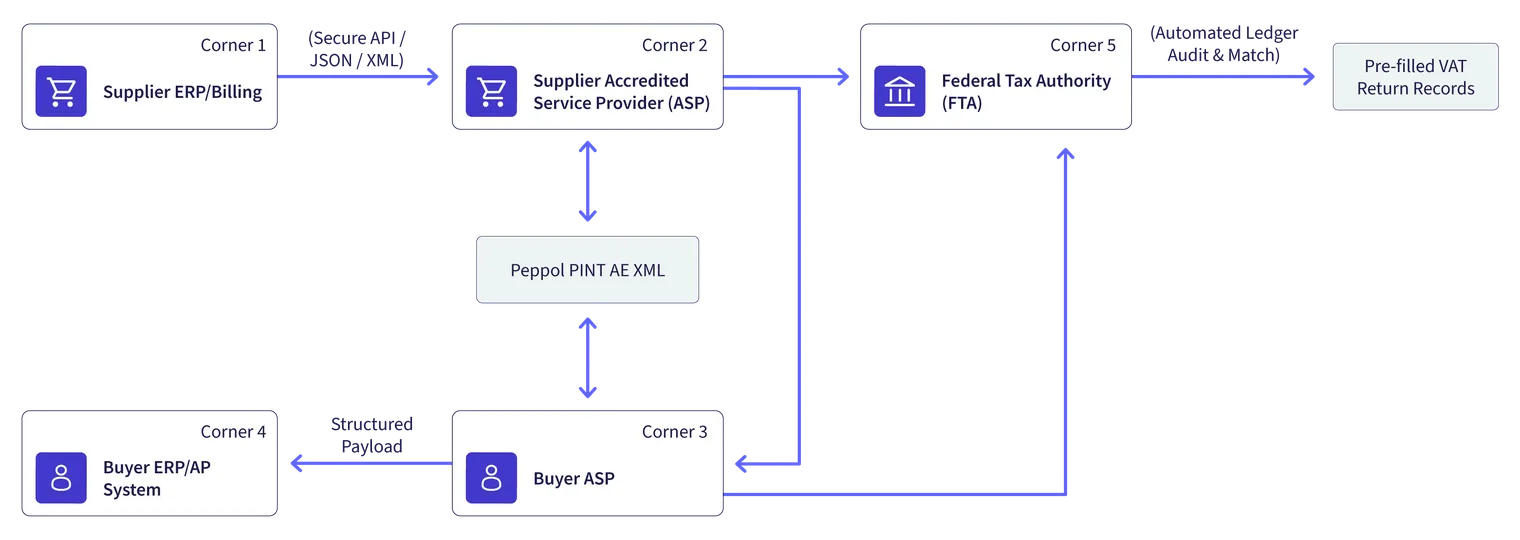
The UAE has implemented a 5-corner Decentralised Continuous Transaction Control and Exchange (DCTCE) model, utilising the international Peppol network:
Operational step-by-step workflow
Generation (Corner 1): The supplier generates the transaction data within their billing system, accounting package, or ERP engine.
Transmission to ASP (Corner 2): The billing data is transmitted securely to the supplier's chosen Accredited Service Provider via REST API, SFTP, or automated connector.
Validation and translation: The supplier's ASP validates the invoice against the PINT AE schema and FTA business validation rules, converting the payload into compliant UBL 2.1 XML.
Exchange over Peppol (Corner 3): The supplier's ASP identifies the recipient's Access Point address via the Peppol directory and securely routes the validated invoice to the buyer's ASP.
Simultaneous reporting (Corner 5): Concurrently, the supplier's ASP routes the required Tax Data Document (TDD) directly to the FTA's national e-invoicing repository.
Delivery and processing (Corner 4): The buyer's ASP delivers the structured XML invoice directly into the customer's accounts payable engine for automated matching and payment execution.
Operational Insight: The 5-corner DCTCE architecture operates on a non-blocking validation model. Businesses exchange valid invoices directly through certified access points without waiting for manual clearance from a tax portal. This approach prevents supply-chain disruptions while ensuring the Federal Tax Authority receives transactional records in near real-time.
Penalties for non-compliance
Tax compliance enforcement in the UAE combines statutory fines under Cabinet Decision No. 106 of 2025 with strict operational and fiscal restrictions.
Financial penalties for technical and procedural violations
Failure to appoint an ASP by the statutory deadline: Entities that fail to contract and onboard a certified ASP by their wave deadline (31 October 2026 for Phase 1; 31 March 2027 for Phase 2) face administrative non-compliance fines starting at AED 10,000, with recurring monthly penalties of AED 20,000 for ongoing non-compliance.
Issuing non-compliant invoices (paper or unstructured PDFs): Issuing commercial documents outside the Electronic Invoicing System once mandatory incurs administrative penalties of AED 5,000 per invalid document, up to a maximum statutory cap of AED 50,000 per tax period.
Failure to issue invoices within the 14-day window: Disregarding the 14-day statutory issuance window under Article 67 results in late-issuance penalties of AED 1,000 to AED 5,000 per violation.
Failure to store e-invoices within the UAE: Violating local data sovereignty and digital retention requirements incurs fines ranging from AED 20,000 to AED 50,000, accompanied by mandatory IT system audits.
Fiscal and commercial risks
The most significant commercial risk under the amended VAT Law involves the disallowance of input VAT deductions.
Under Federal Decree-Law No. 16 of 2024, commercial buyers cannot claim input tax recovery on purchases unless the underlying supply is verified through a valid, structured electronic invoice processed by the Electronic Invoicing System. Businesses receiving paper or standard PDF invoices from in-scope suppliers will have their input tax claims disallowed during audit reviews. This restriction effectively turns supplier non-compliance into an immediate 5% cost penalty for the customer, while exposing non-compliant suppliers to commercial disputes and lost business.
How businesses can prepare
With the Phase 1 ASP appointment deadline set for 31 October 2026, finance, tax, and IT leadership must implement an immediate readiness strategy.
Enterprise action roadmap (Phase 1 preparation) | |
Weeks 1 - 3 Turnover audit & assessment | Calculate total gross revenue for the most recent financial year Determine legal classification (Phase 1 vs. Phase 2) |
Weeks 4 - 6 Master data cleansing | Verify 15-digit TRNs for all domestic business partners via the FTA portal Standardise billing addresses, trade license numbers, and item coding |
Weeks 7 - 10 ASP selection & contract execution | Evaluate vendors against Ministerial Decision No. 64 accreditation standards Formally contract an accredited service provider before 31 October 2026 |
Weeks 11 - 16 System integration & testing | Connect internal ERP systems to your ASP via API Map data fields to the PINT AE UBL 2.1 schema Execute end-to-end sandbox testing ahead of the 1 January 2027 go-live |
1. Assess corporate revenue thresholds
Review financial statements from the most recently completed accounting year to confirm your implementation wave. If gross revenue equals or exceeds AED 50 million, your organisation must contract an ASP by 31 October 2026 and be prepared for mandatory issuance on 1 January 2027.
2. Cleanse and validate master data
The PINT AE schema enforces automated business validation rules. Incomplete customer files cause immediate transmission rejections. Validate customer and supplier master records across your ERP systems:
Confirm the 15-digit Tax Registration Number (TRN) of every trading counterparty.
Verify company legal names against official trade licenses and commercial registries.
Ensure accurate line-item mapping for standard 5%, zero-rated, and exempt supplies.
3. Contract an Accredited Service Provider (ASP)
Taxpayers cannot submit transactions directly to the central FTA infrastructure without an accredited provider. Phase 1 entities must select a service provider certified under Ministerial Decision No. 64 of 2025. Verify that your chosen provider offers native integration with your ERP system, reliable Peppol Access Point routing, automated PINT AE schema translation, and dedicated local support.
4. Upgrade ERP workflows for inbound automation
Compliance requires managing both outbound issuance and inbound accounts payable workflows. Configure your accounts payable processes to ingest, validate, and post inbound PINT AE XML data delivered by your ASP, eliminating manual data entry and ensuring input tax deductibility.
Conclusion
The introduction of mandatory electronic invoicing represents a significant step forward in the modernisation of the UAE digital tax environment. By implementing a decentralised Peppol 5-corner model, the country balances regulatory oversight with commercial efficiency, ensuring structured transaction reporting without disrupting supply-chain operations.
For corporate leadership, meeting these requirements demands timely operational planning. Phase 1 entities must take advantage of the extended window to appoint their Accredited Service Provider by 31 October 2026, ensuring sufficient time for ERP field mapping and end-to-end sandbox testing before the 1 January 2027 mandatory go-live.
Organisations that update their financial systems, clean master data files, and partner with certified e-invoicing providers will satisfy statutory compliance requirements while gaining the operational benefits of automated, modern business processing.
FAQ
Under the May 2026 amendment to Ministerial Decision No. 244 of 2025, Phase 1 taxpayers (businesses with annual gross revenue of AED 50 million or more) must formally appoint and contract an Accredited Service Provider (ASP) by 31 October 2026.